


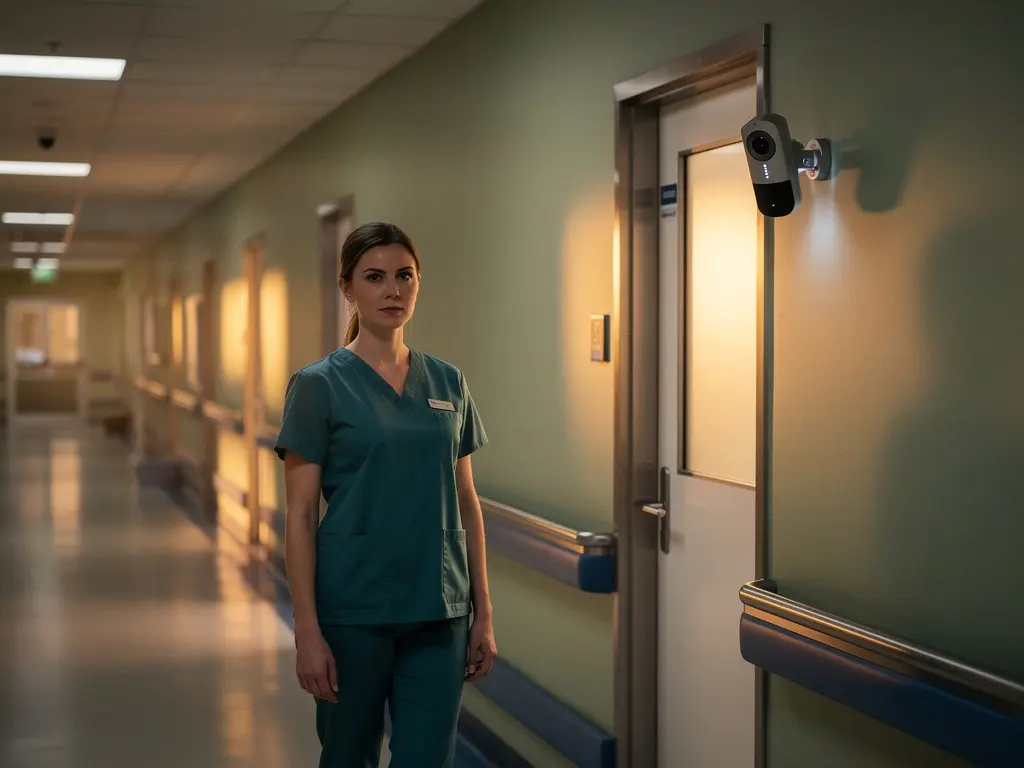
Technology expands the capacity of healthcare staff by taking over routine and time-consuming tasks, allowing employees to focus their attention on direct patient care. For healthcare organizations struggling with a growing staff shortage, AI-driven technology offers a concrete and scalable solution. In this article, we answer the most frequently asked questions about the role of technology in healthcare, from automation to privacy and implementation. Also check out our solutions for a concrete example of how AI supports healthcare.
How does technology expand the capacity of healthcare staff?
Technology expands the capacity of healthcare staff by automating tasks that previously required continuous human presence. Think of nighttime monitoring, tracking patient positions, or detecting fall incidents. This allows the same employees to support more clients without any reduction in the quality of care.
The staff shortage in healthcare is not a temporary problem. Demand for healthcare services grows by approximately six percent annually, while the supply of qualified staff is not keeping pace. Technology bridges this gap not by replacing people, but by enabling them to work more effectively. A caregiver who no longer needs to manually walk rounds every hour has more time for personal contact and complex care tasks.
Smart monitoring systems play a central role in this. They observe continuously, analyze behavioral patterns, and only send an alert when action is needed. This reduces unnecessary interventions and gives healthcare staff more peace of mind and oversight during their shifts.
Which healthcare tasks can be automated with AI?
AI can automate healthcare tasks that are repetitive, observational, or data-driven. Examples include continuous patient monitoring, fall detection, body position recognition, and identifying unsafe situations. These are tasks where human presence does not always add value, but where speed and reliability are critical.
Concrete examples of automatable healthcare tasks include:
- Fall detection: AI recognizes a fall within seconds and immediately alerts healthcare staff.
- Body position monitoring: Automatic recognition of high-risk positions, for example to prevent pressure sores.
- Night monitoring: Continuous supervision without requiring a staff member to be physically present.
- Early warning: AI detects abnormal patterns before a situation escalates.
Tasks that require human judgment, empathy, or physical care are not suitable for automation. AI is not a replacement for the caregiving relationship, but a tool that supports staff in the observational and administrative aspects of their work.
What are the advantages of AI monitoring over traditional systems?
AI monitoring is more accurate, faster, and more reliable than traditional systems such as motion sensors or alarm mats. Traditional systems generate many false alarms, leading to alarm fatigue among healthcare staff. AI systems analyze context and behavior, allowing them to distinguish between a normal movement and a genuine emergency.
The practical advantages of AI monitoring are:
- Fewer false alarms: Advanced AI generates significantly fewer unnecessary alerts than older technologies, reducing workload.
- Faster response times: Alerts are sent within seconds, enabling healthcare staff to act immediately.
- Continuous monitoring: AI operates 24 hours a day, seven days a week, without fatigue or distraction.
- Scalable deployment: Multiple rooms or wards can be monitored simultaneously from a single system.
Traditional systems also often require the physical installation of multiple devices per room and are less flexible when care needs change. AI monitoring software adapts based on new data and therefore continues to improve over time.
How does AI healthcare technology protect patient privacy?
AI healthcare technology protects patient privacy by processing images in a fully automated way, without any human ever viewing the footage. The software independently analyzes movements and situations and only sends an alert when action is genuinely required. Healthcare staff enter the room only at the system’s request.
This principle — where technology observes but humans do not watch — represents a fundamental step forward compared to traditional camera surveillance. With older systems, staff actively monitored footage on screens, which constituted a constant intrusion on client privacy.
In addition, compliance with privacy legislation is essential. Reliable AI healthcare technology meets international standards such as ISO 27001 and NEN 7510, which safeguard the security of patient data. For healthcare organizations, this is not only an ethical requirement but also a legal obligation under European regulations.
When is AI technology the right choice for a healthcare organization?
AI technology is the right choice for a healthcare organization when there is a structural staff shortage, growing demand for care, or a high risk of incidents such as falls. Organizations that struggle to fill night shifts or where staff regularly respond too late to emergencies benefit most from AI monitoring.
A number of concrete signs that AI technology is an appropriate solution:
- Staff are regularly called in for situations that turned out not to be genuine emergencies.
- There have been incidents where a fall or unsafe situation was discovered too late.
- The organization is growing, but the workforce is not growing with it.
- Client privacy is being compromised by existing camera systems.
- The organization wants to demonstrably meet quality and safety standards.
AI is not a solution for every healthcare challenge, but for organizations facing the issues above, it offers a measurable improvement in both efficiency and safety.
How do you implement AI monitoring software in a healthcare facility?
AI monitoring software is implemented in a healthcare facility through a structured process that begins with a needs assessment, followed by technical installation and staff training. Most modern systems are designed as plug-and-play solutions, meaning they can be deployed relatively quickly and without major changes to existing infrastructure.
Implementation typically follows these steps:
- Needs assessment: Identify which departments or rooms would benefit most from monitoring and what the specific risk profiles are.
- Technical preparation: Verify that the existing network and hardware infrastructure is compatible with the software.
- Installation and configuration: Install the software and tailor the settings to the specific care environment.
- Staff training: Ensure that healthcare staff understand how the system works, how to interpret alerts, and how to respond to an alarm.
- Evaluation and adjustment: Monitor system performance during the first few weeks and adjust the configuration where necessary.
A good vendor guides the organization through this process and provides support on questions related to compliance, privacy, and technical integration.
How Kepler Vision Technologies helps address staff shortages in healthcare
At Kepler Vision Technologies, we develop AI software that helps healthcare organizations tackle staff shortages through smart, reliable monitoring. Our products, Kepler Night Nurse and Kepler NurseAssist, are designed for elderly care facilities and hospitals that want to do more with fewer hands.
What our solution concretely offers:
- Fall detection and fall prevention with direct alerts within seconds
- Body position recognition to prevent complications
- Only one false alarm every 92 days, significantly reducing staff workload
- Full privacy protection: footage is never viewed by humans
- Certified to ISO 27001 and NEN 7510 for maximum data security
- Plug-and-play installation, easy to plan and configure
- 21 international patents supporting the uniqueness of our technology
Want to find out how we can help your healthcare organization address the staff shortage with proven AI technology? Get in touch and discover what Kepler Vision Technologies can do for you.
Frequently Asked Questions
How long does it take for AI monitoring software to have a noticeable effect on healthcare staff workload?
Most healthcare organizations notice a difference in workload within the first few weeks after implementation, primarily because the number of unnecessary alarms drops significantly. Full optimization of the system — where the AI has been calibrated to the specific environment and behavioral patterns of clients — typically takes four to eight weeks. After this period, staff consistently report more peace of mind during night shifts and more time for direct patient care.
What are the most common mistakes when implementing AI healthcare technology?
A common mistake is skipping a thorough needs assessment, which results in the system being deployed in areas where it provides the least value. Organizations also frequently underestimate the importance of staff training: technology only works optimally when staff understand how to interpret alerts and how to respond. Finally, the evaluation phase after go-live is often cut too short, even though proper adjustment in the first few weeks is critical to long-term success.
Is AI monitoring also suitable for smaller healthcare organizations or home care?
Yes, modern AI monitoring systems are scalable and therefore also suitable for smaller care facilities or home care settings. Plug-and-play solutions require no large IT infrastructure and can be rolled out room by room or location by location. For home care organizations, AI monitoring offers specific benefits, such as monitoring clients between care visits, which improves safety without requiring a staff member to be continuously present.
How do clients and their families typically respond to AI monitoring in a care environment?
Acceptance among clients and families increases significantly when it is clearly explained that footage is never viewed by humans and that the technology is purely focused on safety. Many families find AI monitoring reassuring, especially at night when fewer staff are present. Transparent communication about how the system works, what data is processed, and how privacy is protected is essential for gaining the support of all those involved.
What technical requirements does AI monitoring software place on a healthcare facility's existing infrastructure?
Most AI monitoring systems require a stable internet connection, sufficient bandwidth for data processing, and compatible hardware such as camera sensors that can be connected to the network. Cloud-based solutions generally place fewer demands on local servers or IT systems. It is advisable to have the vendor carry out a technical scan prior to implementation, so that any bottlenecks in the infrastructure are identified and resolved in a timely manner.
How does AI healthcare technology remain compliant with changing privacy legislation such as the GDPR?
Reliable AI healthcare technology vendors work with a privacy-by-design approach, in which data protection is built into the architecture of the system from the outset rather than added as an afterthought. Certifications such as ISO 27001 and NEN 7510 are periodically reassessed, ensuring the system continues to meet the most current standards. Healthcare organizations are advised to ask about the vendor’s data processing agreement policy at the time of purchase and to verify that data storage takes place within the European Union.
Can AI monitoring be integrated with existing healthcare information systems or electronic client record software?
Many modern AI monitoring systems offer integration capabilities with existing electronic client records (ECR) or healthcare information systems via standard API connections. This makes it possible to automatically link alerts and observation data to the relevant client’s record, further reducing the administrative burden. When selecting a vendor, it is advisable to explicitly ask which integrations are supported and what technical steps are required for a seamless connection with the systems already in use.
Related Articles
- What are the forecasts for the staffing shortage in healthcare by 2030?
- What causes high work pressure in the healthcare sector?
- Which risk factors increase the need for fall prevention in older adults?
- How does technology support safe remote care?
- What trends do we see in digital healthcare monitoring?
This content was generated with the help of AI and it may contain mistakes