


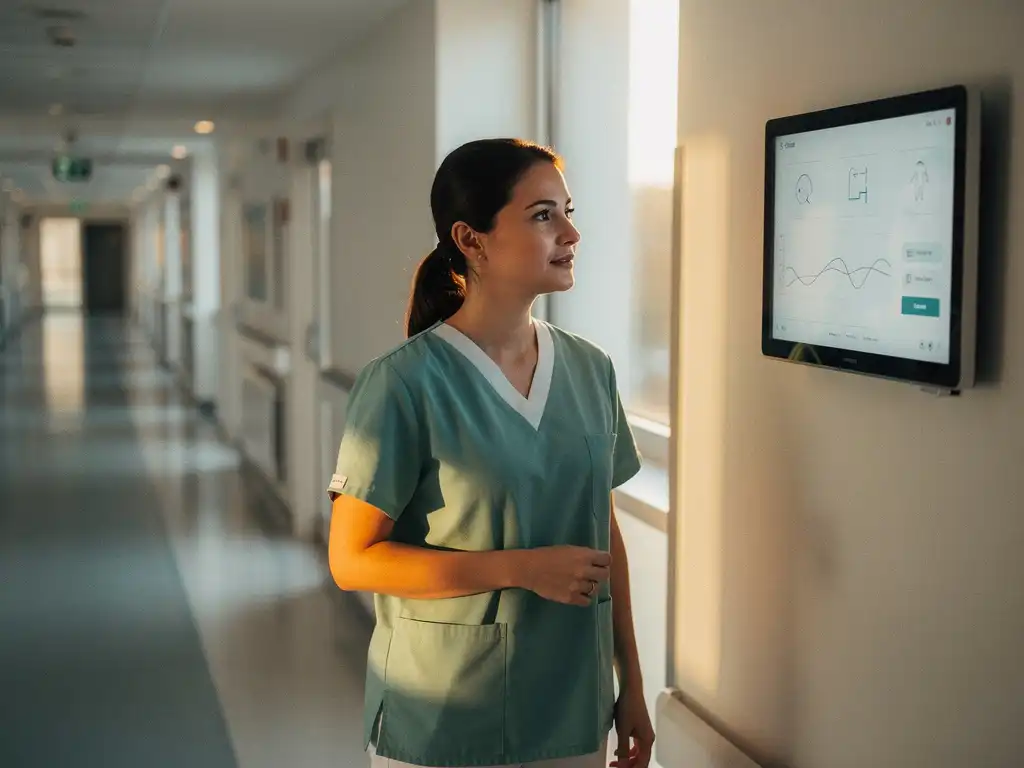
A workload monitor is most effective when you continuously track measurable signals in your care environment and respond to them before a situation escalates. For care organizations, this means automatically recording how many incidents occur, how quickly staff respond, and how the workload is distributed across shifts. In this article, we answer the most frequently asked questions about workload monitoring in healthcare — from what it measures to how you protect privacy.
What exactly does a workload monitor measure?
A workload monitor measures the objective burden on care staff by collecting data on incident frequency, response times, alarm follow-up, and the distribution of care tasks across available personnel. It is not about subjective feelings, but about measurable patterns that together paint a picture of the pressure on a team.
In practice, a workload monitor in healthcare can track the following data:
- The number of alarms and notifications per shift or per department
- The average response time of staff to incidents
- The frequency of nighttime interventions with clients
- The ratio between the number of care requests and the number of available staff
- Recurring moments when workload peaks
By systematically tracking this data, a care organization gains insight into patterns that would otherwise remain invisible. Workload is rarely a sudden problem — it builds up gradually, and it is precisely that buildup that a good monitor makes visible.
What signals indicate excessive workload in healthcare?
Excessive workload in healthcare manifests in measurable signals such as an increase in missed or delayed alarms, rising absenteeism, more errors in care delivery, and a growing number of undetected incidents outside of office hours. These signals often appear weeks before a staff member burns out.
In addition to hard metrics, there are also behavioral signals that point to overload:
- Staff who consistently work overtime or swap shifts
- An increase in alarm fatigue, where notifications are consciously or unconsciously ignored
- Rising response times during night shifts
- More complaints from clients or their families about waiting times
- Higher turnover among permanent staff
The danger with these signals is that each one seems explainable in isolation. It is only when you view them together in a monitor that the pattern becomes visible. Early detection therefore does not mean recognizing a single alarm, but taking the combination of small deviations seriously.
How does AI monitoring help with early detection of workload issues?
AI monitoring helps with early detection of workload issues because the system continuously and objectively collects data, recognizes patterns that are difficult for humans to oversee, and only sends an alert when action is actually required. This reduces unnecessary disruptions and gives managers reliable data on which to base decisions.
Traditional monitoring relies heavily on human observation and reporting, which is time-consuming and prone to bias. AI works differently: it continuously analyzes what is happening in the care environment and learns over time which situations are normal and which are anomalous. This makes it possible to identify a problem before it becomes visible to the team itself.
A key advantage of AI-driven monitoring is the combination of high accuracy and low alarm frequency. Systems that generate too many false alarms actually cause alarm fatigue, which increases workload rather than reducing it. Reliable AI only sends an alert when something is genuinely wrong, enabling staff to respond in a focused and purposeful way.
What is the difference between a workload monitor and traditional staff scheduling?
A workload monitor looks at what is actually happening in care practice, while traditional staff scheduling looks solely at who is on the roster. Scheduling is about availability; monitoring is about workload. Both are necessary, but they answer different questions.
With staff scheduling, you can determine that three employees are assigned to a night shift. What you cannot know from that is how many of those staff members are being called upon simultaneously, how quickly they can respond to an incident, or whether the distribution of care tasks is fair and feasible. That is precisely what a workload monitor makes clear.
The combination of both tools is the most powerful approach. Scheduling ensures the right staffing levels on paper. Monitoring shows whether that staffing is actually sufficient in practice. This allows a care organization not only to respond to problems, but also to adjust its scheduling model based on real experiences on the floor.
When should a care organization deploy a workload monitor?
A care organization should deploy a workload monitor as soon as there is structural understaffing, rising demand for care, increasing absenteeism, or regularly reported incidents outside of office hours. The earlier a monitor is deployed, the more data is available to act preventively.
In practice, many organizations wait too long. A workload monitor is often only deployed once the situation is already critical, whereas its greatest value lies in early detection. Consider the following situations where immediate deployment makes sense:
- Departments where night shifts are structurally understaffed
- Locations with a high percentage of clients at risk of falls
- Teams struggling with high turnover or long-term absenteeism
- Organizations facing growing care demand without proportional increases in staffing
- Care environments where incidents are discovered after the fact rather than in real time
The question is not whether a care organization will ever need a workload monitor, but when the cost of not monitoring outweighs the investment in good technology.
How do you protect client privacy in workload monitoring?
You protect client privacy in workload monitoring by using systems that process footage automatically without anyone viewing it, that comply with applicable privacy legislation such as the GDPR, and that only send an alert when action is actually required. Privacy and monitoring do not have to conflict.
A common concern among care organizations is that monitoring is equivalent to surveillance. This does not have to be the case. Modern AI systems are designed so that footage is processed locally and is never stored or viewed by humans. A staff member only receives a notification when the software detects a situation that requires attention. This keeps client privacy intact while ensuring safety.
When choosing a workload monitor, it is wise to look for the following privacy safeguards:
- Image processing takes place locally, not in the cloud
- Stored data is encrypted and access is strictly limited
- The system complies with ISO 27001 and NEN 7510 or equivalent standards
- Clients and their representatives are informed about the use of monitoring technology
- There is a clear policy on who has access to which data
How Kepler Vision Technologies supports workload monitoring
At Kepler Vision Technologies, we develop AI solutions that help care organizations reduce workload through smart, reliable client monitoring. Our software operates 24 hours a day and only alerts staff when something actually requires attention, allowing them to work in a focused way without constant interruptions.
What our approach delivers in concrete terms for care organizations:
- Fewer false alarms: our system generates an average of just one false alarm every 92 days, significantly reducing alarm fatigue
- Immediate fall detection: staff receive a notification within seconds of an incident, so no one has to wait long for assistance
- Full privacy protection: footage is never viewed by humans, and our systems comply with ISO 27001 and NEN 7510
- Insight into workload patterns: the data collected by our software helps managers objectively measure workload and adjust schedules accordingly
- Simple implementation: plug-and-play installation with no complex IT projects required
Want to find out how our solution fits your care organization? Visit our website and discover what Kepler Night Nurse and Kepler NurseAssist can do for your team.
Frequently Asked Questions
How long does it take for a workload monitor to deliver reliable insights?
Most AI-driven workload monitors begin delivering usable data immediately, but reliable pattern recognition typically requires a period of two to four weeks. During this time, the system learns what normal behavior looks like within your specific care environment, allowing anomalies to be identified more accurately. The longer the system is active, the more refined and reliable the insights become.
What are common mistakes when implementing workload monitoring in healthcare?
A common mistake is deploying a workload monitor without involving staff in the selection and implementation process beforehand. Buy-in on the floor is essential: if staff experience the system as surveillance rather than support, it will be counterproductive. Another pitfall is ignoring the data — a monitor only has value if the insights actually lead to adjustments in scheduling or policy.
Can a workload monitor also be used at smaller care locations or small-scale residential settings?
Yes, workload monitoring is especially valuable for smaller locations, because staffing per shift is often minimal and a single incident can already have a significant impact on workload. Modern systems such as plug-and-play solutions are scalable and require no extensive IT infrastructure, making them suitable for small-scale residential care or care farms as well. The investment quickly offsets the cost of one missed incident or an additional sick day.
How do you discuss the use of a workload monitor with clients and their families?
Transparency is the key word here: clearly explain what the system does, what it does not do, and what privacy safeguards are in place. Emphasize that the technology is there to enhance safety and better support staff, not to surveil clients. In practice, clients and families respond positively when they understand that footage is never viewed by humans and that the system contributes to faster assistance in the event of an incident.
Which staff members within a care organization have access to the data from a workload monitor?
Access to monitoring data is typically limited to managers, schedulers, and quality officers who need the information to improve policies and rosters. Frontline staff only receive the direct notifications relevant to them, such as a fall detection alert on their ward. A well-designed system has a clear access policy with role-based permissions, ensuring that sensitive data is not available more broadly than necessary.
How do you integrate workload monitoring with existing care software or an electronic client record (ECR)?
Many modern workload monitors offer integration options via APIs with widely used care systems and electronic client record platforms, making incident data and workload patterns directly visible within the systems staff already use. Always ask about integration options and technical requirements before purchasing. A system that connects seamlessly with existing workflows lowers the barrier to adoption and increases the practical value of the data collected.
What is a realistic expected outcome after six months of workload monitoring?
After six months, care organizations typically have a clear picture of peak workloads by shift, department, and time of day, and concrete adjustments to staffing schedules become possible based on objective data. Organizations using AI-driven monitoring frequently report a measurable reduction in missed incidents and a decrease in alarm fatigue among staff during this period. The greatest long-term result is the shift from reactive to proactive staffing policy.
Related Articles
- How does workload affect absenteeism?
- Which sectors are struggling the most with staff shortages?
- What to do if an elderly person falls and hits their head?
This content was generated with the help of AI and it may contain mistakes