


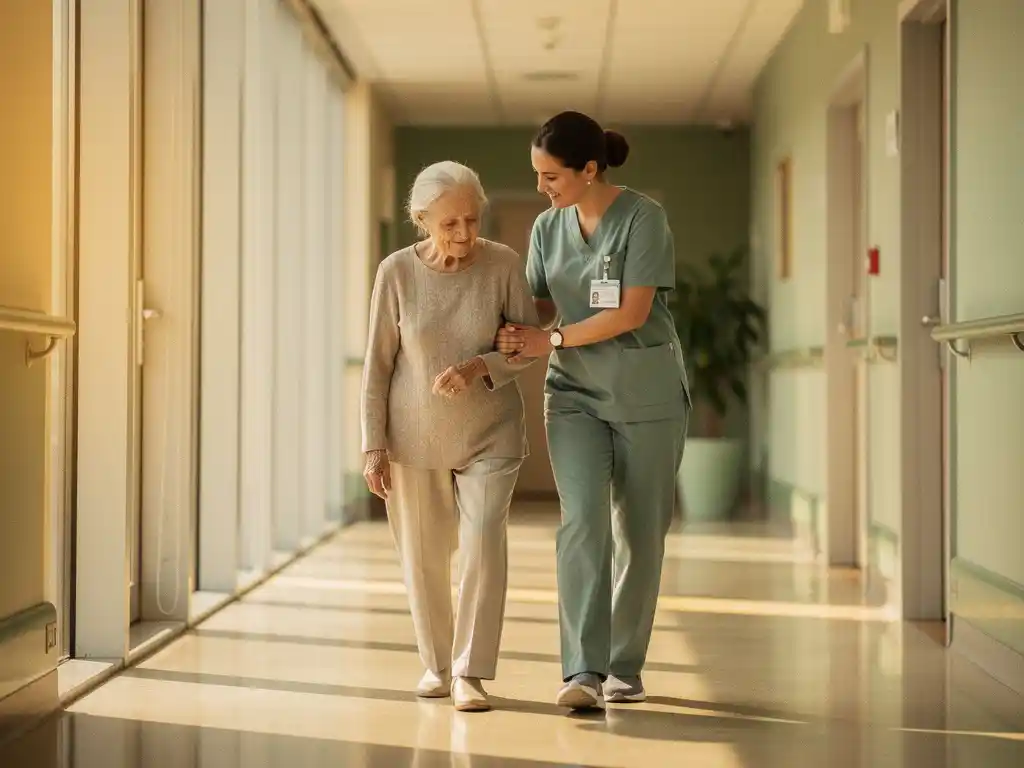
Attracting more people to healthcare starts with understanding why so many healthcare professionals burn out or leave the sector altogether. The combination of high workloads, irregular shifts, and emotionally demanding work makes healthcare a less appealing career choice for many people. At the same time, demand for care services grows by around six percent every year, making the healthcare staffing shortage an increasingly urgent problem. At Kepler Vision, we see how technology can be part of the solution. In this article, we answer the most frequently asked questions about recruitment, job satisfaction, and the role of smart technology in healthcare.
Why is it so difficult to find healthcare staff?
Finding healthcare staff is so difficult because the sector is dealing with a combination of factors that all come into play at once: high workloads, relatively low compensation for the level of responsibility the work entails, irregular working hours, and emotional strain. This makes healthcare less attractive to new entrants and causes existing staff to leave more frequently.
On top of that, an aging population is driving a structural increase in demand for care. There are simply more older people who need care, while the pool of people available to work in healthcare is not growing at the same rate. This structural imbalance makes the healthcare staffing shortage one of the biggest challenges of this decade.
Healthcare also has an image problem. Young people choosing a field of study or career do not always associate healthcare with a modern, dynamic work environment. The perception of administrative burdens, night shifts, and limited autonomy is off-putting — even though the sector offers a great deal of fulfillment and job security.
What strategies help with recruiting healthcare workers?
Effective recruitment strategies for healthcare workers combine a strong employer brand, targeted labor market communication, and practical adjustments to employment conditions. Organizations that invest in a positive employee experience and actively communicate that tend to attract more and better candidates on a consistent basis.
The following approaches work well in practice:
- Invest in your employer brand: Let employees speak for themselves about why they enjoy working at your organization. Authentic stories shared through social media or video are more persuasive than a job posting.
- Offer flexibility: Healthcare workers value the ability to have some control over their schedules or to work part-time without it affecting their career prospects or income.
- Target career changers: People with work experience in other sectors can become job-ready in healthcare relatively quickly through targeted retraining programs.
- Make use of internship placements: Students who have a positive internship experience are more likely to choose a permanent position at the same organization.
- Reduce the administrative burden: Staff who spend less time on paperwork and documentation report higher job satisfaction and are more likely to recommend their employer to others.
Recruitment is only the first step. Organizations that invest in retaining existing staff need to recruit less and build a more stable organization over time.
How can technology help ease the healthcare staffing shortage?
Technology can help ease the healthcare staffing shortage by automating repetitive and time-consuming tasks, freeing healthcare workers to focus on the work that genuinely requires a human presence. Smart systems take over routine monitoring, allowing fewer staff members to safely support more clients.
Consider night shifts in a nursing home: a healthcare worker who manually walks rounds to check that residents are safe spends a large portion of her time on preventive checks where nothing is wrong. AI-driven monitoring software can take over that continuous surveillance and only send an alert when something actually requires attention. This not only saves time but also significantly reduces workload.
Technology alone does not solve the staffing shortage, but it does expand the capacity of existing staff. A team that is intelligently supported by technology can care for more clients without compromising on quality or safety.
What is the difference between AI monitoring and traditional camera surveillance?
The key difference between AI monitoring and traditional camera surveillance is that AI actively analyzes and alerts, while traditional cameras passively record footage that must be reviewed after the fact or by a staff member watching a screen. AI monitoring responds in real time to what is happening; traditional surveillance captures it but does nothing with the information.
Traditional camera surveillance has two major drawbacks. First, it always requires someone to watch the footage, which is labor-intensive and puts pressure on client privacy. Second, while footage is recorded, emergencies are only discovered after they have already occurred.
AI monitoring works in a fundamentally different way. The software automatically recognizes situations such as a fall, an unsafe lying position, or abnormal movement, and immediately sends an alert to the responsible care worker. Footage is processed by the software but never viewed by people, which strongly protects client privacy. Care workers only need to enter the room when the software indicates it is necessary.
How does AI monitoring improve working conditions for healthcare workers?
AI monitoring improves working conditions for healthcare workers by reducing the mental and physical strain of constant vigilance. Staff no longer need to check on a client every few minutes. They can trust the technology and direct their energy toward direct caregiving.
This brings a number of concrete benefits:
- Fewer unnecessary rounds during night shifts, resulting in more rest and less fatigue.
- Faster response in emergency situations, which increases the sense of control and professional effectiveness.
- Fewer false alarms, so staff are not constantly interrupted by alerts that lead nowhere.
- Greater job satisfaction, as the focus shifts from routine checks to meaningful interaction with clients.
Healthcare workers who are less consumed by monitoring and administration generally report higher levels of job satisfaction. This also has a positive effect on staff retention: people who enjoy their work tend to stay longer.
When is AI monitoring the right choice for a healthcare organization?
AI monitoring is the right choice for a healthcare organization when the combination of staffing shortages, safety risks, and privacy requirements calls for a scalable solution that supports staff without requiring additional personnel. It is particularly well suited to organizations with night shifts, a high fall risk among clients, or locations where continuous monitoring is not physically feasible.
Practical indicators that AI monitoring is a good fit:
- Incidents regularly go undiscovered until after they have occurred.
- Staff report that workloads are too high, partly due to the demands of constant vigilance.
- The organization wants to improve client safety without investing in additional night shifts.
- Client privacy is a priority and traditional camera surveillance is therefore not an option.
It is also important that the organization is willing to invest in a careful implementation: staff need to build confidence in the technology and understand how the system works. Technology works best as a complement to well-trained personnel, not as a replacement for them.
How Kepler Night Nurse helps address the healthcare staffing shortage
At Kepler Vision Technologies, we developed Kepler Night Nurse specifically to support healthcare organizations facing the growing staffing shortage. Our AI software monitors clients around the clock in nursing homes and hospitals, detecting immediately when someone falls or ends up in an unsafe situation.
What Kepler Night Nurse offers in practice:
- Real-time fall detection: Care workers receive an alert within seconds, ensuring emergencies never go unnoticed.
- Only one false alarm every 92 days: A thousand times more accurate than traditional technologies, eliminating unnecessary disruptions.
- Full privacy protection: Footage is never viewed by people. Staff only enter the room when the software requests it.
- Plug-and-play installation: Easy to plan, configure, and install without major technical intervention.
- ISO 27001 and NEN 7510 certified: Security and compliance are guaranteed, including for international healthcare organizations.
Want to learn more about what our software can do for your organization? Visit our website and discover how we help healthcare organizations reduce workload and improve client safety.
Frequently Asked Questions
How long does it take for healthcare workers to become comfortable with AI monitoring software?
Most healthcare workers become comfortable with AI monitoring software within one to two weeks, especially when the rollout includes brief training and on-the-floor support. Systems like Kepler Night Nurse are designed to be plug-and-play, which keeps the technical barrier low. Building genuine trust in the technology takes a little longer: staff typically notice this after a few weeks of practical use, once they experience that alerts are reliable and relevant.
What are the most common mistakes made when recruiting healthcare staff?
A common mistake is focusing on filling vacancies in the short term without paying attention to the employer brand and workplace culture over the long term. Organizations that advertise solely on job content and salary miss the opportunity to differentiate themselves on job satisfaction, flexibility, and development opportunities. Another frequent mistake is overlooking career changers and returning workers as a target group, even though this group can become job-ready quickly with the right guidance.
Is AI monitoring also suitable for smaller healthcare organizations or home care?
AI monitoring is in principle scalable and not limited to large institutions, but the added value is greatest in settings where staff need to monitor multiple clients at once, such as nursing homes or residential care facilities. For home care, applicability depends on the situation: for clients with a high fall risk who live alone, AI monitoring can be a valuable addition to regular care. It is advisable to assess on a case-by-case basis whether the investment is justified by the safety gains.
How do you discuss the introduction of AI monitoring with clients and their families?
Transparency and timing are crucial here: discuss the introduction of AI monitoring well in advance with clients and their loved ones, and clearly explain what the software does and does not do. Emphasize that footage is never viewed by people and that the technology is there to enhance safety, not to spy. Practical experience shows that clients and families generally respond positively once they understand that it dramatically reduces response times in emergency situations.
What steps can a healthcare organization take to reduce staff turnover in addition to using technology?
Beyond technology, investing in professional development, offering scheduling flexibility, and actively addressing workload are the most effective measures against staff turnover. Regular conversations about job experience and career aspirations help identify early warning signs of burnout. Organizations that foster a culture in which employees feel heard and take pride in their work consistently see lower turnover rates than organizations that focus solely on staffing numbers.
Does AI monitoring comply with privacy legislation, such as the GDPR?
Well-developed AI monitoring systems are designed with privacy by design as a guiding principle and comply with the GDPR (General Data Protection Regulation). Kepler Night Nurse is also ISO 27001 and NEN 7510 certified, meaning that data security and compliance are structurally guaranteed. It is important, however, that healthcare organizations enter into a data processing agreement at the time of implementation and inform clients in accordance with GDPR requirements.
What is a realistic timeline for seeing a visible improvement in client safety after implementing AI monitoring?
Most healthcare organizations report a measurable improvement in incident response times within the first month after implementation, since the software is operational immediately and sends alerts in real time. A broader impact on client safety — such as a reduction in serious fall incidents — typically becomes visible after three to six months. Structural effects on workload and staff retention are best measured after a full year of use.
Related Articles
- How to Scale AI Patient Monitoring Across Multiple Hospital Departments
- When Is It Wise to Replace Existing Patient Monitoring With AI Monitoring?
- What is the future of the labor market amid persistent staff shortages?
- How do you solve understaffing without hiring new people right away?
- What is the accuracy of modern fall prevention systems for the elderly?
This content was generated with the help of AI and it may contain mistakes