


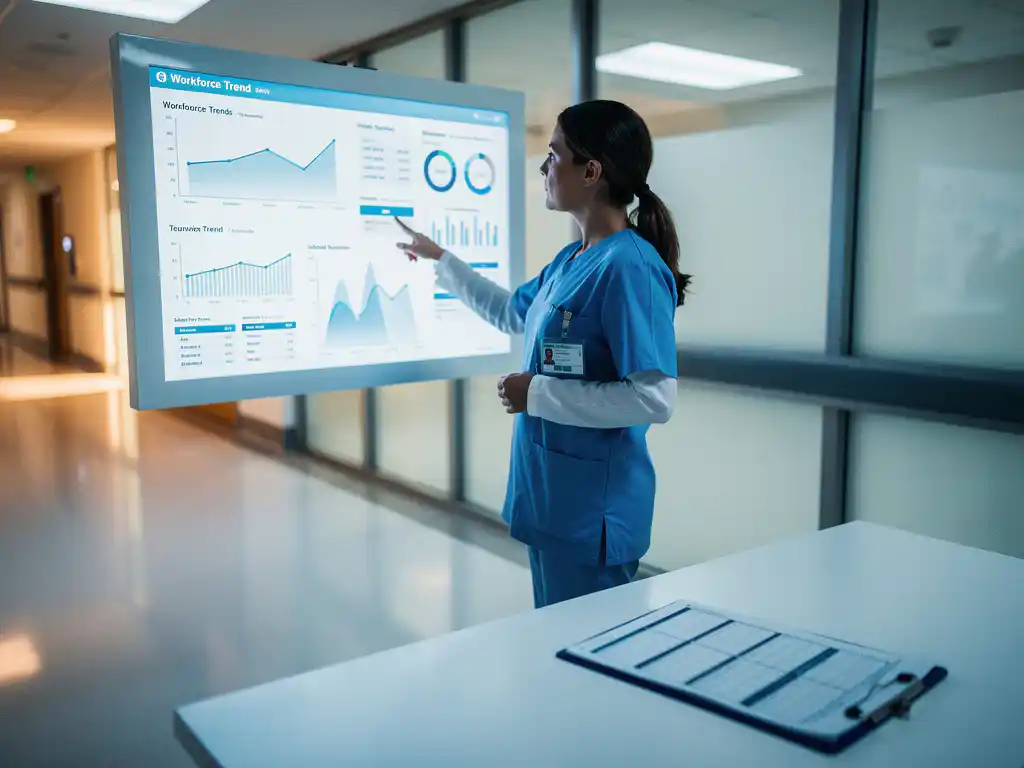
You can predict an impending staffing shortage by combining internal workforce data with external labor market figures and demographic forecasts. For healthcare organizations, this means looking at turnover patterns, the age distribution of your team, absenteeism, and regional labor market pressure. The earlier you recognize these signals, the more time you have to course-correct. In this article, we answer the most frequently asked questions about data-driven workforce forecasting in healthcare.
What data sources are useful for workforce forecasting in healthcare?
Reliable workforce forecasting in healthcare requires a combination of internal HR data and external labor market information. Internal sources provide insight into your current situation, while external sources reveal what is happening in the broader labor market. Together, they form the foundation for a well-informed outlook.
The most valuable internal data sources are:
- Personnel records: age distribution, contract types, job roles, and years of service
- Absenteeism records: frequency, duration, and causes of sick leave
- Turnover data: reasons for leaving, resignation rates, and retirements per year
- Scheduling data: structural understaffing by department or time of day
- Recruitment timelines: how long it takes on average to fill a vacancy
External sources that healthcare organizations can consult include national labor market statistics, government labor market forecasts, regional labor market reports, and sector-specific projections from industry organizations. Always combine your own data with this external context: low turnover within your organization means little if the regional labor market for nurses has been tight for years.
How does a labor market analysis work for healthcare organizations?
A labor market analysis for healthcare organizations maps the supply and demand for healthcare staff, both within the organization and in the surrounding region. You analyze how many employees you need, how many are available in the labor market, and which factors will put that balance under pressure in the coming years.
A practical labor market analysis typically follows four steps:
- Map your current workforce: What roles do you have, how many FTEs per role, and what is the age distribution?
- Determine future care demand: Is the number of clients growing? Is the complexity of care increasing? Demand for healthcare is rising by an average of 6% per year, which structurally increases pressure on staff.
- Analyze the regional labor market: How many qualified healthcare professionals are available in your region? What is the competitive pressure from other organizations?
- Identify the projected shortage: Calculate the gap between required and available capacity over a three-to-five-year period.
A thorough labor market analysis is not a one-time exercise. It forms the basis for strategic workforce planning and must be updated regularly with current data.
What are the earliest warning signs of an impending staffing shortage?
The earliest signs of an impending staffing shortage are often subtle and only recognized once the problem has already grown. Yet they are measurable if you know what to look for. Healthcare organizations that monitor proactively typically spot problems one to two years earlier than those that do not.
Watch for these early warning signs:
- Rising recruitment timelines: Vacancies that stay open longer than average are a direct signal of a tightening labor supply.
- Increased overtime and use of temporary staff: If permanent employees are routinely working extra hours or you are becoming increasingly dependent on agency workers, this points to understaffing.
- Higher absenteeism: Workload-driven sick leave is both a consequence and an amplifier of staffing shortages.
- An aging workforce: A high proportion of employees over 55 predicts a wave of retirements within five to ten years.
- Rising turnover among younger employees: If new colleagues leave quickly, it signals excessive workload, cultural issues, or better opportunities elsewhere.
Combine these signals with external data on the regional labor market. Rising turnover is more alarming in a region where few healthcare professionals are available than in a city with a large supply of healthcare graduates.
What role does AI play in predicting staffing shortages in healthcare?
AI is playing an increasingly important role in predicting staffing shortages in healthcare because it can rapidly analyze large volumes of data and identify patterns that are difficult for humans to detect. Where traditional analyses look backward, AI can look forward based on historical trends and current signals.
Concrete applications of AI in workforce forecasting include:
- Turnover prediction: AI models can calculate which employees are at elevated risk of leaving, based on years of service, age, scheduling conflicts, and absenteeism patterns.
- Capacity planning: Smart scheduling software links care demand patterns to available staffing capacity and flags future shortages by department or time period.
- Scenario analysis: AI makes it possible to model multiple future scenarios — for example, the impact of a retirement wave or a 10% increase in care demand.
Beyond workforce forecasting, AI is also being used in healthcare to reduce the workload of existing staff. By taking over routine monitoring tasks, AI frees care workers to focus on direct patient care. This makes AI not only a forecasting tool, but also a practical means of mitigating the effects of staffing shortages.
How do you translate forecast data into a concrete staffing plan?
You translate forecast data into a concrete staffing plan by linking the projected shortage to specific measures in the areas of recruitment, retention, training, and technological support. A forecast without an action plan has no value: the data must lead to decisions.
A workable approach consists of the following steps:
- Quantify the shortage by job category: How many additional nurses, care assistants, or support staff do you need in year one, year three, and year five?
- Determine which measures can close the gap: Consider intensifying recruitment, internal mobility, career changers entering the sector, or partnerships with educational institutions.
- Calculate the lead time for each measure: Recruiting and onboarding a new employee takes months; training a career changer takes years. Factor this into your planning.
- Identify where technology can take over tasks: Which tasks currently performed by people can be supported or taken over by smart technology?
- Set measurable goals and review milestones: Define when you expect which results and who is responsible for each measure.
A staffing plan is not a static document. Link it to your forecast data and update it whenever circumstances change.
How often should a healthcare organization update its workforce forecast?
A healthcare organization should conduct a thorough update of its workforce forecast at least once a year, with interim adjustments based on quarterly figures for absenteeism, turnover, and staffing levels. Annual updates are sufficient for strategic planning, but operational signals require more frequent attention.
A practical review rhythm looks like this:
- Quarterly: Monitor key indicators such as absenteeism rate, open vacancies, and use of temporary staff. Intervene if trends deviate from the forecast.
- Annually: Carry out a full recalculation of supply and demand. Incorporate new external labor market data, demographic developments, and changes in care demand.
- After major changes: Update immediately following mergers, policy changes, new legislation, or unexpected departure of key staff members.
Healthcare organizations that only update forecasts annually risk responding too slowly to rapid shifts in the labor market. Build in a system of continuous monitoring, even if the in-depth analysis remains an annual exercise.
How Kepler Vision Technologies helps address staffing shortages in healthcare
Predicting a staffing shortage is one thing — managing it effectively is another. At Kepler Vision Technologies, we develop AI solutions that help healthcare organizations directly reduce the impact of staffing shortages, without compromising the quality or safety of care.
Our software does the following in practice:
- 24/7 monitoring of clients and patients without requiring a staff member to be continuously present
- Immediate fall detection: care staff receive an alert within seconds, so they only need to intervene when it is truly necessary
- Extremely low error rate: just one false alarm every 92 days, preventing unnecessary disruptions and reducing workload
- Full privacy protection: footage is never viewed by humans; staff only enter a room when the software requests it
- Easy implementation thanks to a plug-and-play concept that can be configured and installed quickly
This allows available care staff to focus on direct, personal patient care, while our AI handles monitoring. Want to find out how our solution fits the staffing situation in your organization? Contact us and we will be happy to think it through with you.
Frequently Asked Questions
How do I get started with data-driven workforce forecasting if my organization doesn't yet have structured HR data?
Start small: take stock of what data is already available in your HR system, scheduling software, and absenteeism records, even if it is incomplete. Even basic information such as age distribution and turnover rates provides a useful starting point. Supplement this with free external sources such as government labor market forecasts and national statistics to build an initial picture. Gradually expand your data collection so that forecasts become increasingly reliable as you measure more systematically.
What common mistakes do healthcare organizations make when developing workforce forecasts?
A common mistake is looking exclusively at historical turnover figures without accounting for external labor market developments, such as a structurally tightening supply of nurses. Another pitfall is treating the forecast as a one-time project rather than an ongoing process. Many organizations also underestimate the lead time of corrective measures: if you only start recruiting once the shortage has already materialized, you are already too late. Make sure forecast data is not siloed within HR, but is actively shared with management and operational teams.
Is data-driven workforce planning feasible for smaller healthcare organizations with limited resources?
Yes, smaller healthcare organizations can also get started with data-driven workforce planning without major investments in expensive software. Many useful analyses can be done with tools you already have, such as Excel combined with publicly available labor market data from national statistics agencies. Regional collaboration networks also offer sector-specific reports that are directly applicable to smaller organizations. The key is not the complexity of the tools, but the discipline to keep data up to date and analyze it regularly.
How do I get managers and team leaders engaged with workforce forecasts?
Translate forecast data into concrete, recognizable situations at the department level: how many FTEs are at risk of leaving their team in the next two years, and what does that mean for the workload of their current staff? Managers disengage when faced with abstract figures, but respond to insights that directly relate to day-to-day operations. Involve them in interpreting the data as well, since they often pick up early warning signs — such as increased workload or intention to leave — before HR systems do. Make forecast discussions a standing agenda item in regular management meetings.
What are realistic expectations when using AI for workforce forecasting in healthcare?
AI significantly enhances the quality and speed of workforce forecasts, but it does not replace the strategic judgment of HR professionals and executives. AI models are only as good as the data they are trained on: incomplete or unreliable input leads to unreliable output. Do not expect ready-made solutions, but do count on significant time savings when analyzing large datasets and modeling scenarios. Think of AI as a decision-support tool that helps you make faster and better-informed choices — not as a replacement for human insight.
How do I handle privacy legislation (GDPR) when collecting and analyzing workforce data for forecasting?
Personnel data falls under the GDPR, which means you must have a legitimate purpose for processing it and must inform employees accordingly. For forecasting analyses, use anonymized or aggregated data wherever possible, so that individual employees cannot be identified. Document your data processing arrangements in your HR policy and ensure that access to detailed personnel data is restricted to authorized individuals. If in doubt, consult your Data Protection Officer (DPO), who can help you set up a GDPR-compliant data structure for workforce planning.
Which KPIs should I track consistently to detect staffing shortages in time?
The most valuable KPIs for early detection are: average recruitment time per job category, voluntary turnover rate (particularly among employees with less than two years of service), absenteeism rate, and the ratio of permanent to flexible staffing. Add the average age per team as an indicator of future retirement pressure. Monitor these figures at least quarterly and set threshold values that automatically trigger an alert when an indicator falls outside the normal range. This shifts your approach from reactive to proactive workforce management.
Related Articles
- How do you solve understaffing without hiring new people right away?
- How to Use Staff Scheduling to Reduce Workload
- What is the role of technology in addressing staff shortages in healthcare?
- What is the difference between fall detection and fall prevention for elderly people?
This content was generated with the help of AI and it may contain mistakes