


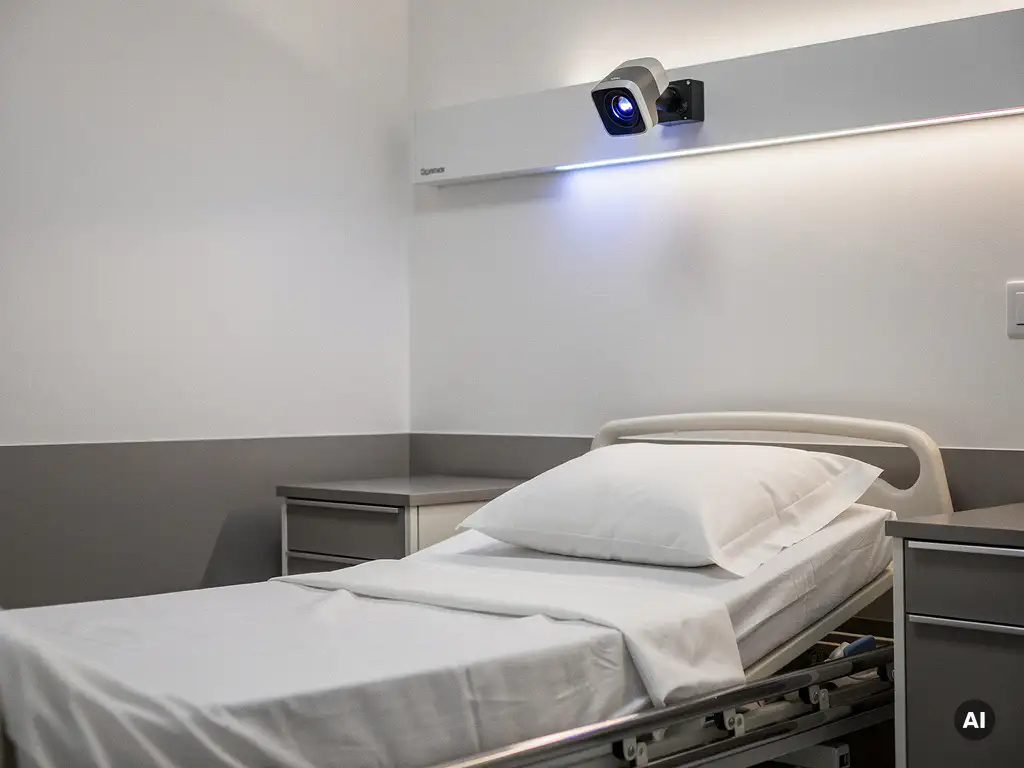
AI patient monitoring systems suitable for hospitals and care facilities combine image recognition, machine learning, and real-time alerting to support care staff in monitoring patients. The most effective systems detect fall incidents, recognize unsafe situations, and immediately send notifications to care workers, without human eyes having to continuously watch camera footage. In this article, we answer the most frequently asked questions about AI monitoring in healthcare.
How do AI patient monitoring systems work in practice?
AI patient monitoring systems analyze camera footage in real time using computer vision and machine learning. The software automatically recognizes specific situations, such as a fall or a dangerous lying position, and sends a notification to care staff within seconds. Care workers do not need to watch the footage themselves; the AI does the work.
In practice, this works as follows: a camera continuously records movements in the room of a patient or resident. The AI system compares those movements with learned patterns and determines whether the situation is normal or an emergency. Only when the software detects an unsafe situation does a care worker receive an alert. This prevents unnecessary interruptions while ensuring that real emergencies never go unnoticed.
What are the key features of AI monitoring software for healthcare?
The key features of AI monitoring software for healthcare are fall detection, fall prevention, lying position recognition, and automated alerting. Together, these features form a safety net that is active 24 hours a day, including at night when staffing levels are at their lowest.
- Fall detection: the software immediately recognizes when a patient falls and alerts care staff within seconds.
- Fall prevention: by recognizing risky movement patterns early, the system can warn before a fall occurs.
- Lying position recognition: the AI detects unsafe or prolonged lying positions that can lead to pressure sores or other complications.
- Automated alerting: notifications are sent directly to the appropriate care worker, without manual intervention.
- Low error rate: advanced systems distinguish real emergencies from ordinary movements, drastically reducing the number of false alarms.
A low error rate is crucial. Systems that generate too many false alarms lead to alarm fatigue among care staff, causing real emergencies to be taken less seriously.
Which type of care organization benefits most from AI monitoring?
Elderly care facilities and hospitals benefit most from AI patient monitoring, especially when they face staff shortages and a growing number of care requests. Psychiatric clinics and rehabilitation centers also benefit from automated surveillance, particularly during nighttime hours.
Elderly care centers are under particular pressure: the demand for care increases annually, while attracting and retaining staff becomes increasingly difficult. AI monitoring offers a direct solution by relieving existing staff of continuous monitoring tasks. In hospitals, the added value is similar: patients in departments with an elevated fall risk, such as geriatrics or neurology, can be monitored 24/7 without deploying additional staff.
How does AI monitoring differ from traditional camera surveillance in healthcare?
The fundamental difference between AI monitoring and traditional camera surveillance is that AI systems interpret what is visible on screen themselves, whereas traditional surveillance requires a staff member to actively watch the footage. AI monitoring is proactive; traditional surveillance is reactive and labor-intensive.
With traditional camera surveillance, someone must continuously watch screens to be able to detect an incident. This is practically impossible in a care environment with limited staff. Moreover, constant observation leads to privacy concerns, as care workers are permanently watching the private spaces of patients.
AI monitoring systems solve both problems. The software analyzes the footage automatically and only alerts when necessary. No human watches unless the situation requires it. Furthermore, advanced AI systems are significantly more accurate than human observation, especially under fatigue or high workload.
How do AI monitoring systems protect patient privacy?
AI monitoring systems protect patient privacy because the footage is processed exclusively by the software and never viewed by humans. Care workers only enter a patient’s room when the system generates an alert, not to check routinely.
This is a fundamental improvement over traditional surveillance. Patients and residents retain their dignity and privacy, as no one watches unnecessarily. Reliable AI systems also comply with strict privacy standards and security standards, such as ISO 27001 and NEN 7510, which safeguard the security of patient data.
For care organizations, compliance with these standards is not only an ethical obligation but also a practical requirement when procuring surveillance technology.
What should a care organization look for when choosing an AI monitoring system?
When choosing an AI monitoring system, a care organization should pay attention to accuracy, privacy protection, integration capabilities, ease of use, and certification. A system that scores strongly on all these points reduces the workload for staff and increases safety for patients.
- Accuracy: check how many false alarms the system generates. A high number of false alarms undermines care staff’s trust in the system.
- Privacy and compliance: the system must comply with applicable laws and regulations, including GDPR, and preferably be certified according to ISO 27001 or NEN 7510.
- Ease of installation: a plug-and-play solution that is easy to configure reduces implementation costs and time.
- Scalability: the system must be able to grow with the organization, both in the number of rooms and in functionality.
- Proven performance: ask for references from comparable care organizations and check whether the system has a patent portfolio or scientific backing.
- Support: good technical support and staff training are essential for a successful implementation.
How we help with AI patient monitoring
We develop AI solutions that help care organizations safely monitor patients, even with limited staffing. Our software, Kepler Night Nurse and Kepler NurseAssist, offers a complete approach to AI patient monitoring in elderly care facilities and hospitals.
- We detect fall incidents and alert care workers within seconds.
- Our software generates only one false alarm per 92 days, which greatly reduces alarm fatigue among staff.
- Footage is never viewed by humans, fully safeguarding patient privacy.
- We comply with ISO 27001 and NEN 7510 and hold an international patent portfolio of 21 patents.
- Our systems are plug-and-play and easy to install, configure, and scale.
Want to discover how our AI monitoring solutions fit your care organization? Visit our website and contact us for a no-obligation conversation.
Frequently Asked Questions
How long does it take to implement an AI monitoring system in a care facility?
The implementation time depends on the size of the care facility and the chosen system, but plug-and-play solutions can typically be operational within a few days. The installation includes placing cameras, configuring the software, and training staff. A phased rollout — starting with one department or wing — is a proven approach to gradually familiarize staff with the technology.
What happens if the AI system experiences a technical failure? Are patients left unmonitored?
Reliable AI monitoring systems have built-in error notifications and fallback mechanisms that immediately alert care staff in the event of a technical failure or connectivity issue. The system continuously monitors itself and sends a notification as soon as a camera or module is not functioning properly. Care organizations are advised to ask the supplier what continuity measures and SLA agreements apply for maintenance and fault resolution.
How do patients and residents typically respond to AI camera surveillance in their room?
Most patients and residents accept AI camera surveillance well, provided they are properly informed about how the system works and what happens to the footage. It is crucial to emphasize that footage is never viewed by humans and is processed exclusively by the software. Transparent communication — supported by information leaflets or a personal conversation — significantly increases trust and lowers the threshold for acceptance.
Can family members of patients access the footage from the AI monitoring system?
No, in well-designed systems neither family members nor unauthorized staff have access to the camera footage; the footage is processed exclusively by the AI software. This is a deliberate choice to safeguard patient privacy and comply with GDPR and other privacy legislation. Care organizations typically record this policy in their privacy statement and inform residents and family members about it during intake.
Can AI patient monitoring also be used for patients with dementia or behavioral issues?
Yes, AI patient monitoring is particularly valuable for patients with dementia or behavioral issues, as this group has an elevated fall risk and may find it harder to ask for help themselves. The system automatically detects risky movement patterns and unsafe situations, regardless of the patient’s cognitive level. Moreover, the monitoring is non-intrusive: no action is required from the patient themselves to trigger an alert.
What are the most common mistakes care facilities make when purchasing an AI monitoring system?
A common mistake is focusing exclusively on the purchase price, without taking into account the total cost of ownership, such as maintenance, updates, and training. In addition, facilities regularly underestimate the importance of a low error rate: systems with many false alarms are quickly ignored by staff, negating the safety gains. Finally, the involvement of care staff in the selection and implementation process is too often overlooked, while buy-in on the work floor is decisive for the success of the technology.
How does a care facility measure the return on investment and effectiveness of an AI monitoring system after implementation?
The return on investment of an AI monitoring system can be measured using concrete KPIs, such as the number of recorded fall incidents before and after implementation, the average response time to alerts, and the level of alarm fatigue among staff. The reduction in injury-related costs — such as hospital admissions following a fall — and the time savings for care workers are also valuable indicators. A good supplier supports care facilities in setting up a measurement methodology and provides reports with which effectiveness can be evaluated periodically.
Related Articles
- How do you attract more people to the care sector?
- What are your rights as an employee when workload is too high due to staff shortages?
- How large is the staffing shortage in healthcare in 2025?
- Hoe helpt technologie bij het creëren van veilige en mensgerichte zorg?
This content was generated with the help of AI and it may contain mistakes