
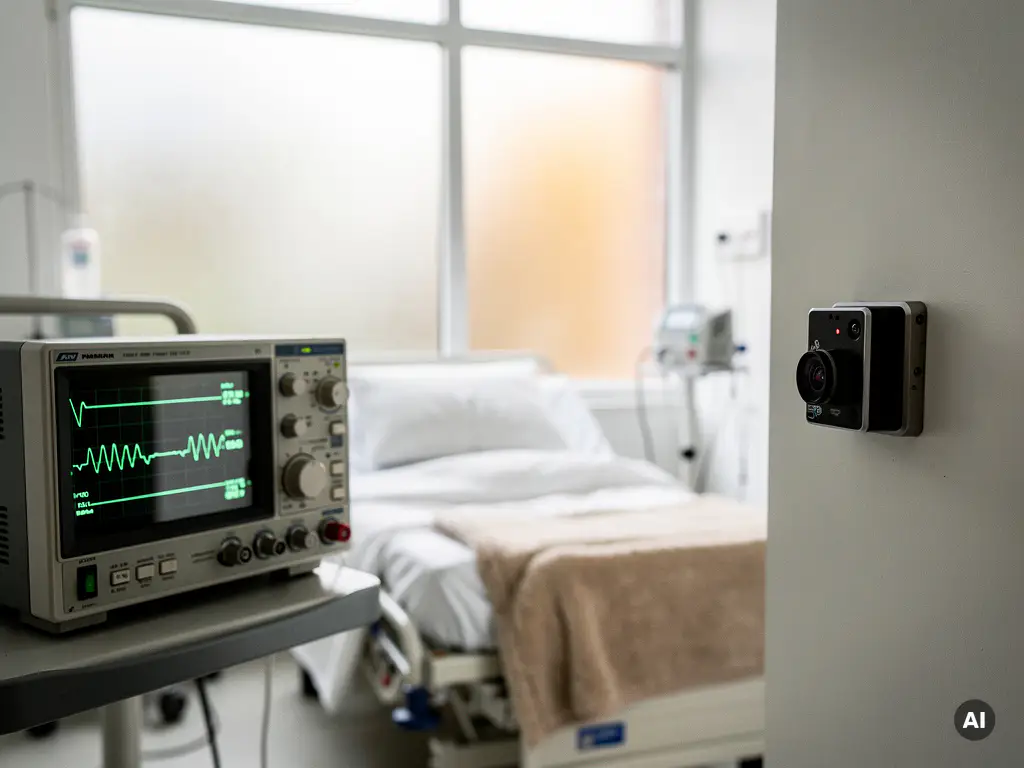
The biggest difference between AI patient monitoring and traditional patient surveillance lies in how oversight is carried out: AI monitors continuously and automatically based on image recognition, while traditional surveillance relies on periodic checks by care staff. AI systems detect unsafe situations immediately and send an alert within seconds, without a staff member needing to be physically present. The questions below take a deeper look at how both methods work, where the differences lie, and when AI monitoring is the better choice.
How does AI patient monitoring work in practice?
AI patient monitoring works by having image recognition software continuously analyze the environment of a patient or resident. The software automatically recognizes situations such as a fall, a dangerous lying position, or unusual movements, and immediately sends an alert to the nearest care staff member. No human intermediate step is needed to trigger the alarm.
In practice, this means that a camera in a resident’s room captures footage, but that footage is never viewed by humans. The AI processes the images in a fully automated way and assesses whether action is needed. Only when the software detects an unsafe situation does a care staff member receive a notification on their device.
This system operates day and night, even during busy shifts or at night when fewer staff are present. Care staff are therefore only deployed when truly necessary, which reduces workload and shortens response time.
What are the disadvantages of traditional patient surveillance?
Traditional patient surveillance is heavily dependent on the availability of care staff. Staff check on residents at fixed intervals or respond to alarm buttons and motion sensors, but as a result miss situations that occur outside those moments. This leads to delayed responses in emergencies such as a fall.
In addition to limited coverage, traditional surveillance suffers from a high number of false alarms. Older technologies such as motion sensors or pressure mats regularly trigger unwarranted alerts, leading to alarm fatigue among care staff. As a result, real alarms are sometimes responded to more slowly or taken less seriously.
There are further structural disadvantages:
- Staff shortages make continuous surveillance physically impossible
- Night shifts have fewer staff, increasing risks
- Manual checks are time-consuming and disturb residents’ sleep
- Response time after a fall or incident depends on chance and staffing levels
For care organizations facing growing demand for care and a shrinking workforce, traditional surveillance offers insufficient guarantees for resident safety.
How accurate is AI monitoring compared to traditional methods?
AI monitoring is significantly more accurate than traditional surveillance methods. Modern AI systems for patient monitoring generate on average just one false alarm every 92 days, while older technologies such as motion sensors or pressure mats can produce multiple unwarranted alerts daily. That difference in reliability is up to a thousand times greater.
This accuracy has a direct impact on the work floor. Fewer false alarms means fewer unnecessary trips for care staff, less disruption to residents’ sleep, and less alarm fatigue. At the same time, genuine emergencies are detected faster and more reliably, because the AI analyzes continuously and without fatigue.
Traditional technologies also lack context. A motion sensor detects movement, but cannot distinguish whether someone is falling or simply turning over in bed. AI image recognition does recognize that context, which fundamentally improves the quality of every alert.
How does AI patient monitoring protect residents’ privacy?
AI patient monitoring protects residents’ privacy because footage is processed exclusively by the software and never viewed by humans. The AI analyzes the images automatically and only sends an alert when an unsafe situation is detected. Care staff enter the room only when the software requests it.
This is a fundamental difference from traditional camera surveillance, where staff or security personnel actively watch the footage. With AI monitoring, the resident’s personal space remains fully intact, even during the night. There is no continuous human observation.
For care organizations working with sensitive patient data, compliance with privacy legislation is a requirement. Reliable AI systems for patient monitoring comply with international security standards such as ISO 27001 and NEN 7510, which guarantee the protection of medical data. This allows care organizations to deploy technology without compromising the dignity and privacy of their residents.
When is AI monitoring the right choice for a care organization?
AI monitoring is the right choice when a care organization is dealing with staff shortages, a growing number of residents, or recurring safety issues that traditional surveillance fails to adequately address. It is particularly valuable in situations where continuous monitoring is physically not feasible with the available staff.
Specific circumstances in which AI monitoring offers clear added value:
- Elderly care facilities with limited night staffing
- Wards with a high fall risk among residents
- Hospitals and psychiatric clinics that require automated observation
- Organizations that want to reduce alarm fatigue among staff
- Institutions that must comply with strict privacy legislation
AI monitoring is not a replacement for care staff, but a support tool. Staff are relieved of routine checks and can focus their attention on situations that truly require human care. This makes the technology not only more efficient, but also more valuable for the job satisfaction of care professionals.
How Kepler Vision Technologies helps with AI patient monitoring
We at Kepler Vision Technologies develop AI solutions that help care organizations combine safety and privacy without adding extra pressure on staff. Our software acts as a reliable digital colleague that watches over residents day and night.
What our approach means concretely for care organizations:
- Immediate fall detection: care staff receive an alert within seconds of a fall or unsafe situation
- Extremely low error rate: just one false alarm every 92 days, a thousand times better than traditional technologies
- Privacy protection: footage is never viewed by humans and the software complies with ISO 27001 and NEN 7510
- Plug-and-play installation: easy to plan, configure, and install in existing care facilities
- 21 international patents: proven and protected technology with a robust innovation portfolio
Want to know whether our AI patient monitoring is a good fit for your care organization? Discover more about our solutions and get in touch for a no-obligation conversation.
Frequently Asked Questions
How long does it take to implement AI patient monitoring in an existing care facility?
Implementation time varies by organization, but modern AI monitoring systems such as those from Kepler Vision Technologies are designed as plug-and-play solutions that can be installed relatively quickly in existing care facilities. In most cases, the process includes an intake and configuration phase, followed by installation and a short onboarding period for care staff. It is advisable to draw up a project plan with the supplier in advance so that the transition runs smoothly and staff are well prepared.
What happens if the AI misjudges a situation or misses an emergency?
Although modern AI systems have a very low error rate — just one false alarm every 92 days — no system is entirely infallible. Reliable suppliers therefore offer continuous software updates and monitoring of system performance to ensure accuracy. In addition, AI monitoring always remains a supplement to human oversight: care staff remain available and can also intervene without an alert when necessary.
How do residents and their families react to the use of camera technology in the room?
Resistance from residents or family members is a common concern when introducing AI monitoring, but often disappears once it is clear that footage is never viewed by humans. It is important to inform residents and their loved ones transparently and in a timely manner about how the system works, what is and is not stored, and what privacy safeguards apply. A good communication strategy before implementation significantly increases acceptance.
Is consent from the resident required before AI monitoring is deployed?
Yes, in the Netherlands informed consent is a legal requirement when deploying camera technology in a resident’s personal living space, even when footage is not viewed by humans. Care organizations must record this in their privacy policy and consent procedures, in line with the GDPR and sector-specific guidelines. It is advisable to seek legal advice and work with the supplier to determine how the consent process is practically organized.
Can AI monitoring be integrated with existing care systems and alerting infrastructure?
Most professional AI monitoring solutions are designed to integrate with existing EHR systems, nurse call systems, and mobile devices used by care staff. When selecting a supplier, it is important to check which integration options are available and whether customization is needed for your specific infrastructure. Good integration ensures that alerts reach the right staff member directly, without additional steps or separate apps.
What are the costs of AI patient monitoring and how does this compare to the savings?
The costs of AI patient monitoring typically consist of an initial installation fee and an ongoing license or subscription price per room or location. Against this investment stand concrete savings: fewer unnecessary trips for staff, lower costs due to faster intervention in incidents such as falls, and reduced absenteeism due to lower workload and alarm fatigue. Many care organizations recoup the investment within a relatively short time, especially when the costs of one serious fall incident are included in the calculation.
Does AI monitoring also work effectively for residents with dementia or unpredictable behavior?
Yes, AI monitoring is particularly valuable for residents with dementia or behavioral issues, because this group has an increased risk of falls, nighttime wandering, or dangerous situations that are difficult to predict. The software analyzes continuously and recognizes abnormal movement patterns or postures without the resident needing to take any action themselves, which is essential for this group. Care staff can therefore respond faster and more effectively, without unnecessarily disturbing the resident or restricting their freedom.
Related Articles
- What is the difference between workload and work-related stress?
- Which mobile apps support fall prevention for seniors?
- What sensors are used in fall prevention systems for elderly people?
- Why is healthcare monitoring shifting from reactive to predictive?
- What innovations are shaping the future of elderly care?
This content was generated with the help of AI and it may contain mistakes