

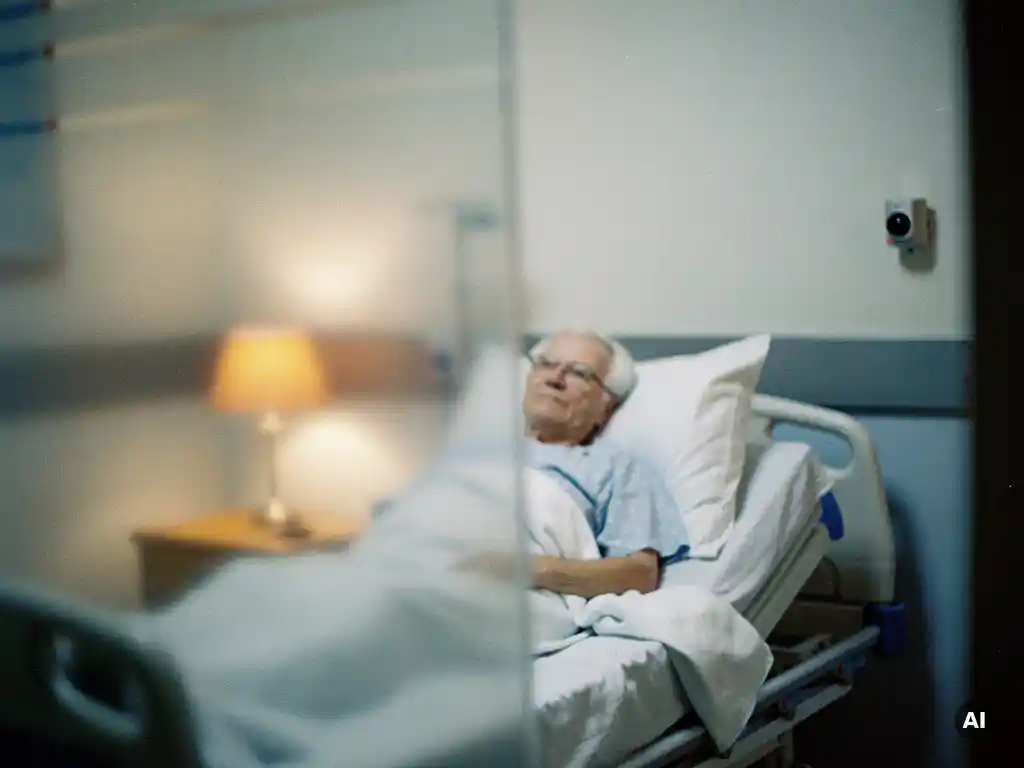
Patient privacy in camera-based AI monitoring is protected by never showing footage directly to people, but instead having it analyzed exclusively by AI software. Only when the software detects an unsafe situation is a care worker alerted to take action. This principle, combined with strong technical and legal measures, makes it possible to guarantee safety and privacy simultaneously. In this article, we answer the most frequently asked questions about privacy in AI monitoring in healthcare.
What privacy risks does camera surveillance in healthcare entail?
Traditional camera surveillance in healthcare carries significant privacy risks, because footage is stored and viewed by staff. This directly affects the human dignity of patients and clients, who find themselves in vulnerable and intimate situations. The greatest risks are unauthorized access to footage, data breaches, and violations of the right to privacy in one’s own living environment.
In care facilities, patients and clients are daily in situations that are experienced as highly personal: washing, dressing, using the toilet, or sleeping. When these moments are captured on camera and viewed by people — even with good intentions — a fundamental tension arises with the right to privacy. Moreover, stored footage increases the risk of data breaches and misuse.
In addition, patients may feel uncomfortable or unsafe when they know they are being continuously observed by people. This can undermine trust in the care facility and negatively affect the quality of the care relationship.
How does AI monitoring software process footage without human viewing?
AI monitoring software processes camera footage fully automatically, without any person ever seeing the images. The software analyzes movement patterns and body positions in real time and only sends a notification to a care worker when an unsafe situation is detected, such as a fall. The care worker does not see any footage, but receives only an automated alert.
This works because the AI software uses computer vision and machine learning to learn to recognize what normal and abnormal situations look like. As soon as the software detects anomalies — such as someone falling or adopting a dangerous lying position — the system immediately generates an alarm. The camera acts as a sensor, not as a surveillance device. Footage is not stored for human viewing, and care workers only enter a patient’s room when the software requests it.
This principle restores patient privacy to the level they deserve: they are monitored for safety, but not surveilled.
What are the GDPR requirements for AI monitoring in care facilities?
AI monitoring in care facilities is subject to the requirements of the General Data Protection Regulation (GDPR). Image data of patients falls under special categories of personal data, which means that care facilities need a legal basis for processing, must carry out a Data Protection Impact Assessment (DPIA), and must be transparent with patients about the use of monitoring technology.
In practice, this means the following for care facilities:
- Legal basis: Processing is only permitted on the basis of consent, legitimate interest, or another GDPR ground, whereby patient safety can be a compelling argument.
- DPIA: A data protection impact assessment is mandatory for large-scale processing of sensitive personal data, including image data.
- Data minimization: No more data may be processed than is strictly necessary for the purpose — in this case, patient safety.
- Retention periods: Data may not be retained longer than necessary.
- Information provision: Patients must be informed about which data is processed, for what purpose, and for how long.
Technology solutions that never store footage and never show it to people inherently comply better with the GDPR’s data minimization principle than traditional camera systems.
What is the difference between traditional camera surveillance and AI-driven monitoring?
The key difference is that traditional camera surveillance stores footage and has it viewed by people, while AI-driven monitoring analyzes footage exclusively automatically and only sends a notification when an unsafe situation is detected. AI monitoring acts as an intelligent sensor, not as a surveillance system.
Traditional camera surveillance
With traditional camera surveillance, footage is continuously recorded, stored, and often viewed by staff or security personnel. This results in large volumes of stored footage, an increased risk of data breaches, and a structural infringement on patient privacy. Furthermore, traditional systems generate many false alarms, leading to alarm fatigue among care workers and reduced alertness in genuine emergencies.
AI-driven monitoring
AI-driven monitoring analyzes footage in real time without storing it for human viewing. The software automatically recognizes situations such as fall incidents or dangerous body positions and immediately sends a notification to the appropriate care worker. This system is considerably more accurate, generates far fewer false alarms, and structurally respects patient privacy. Care workers are only called upon when it is genuinely necessary.
How can care facilities inform patients about AI monitoring?
Care facilities inform patients about AI monitoring by providing transparent communication at admission, supplying written information, and explicitly explaining that footage is never viewed by people. Good information provision increases patient trust and is also a legal obligation under the GDPR.
In practice, care facilities can approach this in the following ways:
- Include a clear explanation in the admission procedure or care plan, covering the purpose of the monitoring, how the software works, and the privacy safeguards in place.
- Make information materials available in plain language, tailored to the target audience, including family members and informal carers.
- Clearly communicate that the camera functions as a sensor and that no person ever views the footage.
- Explain which situations trigger a notification and how care workers respond.
- Designate a contact person for questions about data protection, such as a Data Protection Officer (DPO).
Transparency is not only a legal obligation, but also a way to gain and maintain the trust of patients and their families.
What technical measures safeguard the security of monitoring data?
The security of monitoring data is safeguarded by a combination of encryption, strict access control, certification, and the principle of data minimization. Care facilities must require that suppliers of AI monitoring solutions demonstrably comply with recognized information security standards, such as ISO 27001 and the Dutch NEN 7510 standard for healthcare information.
Concrete technical measures include:
- Encryption: Data is encrypted during storage and transmission, so that it is unreadable to unauthorized parties.
- Access control: Only authorized staff have access to notifications and system data, based on role-based permissions.
- Data minimization: Footage is not stored; only the necessary notification information is processed.
- Audit logging: All access to the system is logged, so that unauthorized access is quickly detected.
- Certification: Suppliers with ISO 27001 and NEN 7510 certification demonstrate that they work systematically on information security.
How Kepler Vision Technologies helps with privacy-safe patient monitoring
We at Kepler Vision Technologies have developed AI monitoring software that structurally combines safety and privacy. Our solutions, Kepler Night Nurse and Kepler NurseAssist, are specially designed for elderly care facilities and hospitals that face staff shortages while also wanting to safeguard the privacy of their patients.
What our approach means in practice for care facilities:
- Footage is never viewed by people; our AI analyzes everything fully automatically.
- Care workers receive a notification within seconds in the event of a fall incident or dangerous situation.
- Our system generates only one false alarm every 92 days, significantly reducing alarm fatigue.
- We comply with ISO 27001 and NEN 7510, ensuring the security of patient data is guaranteed.
- Our software is easy to install thanks to a plug-and-play concept and is scalable for international care facilities.
Would you like to know how we can help your care facility with reliable and privacy-safe patient monitoring? Contact us and discover what our AI solutions can do for you.
Frequently Asked Questions
How long does it take for AI monitoring software to be correctly set up and work reliably in a care facility?
The implementation of AI monitoring software such as Kepler Night Nurse is typically fast thanks to a plug-and-play concept, whereby the system can be operational within a few hours. The AI requires a short learning period to recognize the normal movement patterns of an individual patient, but generates useful notifications from day one. For full integration into the care team’s workflows, it is recommended to train staff in advance on receiving and acting on notifications.
What happens to the data when a patient leaves the facility or passes away?
Because AI monitoring systems that operate according to the privacy-by-design principle do not store footage, there is virtually no remaining data to delete after a patient’s departure or death. Notification logs and system data that are retained must be deleted in accordance with the GDPR and applicable retention periods as soon as they are no longer necessary. Care facilities record this concretely in their processing register and data protection policy.
Can patients or their families object to the use of AI monitoring?
Yes, patients or their legal representatives have the right under the GDPR to object to the processing of their personal data, unless the processing is based on a legal obligation. In practice, transparent communication at admission provides the best foundation: when patients and families clearly understand that no person ever views the footage and that the monitoring is solely aimed at their safety, resistance generally decreases significantly. Care facilities should have a clear procedure for handling objections, preferably with the support of a Data Protection Officer (DPO).
Does AI monitoring also work reliably for patients with unpredictable or complex behavior, such as those with dementia?
AI monitoring software is particularly well suited for patients with dementia or unpredictable behavior, because the system observes continuously and objectively without fatigue or susceptibility to distraction. The software learns the individual movement patterns of a patient and detects anomalies such as falls or dangerous body positions regardless of the behavioral profile. This makes AI monitoring especially valuable in elderly care, where this population is common and the risk of fall incidents is high.
What is the difference between conducting a DPIA for traditional camera surveillance versus AI monitoring software?
With traditional camera surveillance, a DPIA typically reveals a high privacy risk, because footage is stored and viewed by people, which is difficult to justify in a care environment. With AI monitoring software that operates according to the privacy-by-design principle — where footage is not stored and never viewed by people — the risk profile in the DPIA is considerably lower. This makes it legally easier for care facilities to justify the processing and document the required measures.
What common mistakes do care facilities make when implementing AI monitoring systems?
A common mistake is skipping thorough information provision to patients and their families before implementation, which can cause resistance and loss of trust. In addition, facilities sometimes underestimate the importance of involving care workers in the rollout: buy-in on the work floor is essential for successful adoption. Finally, some facilities forget to link the system to clear protocols for acting on notifications, meaning the added value of rapid detection is not fully realized.
Is AI monitoring software also suitable for smaller care facilities with a limited budget?
Yes, modern AI monitoring software is designed to be scalable and can be deployed cost-effectively in smaller care facilities as well, for example by starting with a limited number of rooms or wards. The investment in many cases outweighs the costs of fall incidents, such as hospital admissions, liability, and additional staffing during night shifts. It is advisable to ask the supplier about modular pricing structures and the option to expand the system step by step as the facility grows.
Related Articles
- How large is the staffing shortage in healthcare in 2025?
- How does automation help address staff shortages?
- How does workload affect absenteeism?
- How does HR structurally address workload pressure?
- Which mobile apps support fall prevention for seniors?
This content was generated with the help of AI and it may contain mistakes