


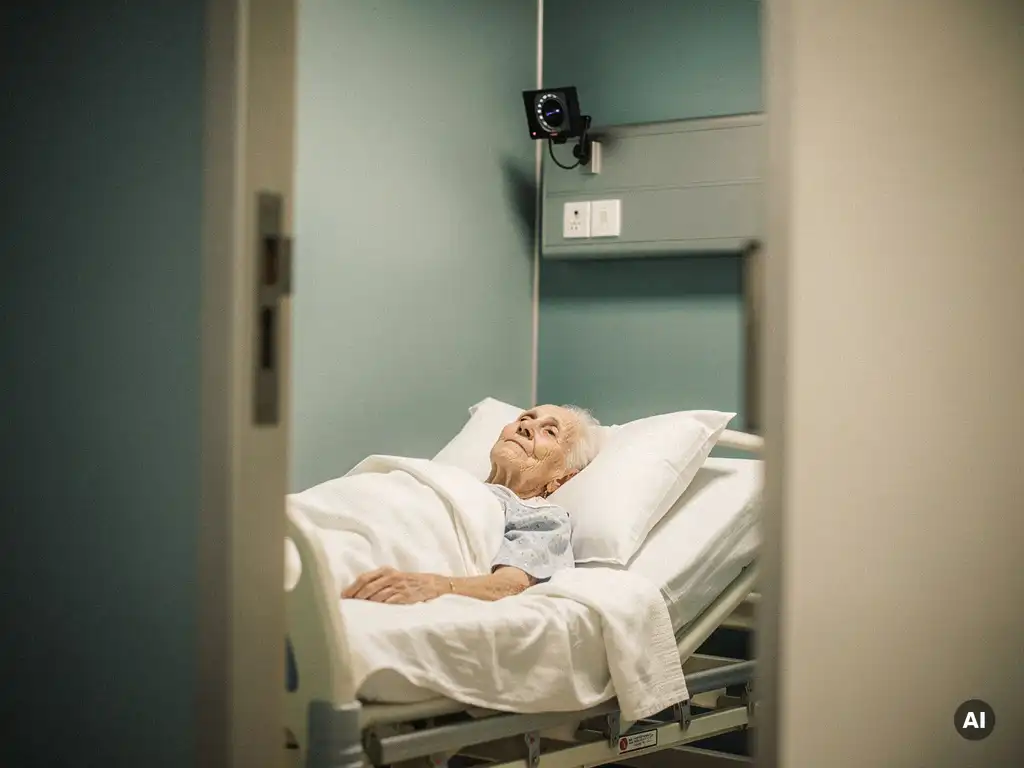
A pilot with AI fall detection delivers concrete, measurable results at most care facilities within four to eight weeks. You can expect fall incidents to be noticed more quickly, the number of missed falls to drop significantly, and care staff to experience fewer unnecessary room alarms. The exact results depend on the size of the ward, the current monitoring practice, and how consistently the system is deployed. In this article, we answer the most frequently asked questions about what an AI fall detection pilot delivers in practice.
How many fall incidents go undetected without AI fall detection?
Without automated fall detection for elderly residents, a significant proportion of fall incidents are noticed too late or not at all. Care staff cannot be continuously present with every resident, especially during the night or busy shifts. Industry estimates indicate that a substantial share of nighttime falls are only discovered at the next round, sometimes twenty to thirty minutes later.
The consequences of a missed fall incident are serious. An elderly person who lies on the floor for an extended period faces an increased risk of hypothermia, pressure injuries, and psychological trauma. Moreover, the likelihood of complications such as a hip fracture or internal bleeding increases the longer the response time. Traditional systems such as motion sensors or pressure mats also generate many false alarms, causing staff to develop alarm fatigue and take alerts less seriously. This further increases the risk of missing genuine incidents.
What are realistic results during an AI fall detection pilot?
During a well-executed AI fall detection pilot, you can realistically expect fall incidents to be detected within seconds, the number of false alarms to drop drastically, and care staff to gain greater confidence in the monitoring. Complete elimination of falls is not a realistic goal for a pilot, but faster response and better documentation are.
Concrete results that care facilities typically report include:
- Significantly shorter response times after a fall incident
- Fewer unnecessary disruptions to residents’ night-time rest due to unnecessary room alarms
- Better insight into fall patterns per resident, enabling prevention
- Reduced workload pressure for staff as alarms become more reliable
- Improved documentation of incidents for reporting and quality improvement
It is important to note that results only become fully visible once the team has grown accustomed to the new way of working. The first two weeks are often an adjustment period for both the technology and the staff.
How long does it take before results become visible in a pilot?
The first measurable results of an AI fall detection pilot typically become visible after two to four weeks. However, full reliability of the data and a clear picture of the impact on work processes require four to eight weeks. A pilot shorter than four weeks provides too little data for a well-founded decision on rollout.
During the first week, the focus is on technical installation and configuring the software to the specific environment. This is followed by a period in which staff learn how to interpret alerts and how to use the information in their care process. Only once that adjustment has taken place do the results reflect the true added value of the system. A pilot of six to eight weeks provides the most reliable basis for a go or no-go decision.
Which KPIs should a care facility track during the pilot?
During a fall detection pilot for elderly residents, the most important KPIs are: the number of detected fall incidents, the average response time after a fall, the number of false alarms per week, and care staff satisfaction with the system. Without these measurement points, it is impossible to objectively assess the added value.
An overview of recommended KPIs:
- Detection speed: how quickly after a fall is an alert generated?
- Response time: how long does it take for a staff member to arrive on the scene?
- False alarm rate: how many alerts turned out not to be a fall incident?
- Missed incidents: were there any falls the system did not detect?
- Staff satisfaction: do staff experience the tool as supportive or as an additional burden?
- Resident comfort: are there any indications that residents find the monitoring burdensome?
Record these KPIs weekly and compare them with the situation before the pilot. This allows you to make a fair comparison at the end of the test period.
What are common challenges in a fall detection pilot?
The most common challenges in an AI fall detection pilot are resistance from care staff, technical adjustments to the environment, and lack of clarity about who is responsible for following up on alerts. These challenges are surmountable, but require thorough preparation.
Resistance from staff
Care professionals are sometimes skeptical about technology that changes their way of working. This is understandable: new tools require adjustment and raise questions about privacy and autonomy. Involve staff early in the process, explain what the software does and does not do, and create space for questions. Support on the work floor is a prerequisite for a successful pilot.
Technical and spatial adjustment
Not every room or ward is immediately suitable for camera-based monitoring. Lighting, room layout, and network connectivity may require adjustments. Plan a technical pre-assessment to prevent surprises during the pilot. The better the preparation, the more representative the results.
When is a pilot successful enough for full rollout?
A fall detection pilot is successful enough for full rollout when detection speed has demonstrably improved, the false alarm rate is low and acceptable, staff experience the tool as adding value, and the technical operation has proven stable throughout the entire pilot period. All four criteria count.
A common mistake is to base the rollout decision solely on technical performance. Equally important is the human side: are staff actively working with the alerts and do they feel supported? If the technology performs well but the team does not use the tool, rollout will not lead to better care outcomes.
At the end of the pilot, create an evaluation document with the measured KPIs, qualitative feedback from staff, and a recommendation for any adjustments ahead of rollout. This document also forms the basis for internal support from management and the board.
How we help with AI fall detection for elderly residents
We develop AI software that supports care facilities at every stage of fall detection, from pilot to full implementation. Our solution is designed for the practice of elderly care and hospitals, and offers:
- Detection within seconds: as soon as someone falls, care staff immediately receive an alert
- Exceptionally low false alarm rate: just one false alarm per 92 days, which is a thousand times better than traditional technologies
- Full privacy protection: footage is never viewed by humans; staff only enter the room when the software requests it
- Plug-and-play installation: easy to configure and quickly operational, even during a pilot
- Compliance with ISO 27001 and NEN 7510: the security of patient data is guaranteed
Want to know what a pilot with our software can deliver for your facility? Contact us and we will be happy to think along with you about an approach that fits your situation.
Frequently Asked Questions
How do I best prepare my team for an AI fall detection pilot?
Start well before the start date with an information session in which you explain what the software does, how alerts work, and what is expected of staff. Designate an internal point of contact who can answer questions and make sure everyone knows who is responsible for following up on an alert. Buy-in on the work floor is not a minor matter: teams that are well prepared demonstrably achieve better pilot results than teams where the technology is introduced without preparation.
What happens if the system misses a fall during the pilot?
A missed incident during the pilot is valuable information, not a reason to immediately write off the technology. Document every missed case carefully: at what time did the fall occur, what were the circumstances, and what camera angle or lighting condition played a role? Share these findings with the supplier so that the system settings can be optimized. A serious supplier actively uses this kind of feedback to improve detection performance during and after the pilot.
Can residents or their families refuse to participate in the pilot?
Yes, participation in a monitoring pilot is always voluntary and residents or their legal representatives have the right to refuse. Inform families in advance in writing about the purpose of the pilot, what data is collected, and how privacy is safeguarded. Make sure the opt-out process is accessible and clearly documented, so that you can also demonstrate to regulators that informed consent has been properly arranged.
What if the pilot results are disappointing — does that always rule out rollout?
Disappointing results do not automatically mean the system does not work; they often point to areas for improvement in the implementation, such as insufficient training, an unfavorable room layout, or unclear follow-up agreements. Analyze per KPI what the cause of the disappointing result is before drawing a definitive conclusion. In many cases, an extended pilot of two to four additional weeks, combined with targeted adjustments, is sufficient to still obtain a reliable picture.
How many rooms or beds do I need at minimum for a representative pilot?
A pilot covering five to ten rooms is generally sufficient to collect statistically meaningful data on detection speed, false alarms, and response times within six to eight weeks. Fewer than five rooms yields too few incidents for a reliable comparison, especially on wards with a low fall frequency. Preferably choose rooms of residents with a known elevated fall risk score, so that the likelihood of measurable incidents during the pilot period is greater.
Which privacy legislation applies to camera-based fall detection in the Netherlands?
Camera-based fall detection in the Netherlands falls under the General Data Protection Regulation (GDPR) and the Medical Treatment Contracts Act (WGBO). Care footage is considered special category personal data, which means you need an explicit legal basis for processing, such as consent or vital interest. Make sure your Data Protection Impact Assessment (DPIA) has been carried out before the start of the pilot and that the data processing agreement with the supplier meets the requirements of the Dutch Data Protection Authority.
Can I use the data from the pilot for quality reports to the inspectorate?
Yes, the structured incident data from an AI fall detection pilot — such as detection times, response times, and fall frequencies — is valuable for internal quality reports and can be used as substantiation during inspection visits by the Healthcare and Youth Inspectorate (IGJ). Do ensure that the data has been demonstrably collected reliably and that you can account for the measurement methodology. A thorough evaluation document at the end of the pilot provides a solid basis for this.
Related Articles
- How do you recognize excessive workload due to understaffing?
- What can you as an employer do to reduce workload?
- Which conversation techniques help in addressing workload pressure?
- How does a good employer deal with work pressure?
- How is AI changing the way healthcare is monitored?
This content was generated with the help of AI and it may contain mistakes