


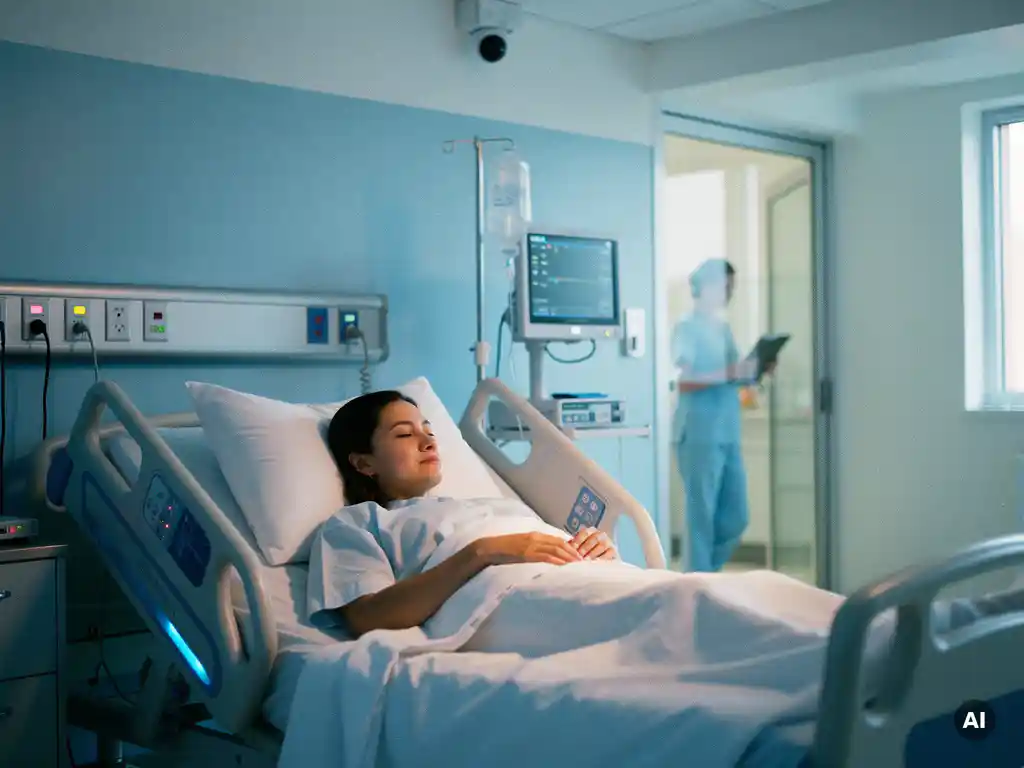
AI patient monitoring improves patient safety in hospitals by continuously and automatically detecting risk situations that care staff may miss, such as falls, unsafe lying positions, or sudden changes in movement. Care staff receive an immediate notification, enabling them to intervene faster and prevent serious consequences. In this article, we answer the most frequently asked questions about how AI monitoring works in practice and what it delivers for hospitals.
What patient safety risks can AI detect in hospitals?
AI patient monitoring detects a wide range of risk situations in real time, without a staff member needing to enter the room. The technology recognizes patterns that indicate danger, such as a fall, an unsafe lying position, or unusual movements that may signal an emergency. Because the system is continuously active, it also flags situations that would otherwise go unnoticed outside office hours or during busy night shifts.
Specific risks that AI monitoring can detect in hospitals include:
- Falls: the system recognizes a fall immediately and alerts care staff within seconds
- Fall risk: certain movement patterns or attempts to get out of bed are flagged early, enabling preventive intervention
- Unsafe lying positions: lying motionless in an incorrect position for extended periods increases the risk of pressure sores; AI detects this and sends an alert
- Emergencies out of sight: patients who need help but cannot signal it themselves are still detected
Especially in hospitals, where patients are often temporarily weakened or disoriented, early detection of these risks is of great importance for treatment outcomes.
How does AI patient monitoring work technically?
AI patient monitoring works by combining image recognition and machine learning. A camera in the patient room continuously captures movements. The AI software automatically analyzes these images and compares them with patterns derived from large amounts of care data. As soon as the system recognizes an abnormal or dangerous pattern, it immediately sends a notification to the responsible care staff member.
The technology is based on computer vision: the software “sees” what is happening in the room, but processes the images in a fully automated way. There is no human observer watching along. The system operates 24 hours a day, 7 days a week, without the fatigue or distraction issues that play a role in human monitoring.
What makes the technology special is its high accuracy. Modern AI systems are trained to distinguish between a genuine emergency and a harmless movement, which greatly reduces the number of false alarms. Fewer false alarms mean that care staff only take action when it is truly necessary, reducing workload and increasing focus.
What is the difference between AI monitoring and traditional surveillance systems?
The key difference is that traditional surveillance systems are passive and dependent on human intervention, whereas AI monitoring actively analyzes and autonomously triggers alerts. A classic camera system captures footage, but someone must actively watch that footage to detect a problem. AI monitoring does this automatically, continuously, and without delay.
Traditional surveillance systems
Traditional systems such as call buttons, motion sensors, or live camera surveillance require the patient to take action themselves, or a staff member to actively watch. This leads to delays, missed situations, and a high burden on staff. In addition, older sensor technologies generate relatively high numbers of false alarms, leading to alarm fatigue among care staff.
AI-based monitoring
AI monitoring works proactively: the system detects a problem before the patient can ask for help themselves or before a staff member notices it. The software analyzes movement patterns and recognizes dangerous situations based on learned patterns. This results in faster response times, fewer missed incidents, and a significantly lower rate of false alarms than is the case with traditional technologies.
How does AI patient monitoring protect patient privacy?
AI patient monitoring protects patient privacy because images are processed in a fully automated way and are never viewed by humans. The AI software analyzes the images locally and in real time; only the outcome of that analysis — namely a notification or a status — is passed on to care staff. There is no live stream being watched by staff members.
This is a fundamentally different approach from traditional camera surveillance, where staff members or security personnel actively watch the footage. With AI monitoring, a care staff member only enters the room when the software requests it, for example when a fall has been detected. This respects the patient’s personal space and reduces unnecessary privacy intrusions.
For hospitals that must comply with strict privacy legislation such as GDPR, this is an important advantage. Systems that comply with international security standards such as ISO 27001 and NEN 7510 additionally provide a demonstrable basis for compliant use of AI monitoring in healthcare.
When is AI monitoring most valuable for a hospital?
AI monitoring delivers the greatest added value in situations where the combination of high risk and limited staffing capacity is greatest. This applies in particular to night care, wards with vulnerable patients, and environments where staff shortages put monitoring under pressure.
Specific situations in which AI patient monitoring is particularly valuable:
- Night shifts: fewer staff available, while the risk of falls and unsafe situations remains unchanged
- Wards with fall risk: geriatric wards, rehabilitation, and neurology, where patients more frequently have mobility issues
- Psychiatric wards: where patients sometimes exhibit unpredictable behavior and additional monitoring is desired
- Periods of staff shortages: AI monitoring serves as a reliable supplement when staffing levels are tight
- Isolation rooms or single-occupancy rooms: where patients are less likely to be noticed by passing staff
In all these situations, AI monitoring is not a replacement for care staff, but a tool that enables staff to act in a more targeted and effective manner.
How does a hospital implement AI patient monitoring in practice?
A hospital implements AI patient monitoring most effectively through a phased approach: start with a pilot ward, evaluate the results, and then scale up. Modern AI monitoring systems are designed as plug-and-play solutions, meaning the technical installation is minimal and the software can be operational quickly without major modifications to the existing infrastructure.
The key steps for a successful implementation are:
- Needs analysis: determine which wards carry the greatest risks and where AI monitoring adds the most value
- Technical preparation: ensure the correct camera positioning and a stable network connection
- Configuration: set up the software to match the specific situation of the ward, including alarm thresholds and notification routes
- Staff training: ensure that staff understand how the system works, what notifications mean, and how to respond to them
- Evaluation and adjustment: monitor the results after the pilot phase and optimize settings where necessary
A good supplier supports the hospital at every step of this process and ensures smooth integration with existing care processes.
How we help hospitals with AI patient monitoring
We develop AI software that enables hospitals to monitor patients continuously and reliably, without placing additional pressure on care staff. Our solution Kepler NurseAssist has been specifically developed for hospital environments and offers:
- Automatic fall detection with a notification to care staff within seconds
- Fall prevention through early detection of risk behavior
- Lying position recognition to prevent pressure sores
- Privacy by design: images are never viewed by humans
- Exceptionally low error rate: only one false alarm per 92 days, making the system 1,000 times more accurate than outdated technologies
- Compliance with ISO 27001 and NEN 7510 for demonstrable data protection
- Plug-and-play installation for fast and straightforward deployment
Would you like to know how we can support your hospital in improving patient safety? Discover our AI monitoring solutions and contact us for a no-obligation conversation.
Frequently Asked Questions
What are the most common mistakes when implementing AI patient monitoring in hospitals?
A common mistake is skipping a thorough needs analysis, causing the system to be deployed on wards where the added value is limited. Insufficient training of care staff is also a stumbling block: if staff do not understand what a notification means or how to respond to it, the effectiveness of the system is significantly reduced. Always ensure a structured onboarding process and involve staff early in the implementation process.
How do care staff typically respond to the introduction of AI monitoring in the workplace?
In practice, there is sometimes initial resistance, mainly due to concerns about patient privacy violations or the fear that the technology will take over their role. Once staff experience that the system relieves rather than replaces them, and that patient privacy is safeguarded through privacy by design, the attitude generally shifts to appreciation. Transparent communication and a clear explanation of how the system works are essential to build support.
Is AI patient monitoring also suitable for smaller hospitals, or only for large institutions?
AI patient monitoring is scalable and therefore suitable for both large and smaller hospitals. Thanks to plug-and-play installations and a modular setup, smaller institutions can start with one or a few wards and expand the system later. Especially for smaller hospitals, where staff shortages weigh relatively heavily, AI monitoring can make a significant contribution to patient safety.
What happens if the AI system experiences a technical failure? Does monitoring go down completely?
Reliable AI monitoring systems are designed with built-in redundancy and error notifications, so that technical staff or the supplier are immediately informed of a failure. In the meantime, existing protocols and care staff are deployed to continue monitoring, just as was the case before implementation. When selecting a supplier, it is advisable to explicitly ask about uptime guarantees, the support model, and procedures in the event of failures.
How long does it take before a hospital sees noticeable results after implementing AI monitoring?
Most hospitals notice a difference within the first weeks of the pilot phase, particularly in response times to incidents and the reduction of false alarms compared to older systems. Measurable impact on indicators such as the number of fall incidents or pressure sores typically becomes visible after one to three months, depending on the ward and the starting situation. A structured evaluation after the pilot phase helps to assess results objectively and further optimize settings.
Can AI patient monitoring be integrated with existing hospital systems such as the EHR or the nurse call system?
Yes, modern AI monitoring systems are generally designed to integrate with existing care infrastructure, including nurse call systems and in some cases also electronic health records (EHR). The degree of integration varies by supplier and hospital environment, so it is important to map this out in advance during technical preparation. A good supplier actively thinks along about integration possibilities and ensures that notifications reach the channels that care staff already use daily.
What questions should a hospital ask when selecting an AI monitoring supplier?
At a minimum, ask about the accuracy of the system expressed in the number of false alarms, compliance with relevant standards such as ISO 27001 and NEN 7510, and the availability of support during and after implementation. Also ask for references from other hospitals already using the system and about the possibilities for a pilot before entering into a long-term commitment. A transparent supplier will give you concrete answers to all these questions and help you make a well-informed decision.
Related Articles
- What Requirements Should You Set for an AI Patient Monitoring System?
- What is the difference between a staff shortage and a labor shortage?
- What does staff shortage do to the quality of service?
- What role does environmental modification play in fall prevention for older adults?
This content was generated with the help of AI and it may contain mistakes