
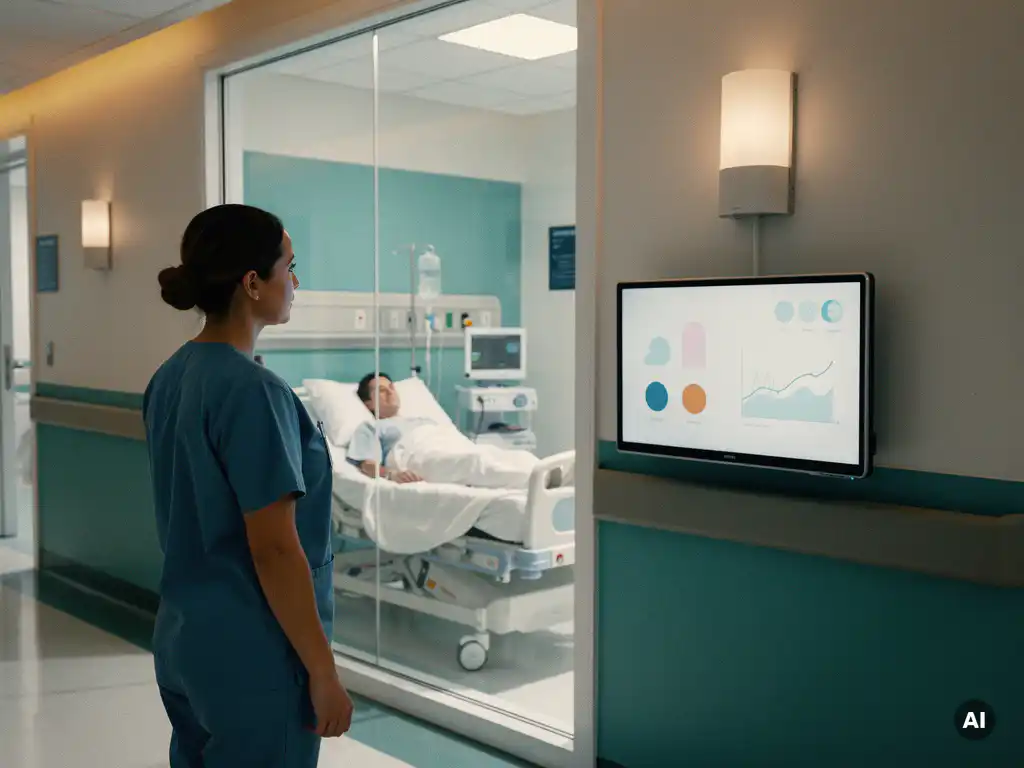
AI patient monitoring supports nurses by taking over continuous patient observation, allowing care staff to focus on direct care delivery instead of passive supervision. The software automatically detects unsafe situations such as fall incidents and immediately alerts the appropriate personnel. In this article, we answer the most frequently asked questions about AI monitoring in healthcare.
What tasks does AI patient monitoring take over from nurses?
AI patient monitoring takes over the task of continuous, passive observation entirely from nurses. Instead of making periodic rounds or manually supervising patients, the software continuously analyzes what is happening in a room and automatically intervenes when necessary. This gives nurses their time and attention back for tasks that require human presence.
Specifically, AI monitoring replaces or supports the following tasks:
- Supervising patients during the night and outside peak hours
- Detecting fall incidents and other acute emergencies
- Recognizing unsafe lying positions that can cause pressure sores or other complications
- Identifying changes in a patient’s behavior or condition
- Alerting the right care staff at the right moment
The result is that nurses only need to go to a room when the situation actually calls for it, rather than making preventive rounds without a direct reason. This is particularly valuable in facilities where staffing is under pressure.
How does AI fall detection work in practice?
AI fall detection uses image recognition software that continuously analyzes a patient’s movements via a camera. As soon as the software detects a fall, the system sends a notification to the on-duty nurse within seconds. No human intervention is required to trigger the alarm.
The process takes place in a number of steps. The camera registers movement in the room. The AI analyzes the footage in real time and compares patterns against a large number of labeled situations on which the system has been trained. When the system recognizes a fall or a dangerous situation, it immediately generates an alarm. The nurse receives a notification and can act immediately.
What distinguishes this system from simple motion sensors is its accuracy. Motion sensors generate many false alarms because they cannot distinguish between a patient walking to the bathroom and a patient falling. AI fall detection understands the context of a movement and filters out irrelevant activity. This significantly reduces alarm fatigue among nurses, which is a well-known problem in healthcare.
What is the difference between AI monitoring and traditional camera surveillance?
The biggest difference between AI patient monitoring and traditional camera surveillance is that AI systems analyze and act autonomously, whereas traditional surveillance requires a person to actively watch the footage. Traditional camera surveillance is passive and reactive. AI monitoring is active and proactive.
With traditional surveillance, a staff member must watch the footage to notice an incident. This is labor-intensive, error-prone, and practically unfeasible with large numbers of patients or at night. Moreover, older detection technology, such as motion sensors or pressure mats, generates a high number of false alarms, causing staff to distrust the system.
AI monitoring solves both problems. The system watches on its own, analyzes on its own, and only alerts when there is a genuine reason. It does not require a staff member to stare at screens permanently, which is both more efficient and less burdensome for personnel.
How does AI patient monitoring protect patient privacy?
AI patient monitoring protects patient privacy because footage is processed exclusively by the software and never viewed by humans. A nurse enters a patient’s room only when the system requests it, not to check whether everything is in order.
This is a fundamentally different approach from traditional camera surveillance, where footage is available to staff members or is stored. With AI monitoring, patients remain continuously protected, even during vulnerable moments such as at night or during personal care. The software analyzes patterns and movements without any personal or identifiable image being stored or shared.
For healthcare organizations, this is also relevant from a compliance perspective. Systems that comply with international standards such as ISO 27001 and NEN 7510 provide a solid legal and technical foundation for the responsible use of monitoring software in healthcare.
Which healthcare organizations benefit most from AI monitoring?
Healthcare organizations that benefit most from AI patient monitoring are elderly care facilities, hospitals, and psychiatric clinics that face staff shortages and a high risk of fall incidents. The greater the pressure on staff and the more vulnerable the patient population, the greater the added value of automated monitoring.
Elderly care facilities
Elderly care centers face a dual challenge: attracting and retaining staff is becoming increasingly difficult, while the demand for care grows every year. Residents of nursing homes also have an elevated fall risk, making direct supervision particularly valuable. AI monitoring offers a structural solution here by automating supervision without replacing human care.
Hospitals and psychiatric clinics
In hospitals, patients are often temporarily weakened, disoriented, or recovering from a procedure, which increases the risk of falls. Psychiatric clinics additionally deal with patients who may exhibit unexpected behavior. In both environments, continuous AI monitoring provides extra safety without requiring a staff member to be physically present at all times.
How do you implement AI patient monitoring in a healthcare facility?
You implement AI patient monitoring in a healthcare facility by choosing a system with a plug-and-play setup that is easy to plan, configure, and install without major changes to the existing infrastructure. A good implementation follows recognizable steps.
- Needs analysis: Map out which departments or rooms have priority and which specific risks apply to your patient population.
- Technical preparation: Check whether the existing network infrastructure is suitable for the camera systems and the associated software.
- Installation and configuration: Install the cameras and configure the software to match the specific layout of the rooms and the desired alarm thresholds.
- Staff training: Ensure that nurses and managers understand how the system communicates alarms and how they should respond to them.
- Evaluation and adjustment: After go-live, monitor how the system performs and adjust settings based on practical experience.
A successful implementation also requires attention to team buy-in. Staff members who understand how AI monitoring works and what it means for them adopt the system more quickly and use it more effectively.
How Kepler Vision Technologies helps with AI patient monitoring
We develop AI solutions that help healthcare organizations reduce pressure on their staff without compromising the quality of care. Our software continuously monitors patients, detects fall incidents immediately, and alerts nurses within seconds. These are the key benefits we offer:
- Fall detection, fall prevention, and lying position recognition in one integrated solution
- Only one false alarm every 92 days, which greatly reduces alarm fatigue among staff
- Full privacy protection: footage is never viewed by humans
- Compliance with ISO 27001 and NEN 7510 for secure processing of patient data
- Easy installation via a plug-and-play concept, suitable for international healthcare organizations
- A robust patent portfolio of 21 patents as a guarantee of technological reliability
Want to discover how our AI patient monitoring fits within your healthcare facility? View our solutions and contact us for a no-obligation conversation.
Frequently Asked Questions
How long does it take for AI patient monitoring to be fully operational after installation?
Most systems with a plug-and-play setup are operational within one to a few days, depending on the number of rooms and the complexity of the infrastructure. After the physical installation of the cameras, a short configuration phase follows in which alarm thresholds and room layouts are set. Additionally, allow for an onboarding period of one to two weeks during which staff become familiar with the system and any settings are adjusted based on initial practical experience.
What happens if the internet connection or network goes down?
A reliable AI monitoring system is designed with local processing capacity, so that core functions such as fall detection and alerting continue to work even during a temporary network outage. It is important to ask about failover procedures and offline functionality when selecting a system. Also check whether the system sends a notification in the event of connectivity issues, so that the care team always knows the status of the monitoring.
Can patients or family members object to the use of AI camera surveillance?
Yes, patients and their representatives have the right to be informed about the use of monitoring systems and may, in certain cases, object. Healthcare organizations are required to communicate transparently about how the system works, what data is processed, and how privacy is safeguarded. In practice, it helps to clearly explain that footage is never viewed by humans and that the system is primarily intended to enhance the safety and independence of the patient, which often resolves objections.
Does AI fall detection work reliably in poorly lit rooms, such as at night?
Modern AI monitoring cameras are equipped with night vision functionality or infrared technology, allowing the system to accurately analyze movements even in completely dark rooms. Precisely at night, when fewer staff members are present and the risk of fall incidents is high, continuous AI monitoring delivers the greatest added value. During implementation, it is advisable to test whether the camera placement and lighting conditions in each room are optimally configured.
What are the most common mistakes when implementing AI patient monitoring?
A common mistake is skipping the buy-in phase: when staff members are not properly involved in the why and how of the system, this leads to resistance or underuse. Other pitfalls include not adjusting alarm thresholds to the specific patient population, which results in too many or too few notifications, and underestimating network preparation. A phased rollout, starting with one or two departments before scaling up, helps to identify teething problems early and configure the system optimally.
Can AI monitoring be integrated with existing healthcare software such as an electronic patient record (EPR)?
Many modern AI monitoring solutions offer integration options with existing healthcare systems via standard API connections, but the available options differ per provider. An integration with the EPR or an alarm management system can further streamline the workflow, as notifications arrive directly in the right place without staff having to switch between systems. Ask the provider specifically which integrations are supported and what the technical requirements are for your current software environment.
How do you measure the success of AI patient monitoring after implementation?
The effectiveness of AI patient monitoring is measured using concrete indicators such as the number of detected fall incidents, the response time of nurses after an alarm, the number of false alarms, and staff satisfaction. Compare these figures with the situation before implementation to make the actual impact visible. In addition, it is valuable to periodically collect feedback from nurses on how the system affects their workload and work experience, so that settings can be optimized in a targeted way.
Related Articles
- What Are the Key Considerations When Tendering for AI Fall Detection?
- What Is the Difference Between AI Patient Monitoring and Traditional Patient Monitoring?
- How do you attract more people to the care sector?
- Wat zijn de kansen van kunstmatige intelligentie voor zorginstellingen?
This content was generated with the help of AI and it may contain mistakes