


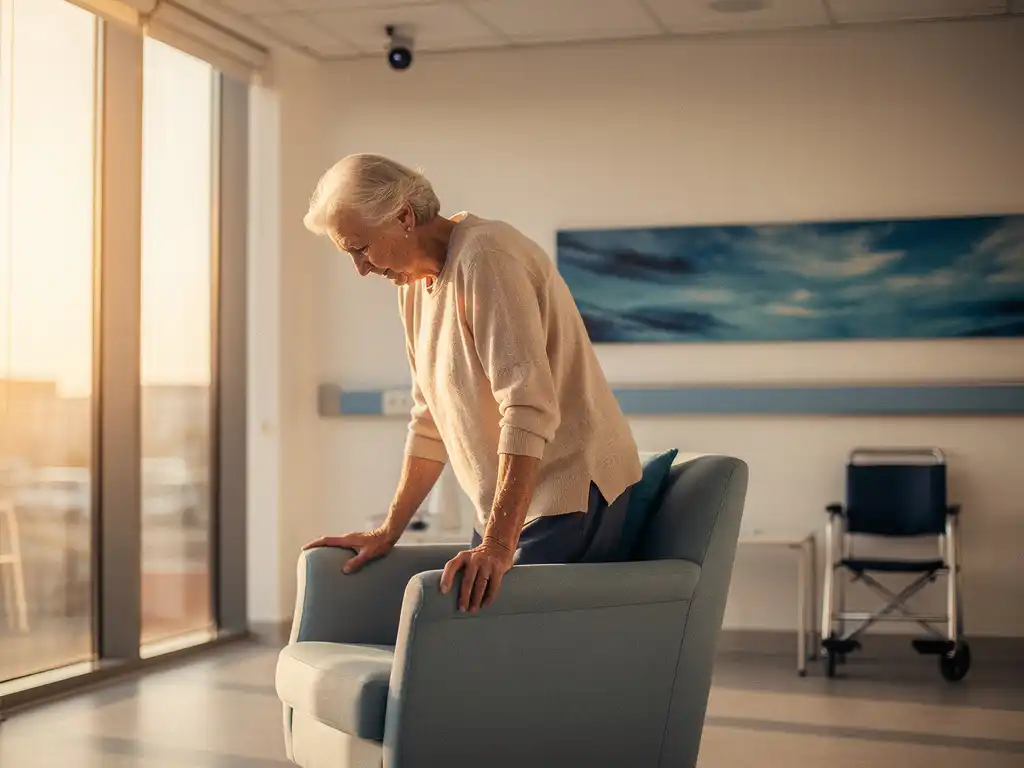
Elderly care faces an enormous challenge: staff shortages are growing while demand for care increases by 6% annually. At the same time, thousands of elderly people fall in care facilities each year, leading to serious injuries and high healthcare costs. Fall prevention for the elderly using advanced technology may offer a solution to both problems.
Modern AI systems can watch over residents 24/7 without requiring additional staff. This article answers the key questions about how fall prevention technology can help solve staffing shortages in elderly care.
What is fall prevention technology and how does it work in elderly care?
Fall prevention technology is an AI-driven system that provides continuous monitoring to prevent and immediately detect fall incidents among the elderly. These systems use advanced computer vision and machine learning algorithms to analyze movement patterns and recognize risk situations.
The technology works with intelligent cameras that are strategically placed in care facilities. These cameras collect image data that is analyzed by AI software to detect various scenarios. The system can distinguish between normal daily activities and potentially dangerous situations, such as unsteady movements, stumbling, or actual falls.
In practice, this means that care staff are only alerted when there is actually an emergency situation. The software also analyzes lying positions and can detect when someone lies in an uncomfortable position for too long, which helps prevent pressure sores and other complications.
Can AI systems actually replace care staff in fall monitoring?
AI systems cannot completely replace care staff, but they can significantly reduce monitoring tasks and increase efficiency. This technology functions as an intelligent assistant that supports existing staff in monitoring multiple residents simultaneously.
The major advantage is that AI systems operate 24/7, without fatigue or distraction. Where a care worker must be physically present to observe a situation, AI technology can monitor multiple rooms simultaneously. This means that one care worker can effectively supervise more residents without compromising the quality of care.
The role of care staff thus shifts from continuous observation to targeted intervention. Care workers only receive notifications when their direct attention is needed, allowing them to spend their time on personal care, medication administration, and other essential tasks that require human expertise.
What are the costs of fall prevention systems for care organizations?
The costs of fall prevention systems vary depending on the size of the facility and the number of rooms to be monitored, but the investment is often quickly recouped through lower care costs and more efficient staff deployment. The initial implementation costs include hardware, software, and installation.
Care organizations must consider various cost factors. The hardware consists of intelligent cameras and processing units, while the software involves license costs and maintenance. Additionally, there are one-time costs for installation and staff training.
The financial benefits manifest in various ways. Fall incidents often lead to expensive hospital admissions and long-term treatments. By preventing falls or detecting them faster, these costs can be significantly reduced. Moreover, care organizations can care for more residents with the same number of staff, which increases operational efficiency.
How accurate are modern fall detection systems in practice?
Modern fall detection systems achieve remarkable accuracy, with only one false alarm per 92 days, which is 1,000 times better than traditional technologies like motion sensors or pressure mats. This high precision is crucial for care staff confidence.
The accuracy is achieved through advanced machine learning algorithms that have been trained on thousands of hours of footage. These systems learn to distinguish between real fall incidents and normal movements, such as bending, sitting, or lying down. The AI can even detect subtle changes in movement patterns that may indicate an increased fall risk.
In practice, this high accuracy means that care workers can have confidence in the alarms they receive. False alarms lead to alarm fatigue and can cause staff to start ignoring notifications. By drastically reducing the number of false alarms, the system remains effective and reliable.
What privacy challenges does fall monitoring technology bring?
Privacy is an important concern with fall monitoring technology, but modern systems are designed so that images are never viewed by humans, protecting residents’ privacy while maintaining effective monitoring. The AI analyzes images automatically, without human intervention.
Advanced fall prevention systems comply with strict privacy standards such as ISO 27001 and NEN 7510. These certifications guarantee that patient data is securely stored and processed. Image processing occurs locally on secure servers, without sensitive information being sent to external cloud services.
A crucial aspect is that care workers only enter the room when the software requests it. This means that residents experience more privacy than with traditional care methods, which require regular physical checks. The system respects residents’ dignity by only alerting during actual emergency situations.
How Kepler Vision Technologies helps with fall prevention for the elderly
We offer a complete solution for fall prevention in elderly care with our Kepler Night Nurse software. Our system combines the highest accuracy with optimal privacy protection and helps care organizations effectively deal with staff shortages.
Our solution offers concrete benefits:
- 24/7 monitoring with only one false alarm per 92 days
- Immediate detection of fall incidents within seconds
- Complete privacy through AI analysis without human involvement
- Complies with ISO 27001 and NEN 7510 standards
- Plug-and-play installation without complex configuration
With 25 experts in machine learning and computer vision, we have developed a robust international patent portfolio with 21 patents. Our system is already successfully used by international care organizations that want to solve their staff shortages without compromising care quality.
Would you like to discover how fall prevention technology can help your care organization? Contact us for a personal conversation about the possibilities for your situation.
Frequently Asked Questions
How long does it take to implement a fall prevention system in our care facility?
The implementation of a fall prevention system usually takes 2-4 weeks, depending on the size of your facility. This includes the installation of cameras, software configuration, and training of your staff. Thanks to plug-and-play technology, no complex technical configuration is needed.
What happens if the system gives a false alarm or misses a real fall?
Modern fall detection systems have an accuracy of only 1 false alarm per 92 days. Should a false alarm occur, staff can easily confirm this and the incident is logged for further optimization. The system continuously learns to further improve accuracy.
Can residents or their families object to camera monitoring?
Yes, residents always have the right to refuse. It is important to communicate transparently about how the system works and that images are never viewed by humans. Many families are actually reassured by the 24/7 monitoring, especially during nighttime hours when less staff is present.
How do fall prevention systems integrate with existing care records and alarm systems?
Fall prevention systems can be integrated with existing care software via standard APIs. Incidents are automatically logged in the electronic patient record, and alarms can be forwarded to existing call systems or mobile devices of care workers.
What are the most common implementation challenges and how do you solve them?
The biggest challenges are usually staff acceptance and technical integration. Careful training and involving staff in the implementation process significantly increases acceptance. Technical challenges are minimized through a professional implementation team and extensive testing phases.
How do you measure the return on investment (ROI) of fall prevention technology?
ROI is measured by comparing the number of prevented fall incidents with the average costs per fall ($18,000-$30,000 including hospital admission). Additionally, you can measure increased staff efficiency by the number of residents that can be monitored per care worker. Many organizations see a positive ROI within 12-18 months.
Related Articles
- How is the government addressing the staff shortage?
- What is the role of technology in addressing staff shortages in healthcare?
- What is the difference between a staff shortage and a labor shortage?
- What are the latest developments in fall prevention for the elderly?
- Why is the need for smart healthcare solutions growing?
This content was generated with the help of AI and it may contain mistakes