


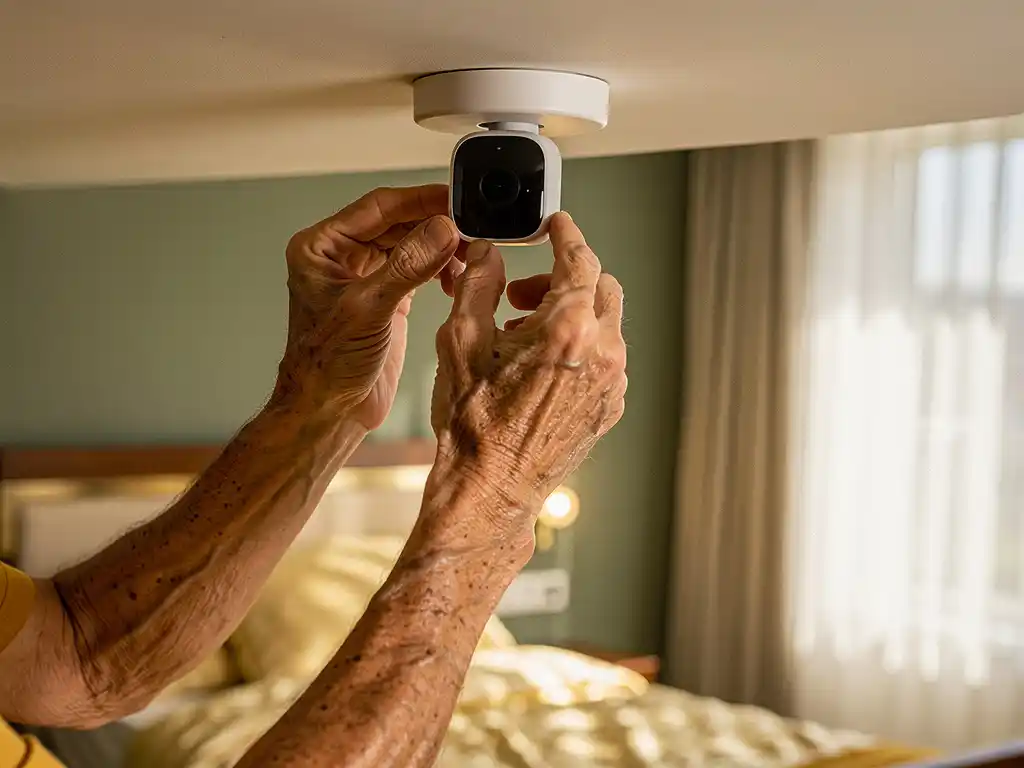
Fall prevention for elderly individuals is becoming increasingly important as the aging population grows, but at the same time, these technical solutions raise questions about privacy and data protection. Healthcare organizations face the challenge of implementing effective monitoring systems that both ensure the safety of residents and respect their fundamental right to privacy.
The balance between quality of care and privacy protection requires a thoughtful approach, where technical innovation goes hand in hand with strict compliance with privacy legislation. This article answers the most frequently asked questions about preventing privacy violations in fall prevention within healthcare institutions.
What are the biggest privacy risks in fall prevention for elderly individuals?
The biggest privacy risks in fall prevention for elderly individuals include unauthorized access to visual material, insufficient data security, unclear consent procedures, and a lack of transparency about data processing. These risks can lead to serious violations of residents’ personal privacy.
Camera-based systems often pose the greatest privacy risk because they continuously record images of intimate moments. When these images are stored with insufficient security or can be viewed by unauthorized persons, a direct privacy violation occurs. Additionally, systems that send images to external servers may be vulnerable to data breaches during transmission.
Another significant risk is the lack of clarity about who has access to collected data and for what purposes it is used. Without clear procedures for data minimization, healthcare institutions may collect more information than necessary for fall prevention, which conflicts with privacy by design principles.
Which privacy laws apply to fall prevention in healthcare institutions?
For fall prevention in healthcare institutions, the General Data Protection Regulation (GDPR), the Medical Treatment Contracts Act (WGBO), and the NEN 7510 standard for information security in healthcare primarily apply. This legislation sets strict requirements for collecting, processing, and storing personal data of residents.
GDPR requires healthcare institutions to have a lawful basis for data processing, such as consent from the resident or a legitimate interest of the healthcare institution. In fall prevention, legitimate interest is often used, where the resident’s safety outweighs the privacy intrusion, provided adequate safeguards are in place.
The WGBO gives patients the right to information about their treatment and the technology used. This means residents must be fully informed about the fall prevention system, how it works, and what data it collects. The NEN 7510 standard additionally specifies technical and organizational measures that healthcare institutions must implement to ensure the security of health data.
How does privacy-friendly AI monitoring work in fall detection?
Privacy-friendly AI monitoring in fall detection works with advanced algorithms that analyze movement patterns without requiring human observation of visual material. The system processes images locally and only sends alarm notifications to healthcare staff when a fall is detected, while the original images are not stored or shared.
This technology uses computer vision algorithms trained to recognize specific movement patterns that indicate a fall. Instead of continuously storing video recordings, the system analyzes images in real time and extracts only relevant movement data. This means there are no stored video images that can later be viewed by humans.
A crucial aspect of privacy-friendly AI is edge computing, where all processing takes place locally on the device itself. This means sensitive image data never needs to leave the device, eliminating the risk of data breaches during transmission. The system can also be configured to exclude certain zones from monitoring, such as bathrooms, to further protect privacy.
Which technical measures effectively prevent privacy violations?
Effective technical measures against privacy violations in fall prevention include end-to-end encryption, local data processing, automatic data deletion, access control with multi-factor authentication, and a privacy-by-design architecture. These measures ensure that personal data is optimally protected from the moment of collection through deletion.
End-to-end encryption ensures that all data exchanged between devices is fully encrypted and can only be read by authorized recipients. Local data processing means that sensitive image data never leaves the device and only analyzed metadata is forwarded to healthcare staff.
Automatic data deletion implements strict retention periods, where data is automatically erased after a predetermined period. Multi-factor authentication prevents unauthorized access to the system, while privacy by design ensures that privacy protection is built into the system from the design stage rather than added later.
How do you inform residents and families about privacy protection?
Informing residents and families about privacy protection requires clear, understandable communication through multiple channels: written information brochures, personal conversations, technology demonstrations, and regular system updates. The information must be provided in simple language and cover all aspects of data collection and data protection.
An effective information campaign begins with a comprehensive privacy statement explaining what data is collected, why it is necessary, how long data is retained, and who has access to it. This information must be available in various formats, including large print for the visually impaired and translations for non-native speakers.
Practical demonstrations where residents and families can see how the system works help build trust. For example, show how the system only alerts during actual fall incidents and does not respond to normal daily activities. Regular information sessions and a contact person for privacy questions ensure continuous transparency and trust in the system.
How Kepler Vision Technologies helps with fall prevention for elderly individuals
At Kepler Vision Technologies, we offer a unique solution for privacy-friendly fall prevention with our advanced AI technology, which fully complies with the highest privacy standards. Our systems process all images locally and ensure that no human observation of visual material takes place.
Our advantages for healthcare institutions include:
- Full compliance with ISO 27001 and NEN 7510 standards
- Local image processing without external data transfer
- Only one false alarm per 92 days, for minimal disruption
- 24/7 monitoring without infringing on residents’ privacy
- A robust international patent portfolio with 21 patents
With more than 25 employees specialized in machine learning and computer vision, we guarantee the highest quality and reliability. Our plug-and-play solution makes implementation simple and ensures immediate results in your healthcare facility. Contact us to discover how our privacy-friendly fall prevention can improve your quality of care without compromising your residents’ privacy.
Frequently Asked Questions
How do I start implementing a privacy-friendly fall prevention system in my healthcare facility?
Start with a thorough risk analysis and assemble an implementation team consisting of IT specialists, privacy officers, and healthcare staff. Choose a vendor that complies with ISO 27001 and NEN 7510 standards, and plan a pilot phase in a limited number of rooms. Ensure that all residents and families are informed in advance and give their consent.
What should I do if a resident or family objects to the fall prevention system?
Always respect the choice of residents and offer alternative solutions, such as wearable fall detectors or adjusted monitoring rounds. Document the objection carefully and consult with your legal department about adjustments to the care plan. Keep communicating openly about why the system is important for safety, but never force participation.
What common mistakes should I avoid when implementing AI fall detection?
Avoid installing systems in private spaces like bathrooms, storing visual material longer than necessary, and not training staff in proper use. Also ensure you don’t forget to inform residents about software updates and never change privacy settings without prior communication.
How often should I evaluate my privacy policy and procedures for fall prevention?
Evaluate your privacy policy at least annually or with any significant change in technology or legislation. Plan quarterly audits of access rights and data processing, and conduct monthly checks on the functioning of automatic data deletion. In case of incidents or complaints, you must immediately conduct an additional evaluation.
Can I use fall prevention data for research or quality improvement?
Yes, but only with explicit consent from residents and after anonymizing all personal data. Ensure that research data is completely disconnected from individual residents and establish a separate ethical protocol. Always inform residents about the purpose of the research and give them the option to exclude their data.
What are the costs of complying with privacy legislation in fall prevention?
Costs include initial investments in privacy-compliant technology (10-30% higher than standard systems), staff training, annual audits, and possibly a part-time privacy officer. However, these investments prevent costly fines and reputation damage from data breaches. Plan 15-25% of your IT budget for privacy and security measures.
Related Articles
- How to Use Staff Scheduling to Reduce Workload
- How do you keep healthcare workers in the workforce longer?
- What role does computer vision play in tomorrow's healthcare?
This content was generated with the help of AI and it may contain mistakes