


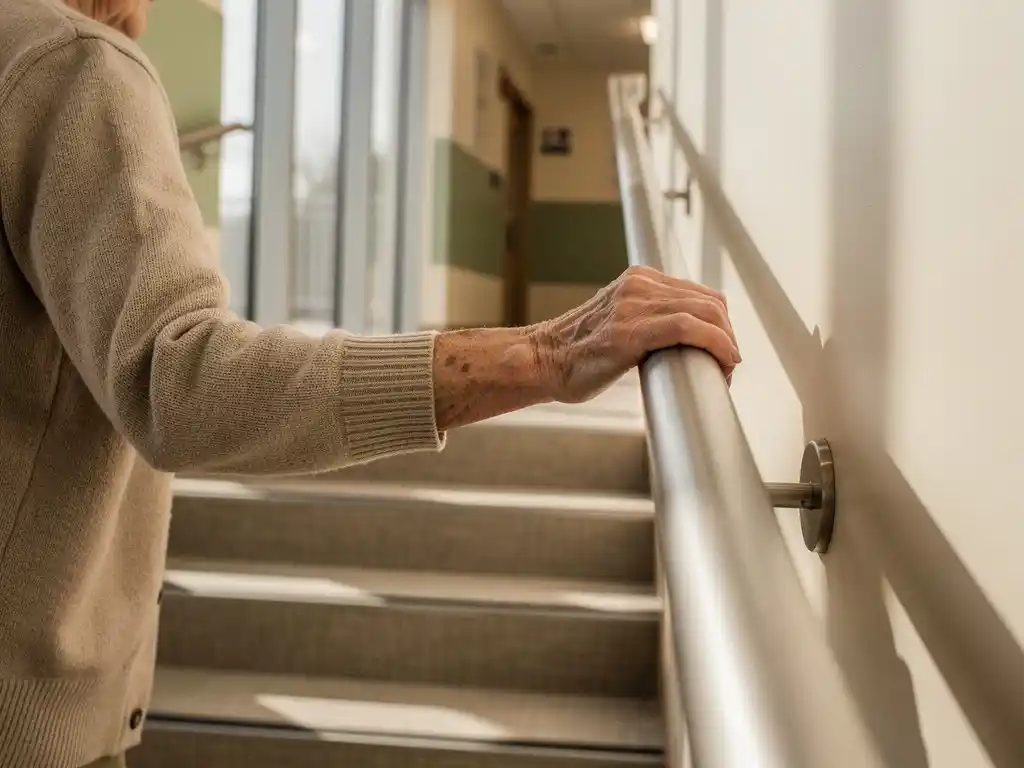
Falls are one of the biggest health risks for elderly people, with thousands of fall incidents annually in Dutch care facilities. Modern fall prevention for the elderly combines traditional care methods with advanced technology to drastically reduce these risks. Innovative AI solutions make it possible to maintain 24/7 supervision of residents without violating their privacy.
This technological advancement has become crucial as care facilities struggle with staff shortages while demand for care increases by 6% annually. By implementing smart systems, care organizations can utilize their limited staff capacity more efficiently while ensuring resident safety.
What is fall prevention for the elderly and why is it so important?
Fall prevention for the elderly is a structured approach where risk factors are identified and measures are taken to prevent fall incidents before they occur. It encompasses both physical adjustments in the living environment and technological monitoring to detect dangerous situations in a timely manner.
The importance of fall prevention cannot be underestimated. Falls in elderly people often lead to serious injuries, such as hip fractures, which require long-term rehabilitation and can permanently affect independence. In care facilities, fall incidents also represent a significant cost factor due to additional care provision, medication, and possible legal consequences.
Effective fall prevention consists of multiple components: risk analysis of individual residents, adaptation of the physical environment, medication assessment, and continuous monitoring. This holistic approach not only reduces the number of fall incidents but also improves the overall quality of life for residents.
How does AI technology work for fall detection in care facilities?
AI technology for fall detection uses advanced computer vision algorithms that analyze camera footage in real time to automatically recognize fall incidents. The system learns patterns of normal movements and detects deviations that indicate a fall or dangerous situation.
The technology works through continuous image analysis without requiring human observation. When the system detects a fall, an alarm is sent to care staff within seconds. This rapid response time is crucial because prolonged lying after a fall can cause serious complications.
Modern AI systems can distinguish between different types of movements and situations. They not only recognize actual falls but can also identify risky situations, such as swaying or lying in bed for extended periods in unnatural positions. This proactive approach enables true fall prevention instead of exclusively reactive care.
What is the difference between fall prevention and fall detection systems?
Fall prevention systems focus on preventing falls by identifying risky situations before a fall occurs, while fall detection systems only react after a fall has taken place to provide quick assistance.
Fall prevention technology analyzes behavioral patterns and movements to recognize potentially dangerous situations. The system can, for example, detect when someone is walking unsteadily, sitting too long on the edge of the bed, or is in a risky position. By providing timely warnings, care staff can intervene before an actual fall occurs.
Fall detection, on the other hand, is reactive and activates as soon as a fall is detected. The primary goal is to minimize the time between falling and providing help. While this is crucial for the outcome after a fall, it does not prevent the fall itself.
The most effective systems combine both approaches. They provide proactive warnings for risky situations and detect actual falls when prevention was not successful. This integrated approach maximizes both safety and care quality.
How accurate are modern fall detection systems in practice?
Modern AI-driven fall detection systems achieve remarkable accuracy, with an average of only one false alarm per 92 days. That is 1,000 times better than traditional technologies, such as motion sensors or pressure mats.
This high accuracy is achieved through advanced machine learning algorithms that have been trained on thousands of hours of footage. The system continuously learns and can distinguish between real fall incidents and normal activities, such as picking up dropped objects or stretching in bed.
The practical impact of this accuracy is enormous for care facilities. Fewer false alarms means that care staff are not unnecessarily pulled away from other tasks, which increases efficiency and reduces stress. At the same time, the high detection rate ensures that real emergency situations are not missed.
Various factors contribute to this accuracy: the quality of the cameras, the advanced AI algorithms, and continuous calibration of the system. Regular updates and refinements of the software ensure that performance only improves over time.
What privacy aspects play a role in fall prevention technology?
Privacy in fall prevention technology is ensured because images are completely processed by AI and are never viewed by human eyes. Care staff only receive notifications when the system detects a risky situation or a fall.
This privacy-by-design approach means that residents maintain their dignity while still enjoying continuous protection. The system processes footage locally and does not send video recordings, but only structured alerts to care staff.
Compliance with privacy regulations, such as GDPR, is guaranteed through strict security protocols and certifications like ISO 27001 and NEN 7510. These standards ensure that all patient data is safely stored and processed according to the highest security standards.
Transparency toward residents and family is essential. Care facilities must clearly communicate how the system works, what data is collected, and how privacy is protected. This open communication builds trust and ensures acceptance of the technology.
How Kepler Vision Technologies helps with fall prevention for the elderly
We offer with Kepler Night Nurse and Kepler NurseAssist advanced AI solutions that maintain 24/7 supervision of residents without violating their privacy. Our systems combine fall detection, fall prevention, and lying position recognition in one integrated solution.
Our technology offers care facilities:
- Only one false alarm per 92 days – 1,000 times more accurate than traditional systems
- Direct alerts within seconds after detection of an incident
- Complete privacy protection through AI processing without human observation
- Compliance with ISO 27001 and NEN 7510
- Simple plug-and-play installation without complex configuration
With our 21 patents and expertise in machine learning and computer vision, we help international care organizations address staff shortages while improving care quality. Discover how our AI solutions can support your care facility by contacting us for a no-obligation conversation about your specific needs.
Frequently Asked Questions
How long does the implementation of an AI fall prevention system take in our care facility?
The implementation of a Kepler Vision system typically takes 2-4 weeks, depending on the size of your facility. Thanks to our plug-and-play technology, no complex configuration is needed and existing camera infrastructures can often be reused. Staff can work fully with the system within a few days after installation.
What happens if the system gives a false alarm during the night shift?
With only one false alarm per 92 days, incorrect warnings are very rare. When a false alarm does occur, care staff can easily confirm this via the mobile app and mark the incident as ‘no action required’. The system learns from this feedback and continuously improves its accuracy.
Can residents turn off the system if they want privacy?
Yes, residents always have the option to temporarily disable the system via a simple button in their room. This respects their autonomy and privacy wishes. Care staff are informed when monitoring is disabled, so they can take alternative care measures if necessary.
How does the system work for residents who are wheelchair-bound or use a walker?
The AI system is specifically trained to recognize various mobility aids and distinguish between normal movements with wheelchairs, walkers, or walking sticks and actual fall risks. The system automatically adjusts its detection algorithms based on each resident’s individual mobility situation.
What are the costs of such a system and how does this relate to potential savings?
While specific costs depend on the size and configuration of your facility, studies show that AI fall prevention pays for itself within 12-18 months through reduced care costs, less staff deployment, and lower insurance costs. Contact us for a personalized cost-benefit analysis based on your situation.
How does the system handle poor lighting conditions at night?
Our AI technology works excellently in low-light conditions thanks to advanced infrared cameras and algorithms specifically optimized for nighttime monitoring. The system maintains the same accuracy day and night, without requiring additional lighting that could disturb residents.
What happens to the data if our care facility stops using the system?
All data remains the property of your care facility and can be fully exported or safely deleted upon request according to GDPR guidelines. Kepler Vision does not retain resident data longer than necessary and provides full transparency about data processing and deletion upon contract termination.
Related Articles
- What to do if an elderly person falls and hits their head?
- How does AI change the way healthcare is organized?
- What are the most important innovations in healthcare technology today?
- What is the impact of smart monitoring on care processes?
- How does intelligent software change the healthcare infrastructure?
This content was generated with the help of AI and it may contain mistakes