


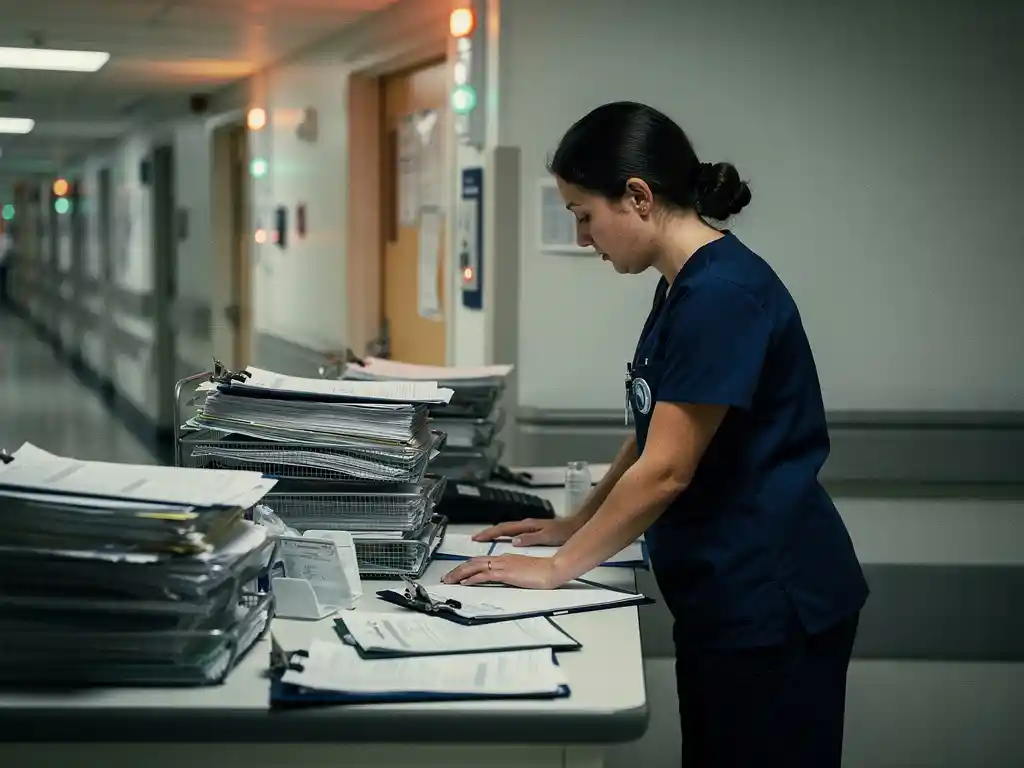
Staff shortages significantly increase the workload of healthcare workers. When fewer colleagues are available, those who are present must handle more tasks in the same amount of time — or less. This leads to physical and mental overload, higher rates of absenteeism, and a downward spiral that makes the shortage even worse. In this article, we answer the most important questions about the causes, consequences, and solutions to staff shortages in healthcare.
What are the direct consequences of staff shortages for healthcare workers?
Staff shortages directly increase the workload per employee. Tasks that would normally be distributed among multiple colleagues fall on fewer shoulders. Healthcare workers put in more overtime, skip breaks, and feel responsible for a greater number of clients at once. This results in fatigue, stress, and a higher risk of errors.
The effects are noticeable both physically and psychologically. Workers report complaints such as back pain, sleep problems, and emotional exhaustion more frequently. At the same time, their sense of control diminishes: there is simply no longer enough time to deliver all care at the desired standard. This leads to feelings of guilt and a decline in job satisfaction.
Another direct consequence is the increased risk of absenteeism. Overworked employees call in sick more often, which causes the shortage to grow further. This creates a vicious cycle that is difficult to break without structural measures.
How does high workload affect the quality of care?
A high workload resulting from staff shortages has a direct negative impact on the quality of care. When staff have too little time per client, signs of deterioration or danger are more easily missed. This increases the likelihood of incidents such as falls, medication errors, or delayed responses to emergencies.
Care quality depends not only on knowledge and skills, but also on attention and presence. When understaffed, there is less room for personal contact, preventive action, and careful observation. Clients notice this: they feel less safe and less heard.
For healthcare organizations, this also means a higher risk of complaints, incident reports, and reputational damage. The combination of exhausted staff and too few hands at the bedside poses a serious threat to the safety of vulnerable people.
Why is the staff shortage in elderly care growing?
The staff shortage in elderly care is growing due to a combination of an aging population, labor market pressure, and high employee turnover. Demand for care is growing by approximately six percent per year, while the supply of qualified staff is failing to keep pace. This structural imbalance makes it increasingly difficult for elderly care facilities to attract and retain enough people.
An aging population is driving up demand for care
The population is aging rapidly. The number of elderly people requiring intensive care increases every year. At the same time, the pool of people available to care for them is relatively smaller. This demographic gap is one of the most significant structural causes of the shortage.
High turnover driven by workload compounds the problem
Ironically, the high workload only worsens the staff shortage itself. Employees who feel overworked are more likely to move to a different sector or reduce their working hours. Young healthcare professionals are put off by the working conditions. As a result, not only is attracting new staff difficult, but retaining experienced workers is also a major bottleneck.
What solutions help reduce workload caused by staff shortages?
There are several strategies healthcare organizations can use to reduce workload caused by staff shortages. The most effective approach combines smart use of technology, better task distribution, and a focus on employee well-being.
- Deploy smart technology: Automating monitoring tasks reduces the mental burden on staff and gives them more time for direct care delivery.
- Reprioritize tasks: By analyzing and redistributing tasks, employees can focus on what truly requires human attention.
- Flexible scheduling: Greater autonomy over working hours increases job satisfaction and reduces turnover.
- Invest in preventive well-being policies: Early intervention when signs of overload appear prevents long-term absenteeism.
- Partner with technology providers: Healthcare facilities that invest in supportive technology reduce the pressure on individual employees without compromising care quality.
No single measure will fully resolve the shortage, but a combination of the approaches above makes it manageable. Healthcare organizations that invest early in structural solutions are better equipped to handle growing demand for care.
How can AI monitoring relieve the burden on healthcare workers?
AI monitoring relieves healthcare workers by taking over continuous surveillance that would otherwise require a human presence. Smart software can monitor clients, detect dangerous situations, and only send an alert when action is genuinely needed. This means staff no longer need to be physically present with every client at all times, and can instead direct their attention where it matters most.
Traditional monitoring requires staff to regularly visit rooms or watch screens, even when nothing is wrong. This consumes time and energy that could be better spent on direct care. AI takes over this repetitive supervision, so staff only need to intervene when it is truly necessary.
Moreover, reliable AI monitoring contributes to a sense of security for both staff and clients. Employees know that an extra layer of oversight is in place, even outside peak hours. This reduces the mental pressure and the constant sense of responsibility that comes with being understaffed.
How Kepler Vision Technologies helps address staff shortages in healthcare
At Kepler Vision Technologies, we have developed our AI solutions specifically for healthcare facilities dealing with staff shortages and increasing workloads. Our software continuously monitors clients, so staff do not have to. Here are the key benefits:
- 24/7 automated monitoring: Kepler Night Nurse detects fall incidents and unsafe situations immediately, day and night.
- Extremely low false alarm rate: Just one false alarm every 92 days, so staff are not unnecessarily disturbed.
- Privacy-safe: Footage is never viewed by humans. Staff only enter a room when the software requests it.
- Easy implementation: Thanks to the plug-and-play design, the software can be installed and configured quickly and simply.
- Proven safety and compliance: We comply with the ISO 27001 and NEN 7510 standards for the protection of patient data.
Our solutions help healthcare facilities deliver responsible, safe care even with reduced staffing levels. Want to find out what we can do for your organization? Get in touch and discover how we can work together to reduce workload.
Frequently Asked Questions
How do I get started with implementing AI monitoring in my healthcare facility?
Start with a needs assessment: identify which departments experience the highest workload and where supervision tasks consume the most time. Then contact a technology partner such as Kepler Vision Technologies for a demo or pilot. Thanks to plug-and-play implementation, the barrier to entry is low and you can quickly see what the technology delivers in practice — without major upfront investment.
What if staff resist AI monitoring in the workplace?
Resistance is understandable and often stems from concerns about privacy, job security, or trust in technology. Involve employees early in the process, explain how the technology works, and emphasize that AI plays a supportive role — not a replacement one. Concrete results, such as fewer false alarms and fewer nighttime rounds, quickly help staff experience the benefits firsthand.
How does AI monitoring protect client privacy?
Modern AI monitoring systems such as Kepler Night Nurse are designed so that footage is never viewed by humans. The software analyzes situations automatically and only sends an alert when action is genuinely required. In addition, quality solutions comply with strict privacy standards such as ISO 27001 and NEN 7510, ensuring that personal data remains protected.
Is AI monitoring suitable for smaller healthcare facilities with a limited budget?
Yes, AI monitoring is not exclusive to large healthcare organizations. Many solutions are modular and scalable, allowing you to start with a single department or a limited number of rooms. For many smaller organizations, the cost savings from reduced absenteeism, fewer incidents, and more efficient staffing quickly outweigh the initial investment.
What common mistakes do healthcare facilities make when addressing staff shortages?
A common mistake is focusing exclusively on recruitment while failing to address the underlying causes of turnover — such as high workload and lack of autonomy. As a result, new employees leave just as quickly as they arrive. A sustainable approach combines recruitment with retention policies, well-being measures, and smart technology that structurally reduces day-to-day pressure.
How do I measure whether the measures taken against workload are actually having an effect?
Use concrete indicators such as the absenteeism rate, the number of incident reports, employee satisfaction scores, and the number of overtime hours per employee. Measure these figures both before and after implementing measures to objectively assess their impact. AI systems also automatically generate reports on incidents and response times, providing valuable insights for further optimization.
Can AI monitoring also help reduce workload related to night shifts?
Absolutely — night shifts are precisely the situations where AI monitoring makes the greatest difference. With fewer staff present and clients who may fall or get into difficulty unnoticed, continuous automated monitoring provides an essential safety net. Night shift staff no longer need to do preventive rounds and can respond in a targeted way when the software sends an alert, significantly reducing the burden.
Related Articles
- Which KPIs Do You Use to Measure the Impact of AI Patient Monitoring?
- How do you deploy flexible workers during staff shortages?
- What are the consequences of staff shortages for patients and clients?
- What are the latest developments in fall prevention for the elderly?
- What are the risk factors for fall prevention?
This content was generated with the help of AI and it may contain mistakes