


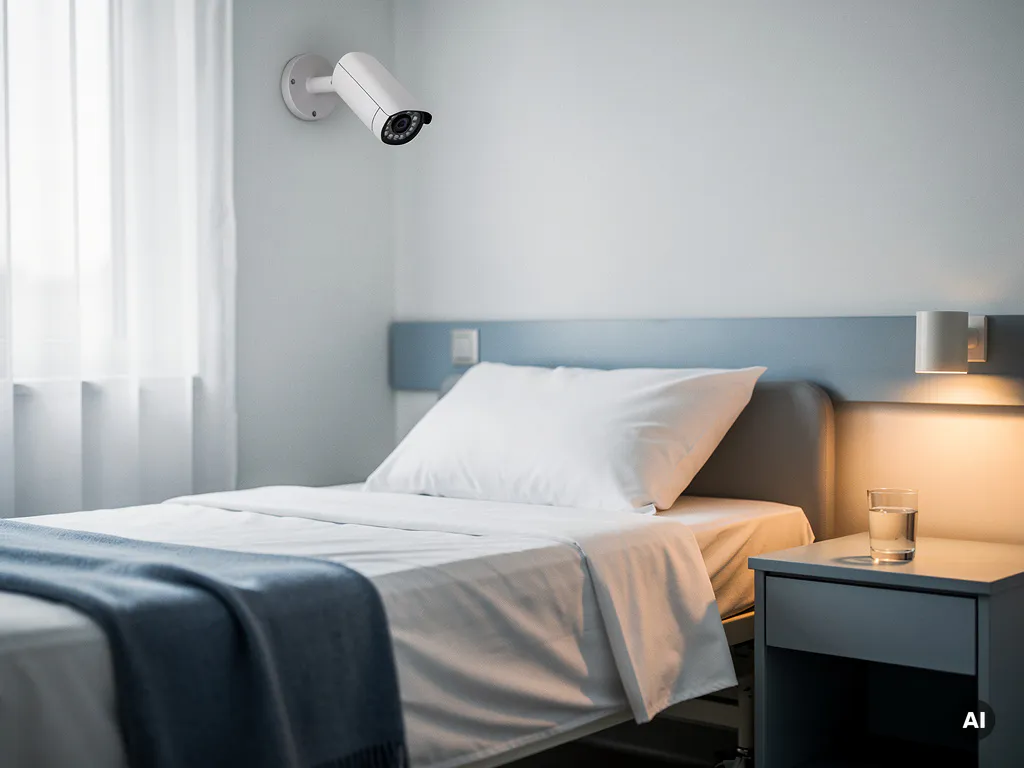
Choosing the right AI patient monitoring system for a care organization requires attention to accuracy, privacy protection, certifications, and ease of use. The best systems combine reliable detection with a low false alarm rate and comply with applicable care standards. In this article, we answer the most frequently asked questions to support your decision.
Which features are essential in an AI monitoring system?
An AI monitoring system for healthcare must at minimum include fall detection, lying position recognition, and automatic alerting. In addition, real-time processing, privacy-conscious image analysis, and easy integration with existing care systems are essential. Without these basic features, a system offers insufficient added value for care staff and clients.
Fall detection is the most critical feature: the system must immediately recognize a fall and send a notification to care staff within seconds. The faster the response time, the smaller the chance of serious consequences for the client. In addition to fall detection, fall prevention is increasingly becoming part of modern systems: by detecting risky movements or postures early, a care worker can intervene before an incident occurs.
Lying position recognition is an addition that helps care organizations prevent pressure sores and monitor the sleep comfort of clients. Finally, a good system must also be scalable: whether it involves one ward or multiple locations, the software must grow with the organization.
How accurate does an AI monitoring system need to be?
An AI monitoring system for patient monitoring must be extremely accurate, with a false alarm rate that is as low as possible. False alarms lead to unnecessary disruptions, fatigue among care staff, and reduced trust in the system. A benchmark of at most one false alarm per month is considered a realistic maximum for professional use.
Older technologies such as motion sensors or infrared detectors frequently generate false alarms, which actually increases the workload of care staff. Modern AI systems with computer vision can process contextual information and thereby distinguish between a normal movement and an actual fall. This results in a significantly lower false alarm rate.
When evaluating the accuracy of a system, it is wise to ask for concrete performance data based on real implementations, not just laboratory tests. Also ask vendors about their method for continuously improving the model, so that accuracy remains at the required level in practice.
How does AI patient monitoring protect the privacy of clients?
AI patient monitoring protects the privacy of clients because image processing takes place in a fully automated manner and images are never viewed by humans. Care staff are only alerted when the system detects an unsafe situation, preventing unnecessary intrusions into the personal space of clients.
This is a fundamental difference from traditional camera surveillance, where images are actively monitored by staff. With AI-driven monitoring, the software takes over the observation task entirely. The human gaze is removed from the equation, which greatly benefits the dignity and comfort of clients.
Good systems process image data locally or in a secure environment and do not store unnecessary personal data. Transparency toward clients and their loved ones about how the system works and what data is processed is an important part of responsible implementation.
What certifications and standards must an AI care system comply with?
An AI care system must comply with relevant safety and privacy standards such as ISO 27001 for information security and NEN 7510 for the protection of medical data in the Netherlands. In addition, compliance with the GDPR is mandatory for every organization that processes personal data of clients.
ISO 27001 is an international standard that demonstrates that an organization takes information security seriously. NEN 7510 is the Dutch implementation of this, specifically focused on healthcare. Together, these certifications give care organizations assurance that patient data is stored and processed securely.
When selecting an AI vendor, it is advisable to verify that certifications are current and have been granted by an independent party. Also ask about the vendor’s patent portfolio: a robust patent portfolio is an indication of technological originality and protects the care organization against dependence on unvalidated solutions.
How easy is it to implement AI monitoring in a care institution?
Implementing AI monitoring in a care institution is easiest when the system works as a plug-and-play solution that requires minimal technical expertise. Good systems are quick to configure, easy to schedule per room or ward, and require no major changes to the existing infrastructure.
A successful implementation depends on three factors: technical simplicity, vendor support, and buy-in from care staff. Technically, the system must be compatible with existing networks and equipment. The vendor must actively support the installation and provide training for staff.
Buy-in from care staff is at least as important as the technical side. Staff must understand what the system does, how it relieves their workload, and what the limits of the technology are. A clear communication strategy prior to the rollout prevents resistance and accelerates adoption.
When is AI monitoring the right choice for a care organization?
AI monitoring is the right choice when a care organization is dealing with staff shortages, growing care demand, or a high risk of incidents such as falls among vulnerable clients. It is particularly valuable in situations where continuous monitoring by humans is not feasible or desirable.
Elderly care institutions and hospitals that struggle to attract and retain staff, while the demand for care continues to grow, benefit most from automated patient monitoring. The technology takes over observation tasks without reducing the quality of care, and gives care staff the space to focus on direct care delivery.
AI monitoring is also a logical step for organizations that want to strengthen their night shifts without deploying additional staff. Nighttime incidents such as falls are often discovered too late, with serious consequences. A system that monitors 24/7 and alerts immediately significantly reduces this risk.
How Kepler Vision Technologies helps with AI patient monitoring
We at Kepler Vision Technologies develop AI software that supports care organizations in monitoring clients, without compromising privacy. Our solutions are specifically designed for the challenges that elderly care institutions and hospitals face on a daily basis. Here is what we offer:
- Fall detection and fall prevention: Our software immediately recognizes falls and alerts care staff within seconds.
- Lying position recognition: We monitor the lying posture of clients to detect risks of pressure sores at an early stage.
- Exceptionally low false alarm rate: Our system generates an average of only one false alarm per 92 days, significantly reducing the workload of care staff.
- Complete privacy protection: Images are never viewed by humans. Care staff are only called when the system deems it necessary.
- Certified security: We comply with ISO 27001 and NEN 7510 and hold an international patent portfolio of 21 patents.
- Easy implementation: Our software works as a plug-and-play solution that can be installed quickly and without major technical modifications.
Would you like to know whether our AI monitoring solution is a good fit for your care organization? Discover more about our approach and get in touch for a no-obligation conversation.
Frequently Asked Questions
What are the most common mistakes when selecting an AI monitoring system?
A common mistake is evaluating a system based on laboratory results rather than real-world performance. Always ask vendors for realistic performance data from actual care institutions, including the false alarm rate under daily conditions. In addition, organizations often underestimate the importance of buy-in from care staff: a technically excellent system that is not embraced by staff will add little value in practice.
How do I deal with clients or family members who object to AI monitoring?
Transparent communication is key here. Clearly explain to clients and their loved ones that images are never viewed by humans and that the system only alerts in the event of an unsafe situation. Emphasize that AI monitoring actually protects privacy better than traditional camera surveillance, and involve clients and family members as early as possible in the process to build trust.
Does AI patient monitoring also work reliably in dark or poorly lit spaces, such as at night?
Modern AI monitoring systems are specially designed to function reliably even in low-light conditions, for example via infrared cameras or special night vision modes. This makes them particularly suitable for nighttime monitoring, a period during which incidents such as falls most often go unnoticed. Explicitly verify with the vendor whether the system has been validated for use in nighttime conditions.
Can AI monitoring be combined with other care technologies we already use?
Yes, the best AI monitoring systems are designed to integrate with existing care systems, such as electronic client records (ECD) and alerting platforms. It is important to ask the vendor which integrations are available as standard and whether customization is possible. Good integration ensures that alerts reach the right place directly, without care staff having to perform additional actions.
How long does it typically take for care staff to become familiar with the new system?
With a well-designed plug-and-play system with an intuitive interface, the learning curve is generally short: most staff members are operational within one to a few training sessions. The vendor plays a crucial role here by providing targeted training and clear instructional materials. Organizations that invest in a clear introduction and communication strategy prior to the rollout experience the fastest and smoothest adoption.
What happens if the AI system experiences a technical failure? How is care continuity ensured?
A reliable vendor always provides a clear protocol for outages, including direct technical support and a communicated recovery time (SLA). Care organizations are advised to agree on uptime guarantees and fallback procedures during contract negotiations in case the system temporarily goes offline. It is also advisable to ask whether the system supports local processing, so that an internet outage does not immediately lead to system failure.
Is AI patient monitoring also suitable for smaller care organizations or home care situations?
Scalable AI monitoring systems can in principle be deployed for both large institutions and smaller care organizations, provided the software is set up in a modular and flexible way. For home care situations, additional considerations apply, such as the availability of a stable network and the installation options in a private residence. Discuss with the vendor which configurations are available and whether specific solutions exist for small-scale or home care applications.
Related Articles
- How does workforce planning help reduce workload?
- How do you prioritize tasks to reduce workload?
- How does AI improve collaboration between healthcare and technology?
- How does healthcare technology contribute to better decision-making?
- Wat zijn de kansen van kunstmatige intelligentie voor zorginstellingen?
This content was generated with the help of AI and it may contain mistakes