


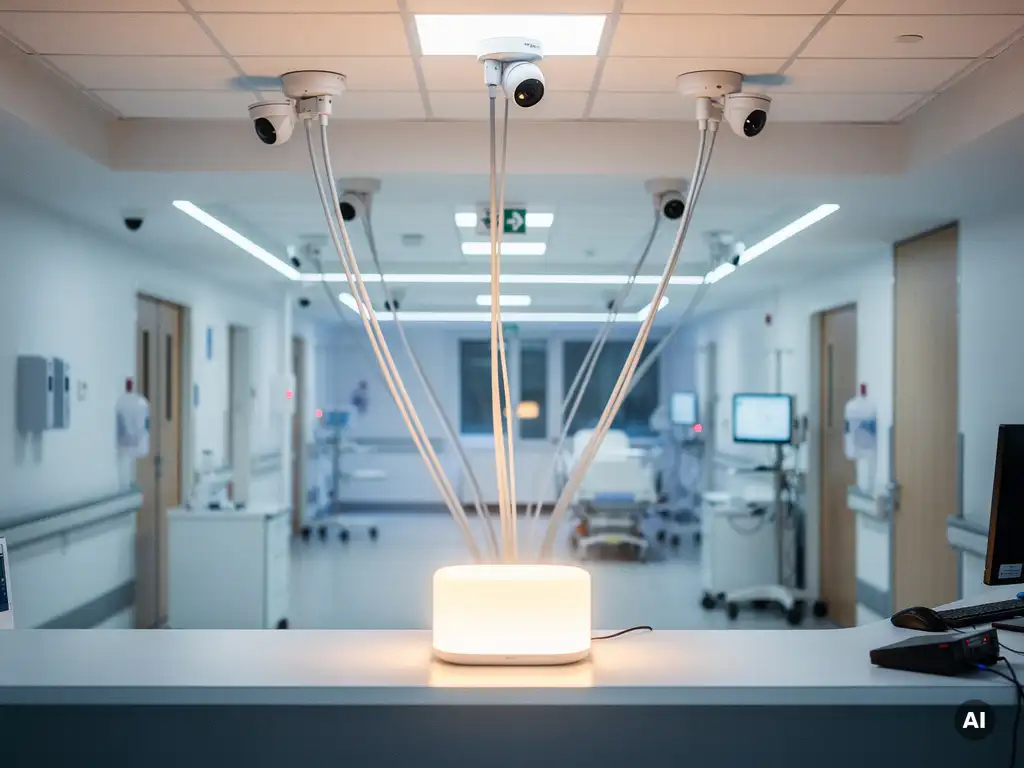
Scaling AI fall detection from one department to multiple care locations is most effectively done by starting with a structured pilot program, documenting the lessons learned, and building a standardized rollout model that is applied location by location. The key lies not in the technology itself, but in the combination of clear prioritization, technical preparation, and staff training. In this article, we answer the most frequently asked questions about a broad rollout of fall detection for elderly residents.
What are the biggest challenges when rolling out fall detection across multiple locations?
The biggest challenges when scaling fall detection to multiple care locations are organizational resistance, inconsistent technical infrastructure, and the lack of a central management model. Technology is rarely the stumbling block; the human and operational side of the rollout determines whether a broad implementation succeeds or stalls.
In practice, care organizations encounter the following recurring bottlenecks:
- Staff resistance: Care professionals who were not involved in the pilot phase are often more skeptical about new technology than colleagues who are already familiar with the system.
- Variation in network infrastructure: Each location has its own IT environment. What works at location A sometimes requires additional adjustments at location B.
- Lack of central coordination: Without a project manager coordinating the rollout, silos emerge: locations that configure and use the system differently.
- Insufficient knowledge transfer: Experiences and best practices from the first location do not automatically reach new locations.
A rollout that addresses these challenges in advance proceeds considerably more smoothly than one where each location has to reinvent the wheel.
How do you choose which departments or locations go first?
For the initial rollout, choose the locations or departments where the combination of fall risk, staffing pressure, and organizational support is greatest. These are the places where the technology has a directly measurable impact and where motivated staff can carry the implementation as internal ambassadors.
Concrete criteria for determining priority:
- Fall incidence: Departments with a high number of fall incidents benefit most from automated fall detection for elderly residents and at the same time provide the clearest measurement of results.
- Staffing levels: Locations with structural understaffing benefit most from AI support that monitors residents 24/7.
- Technical readiness: A location with a stable network and an IT contact person is better prepared for a swift implementation.
- Internal support: A location manager or team leader who is enthusiastic about the technology significantly increases the likelihood of successful adoption.
Preferably start with two or three locations simultaneously, so you can compare learning experiences and build a rollout handbook that is scalable from that point forward.
What technical requirements apply to each new care location?
Each new care location needs at minimum a stable internet connection, sufficient bandwidth for data transmission, suitable camera mounting points in residents’ rooms, and a local point of contact for IT support. If these basic requirements are not in order, installation will be delayed or the system will not function optimally.
More specifically, the following technical points of attention apply:
- Network and connectivity: AI fall detection software processes image data locally or in the cloud. Check per location whether the network can handle the required bandwidth without impacting other systems.
- Camera installation: Camera placement is critical for detection accuracy. A good placement strategy per room type prevents blind spots.
- Privacy by design: Verify per location that image processing complies with applicable privacy legislation. Systems in which images are never viewed by humans require a different configuration than traditional camera surveillance.
- Integration with existing systems: Connecting with alarm systems or nurse call systems differs per location and requires advance coordination with the IT department.
A technical checklist per location, drawn up after the first pilot implementation, saves a significant amount of time with each subsequent rollout.
How do you ensure that care staff at every location use the AI software correctly?
Care staff use AI fall detection software correctly when they understand what the system does, what it does not do, and how they should respond to an alert. Training is necessary for this, but the way in which that training is delivered determines whether knowledge also sticks in day-to-day practice.
Effective training approach
Classroom instruction works best in combination with practical exercises directly on the ward. Staff learn faster when they operate the software in their own work environment rather than in a neutral training room. Ensure that every staff member has handled at least one alert during training, so that the sequence of actions feels familiar.
Internal ambassadors as the key to adoption
Designate one or two staff members per location as an internal point of contact for the software. These ambassadors are the first point of contact for questions from colleagues and ensure continuity when new staff join. Organizations that work with this model see higher and more consistent adoption than organizations that rely solely on central support.
What is the difference between central and decentralized management models for AI fall detection?
In a central management model, the AI fall detection software is configured, monitored, and updated from a single point for all locations. In a decentralized model, each location has its own management authority. The central model offers more consistency and oversight; the decentralized model offers more flexibility per location but increases the risk of differences in usage and quality between locations.
The choice between the two models depends on the size of the organization and the degree of standardization desired:
- Central management is suitable for organizations with many locations that want to operate uniformly. It reduces the management burden per location and enables organization-wide reporting.
- Decentralized management is better suited to organizations where locations differ greatly from one another in size, resident population, or care intensity, and where local autonomy is important.
- Hybrid model: Many care organizations opt for a middle ground: central configuration of basic settings and alerting protocols, combined with local authority for minor adjustments.
Determine the management model preferably before the first broad rollout, so that the technical setup can be aligned accordingly.
How do you measure the success of a broad rollout of AI fall detection?
The success of a broad rollout of AI fall detection is measured using a combination of safety outcomes, operational indicators, and adoption figures. A reduction in the number of fall incidents is the most direct measure, but only means something when you also set it against response times, the number of false alarms, and staff perceptions of workload.
Relevant measurement points per category:
- Safety: Number of fall incidents per location before and after implementation, severity of fall-related injuries, response time after an alert.
- Technical performance: Number of false alarms per time period. Systems with a low error rate, such as one false alarm per 92 days, give staff greater confidence in the alerts.
- Adoption: Percentage of staff actively using the system, number of missed alerts due to disabled equipment, frequency of questions to internal ambassadors.
- Workload: Time saved per shift through fewer preventive room rounds, perceived workload before and after implementation.
Measure these indicators per location individually as well as organization-wide. This allows you to see not only whether the rollout is successful on average, but also which locations are falling behind and need additional support.
How we help with scaling AI fall detection
We support care organizations at every step of a broad rollout of fall detection for elderly residents, from the first pilot location to a fully deployed network of care locations. Our approach is built on concrete results and a plug-and-play concept that keeps the technical threshold as low as possible per location.
What we offer:
- Fall detection and fall prevention: Our AI software detects falls within seconds and immediately alerts care staff, so that no incident goes unnoticed.
- Lying position recognition: In addition to fall detection, the software monitors residents’ lying positions, contributing to the prevention of fall risks during the night.
- Privacy by design: Images are never viewed by humans. Care staff only enter the room when the software requests it.
- Accuracy: With just one false alarm per 92 days, we offer a reliability that is a thousand times higher than outdated technologies.
- Compliance: We comply with ISO 27001 and NEN 7510, ensuring that privacy and data security are guaranteed at every location.
Would you like to know how we can support your organization with a scalable rollout? View our solutions and discover how we work together with international care organizations.
Frequently Asked Questions
How long does an average rollout of AI fall detection at a new care location take?
The lead time typically varies between two and six weeks per location, depending on technical readiness and the availability of staff for training. Locations with a stable network, an active IT contact person, and internal support achieve the shortest lead time. By working with a rollout handbook drawn up after the pilot phase, you can further reduce the installation time at each subsequent location.
What do you do if staff at a new location continue to show resistance, even after training?
Persistent resistance rarely has to do with the technology itself, but almost always stems from a lack of involvement or trust in the process. Actively engage skeptical staff by asking them to contribute to working agreements around the system, rather than imposing a ready-made way of working on them. A personal conversation with the location manager or a visit to a location where the system is already running successfully can make all the difference.
Can residents or their families object to the use of AI fall detection in the room?
Yes, residents and their representatives have the right to object or withhold consent. It is essential to provide clear information prior to installation about how the system works, which images are processed, and who has access to them. Systems that work with privacy by design — where images are never viewed by humans — significantly lower the threshold for acceptance and simplify the consent procedure.
How do you handle locations that are technically behind and do not meet the minimum requirements?
For technically lagging locations, schedule a preparation phase before the actual rollout begins. Together with the IT department, map out the bottlenecks — such as an outdated network or missing hardware — and draw up a concrete action plan with a realistic timeline. Do not force the rollout as long as the basic requirements are not in order; a failed implementation due to poor preparation damages support for all future locations.
Is it possible to roll out AI fall detection in phases, for example starting with night care only?
Yes, a phased rollout by shift or care moment is an effective strategy to familiarize staff with the system step by step. Starting with night care is logical, because fall incidents occur most frequently at night and the system then most clearly demonstrates its direct added value. After a successful night phase, you can expand usage to the day and evening shifts, with staff already having a positive frame of reference.
What common mistakes should you avoid when scaling to multiple locations?
The most common mistake is scaling too quickly without properly documenting the lessons from the pilot phase and embedding them in a rollout handbook. Other common mistakes include skipping the technical preparation per location, appointing ambassadors without giving them sufficient time and authority, and not measuring results per location separately. A structured evaluation after each new location prevents the same problems from recurring.
How do you ensure the quality of the system is maintained as more locations are added?
Quality assurance across a growing number of locations requires a combination of central monitoring, periodic location audits, and a clear escalation path for technical or operational issues. Establish organization-wide KPIs — such as the maximum permitted number of false alarms and the minimum response time — and report on these monthly per location. Locations that structurally deviate from the norm receive targeted support, so that overall quality does not dilute as the organization continues to grow.
Related Articles
- How does workforce planning help reduce workload?
- Which healthcare professions have the greatest staff shortages?
- What are the signs of excessive workload in the workplace?
- How do you measure the success of fall prevention programs for older adults?
This content was generated with the help of AI and it may contain mistakes