

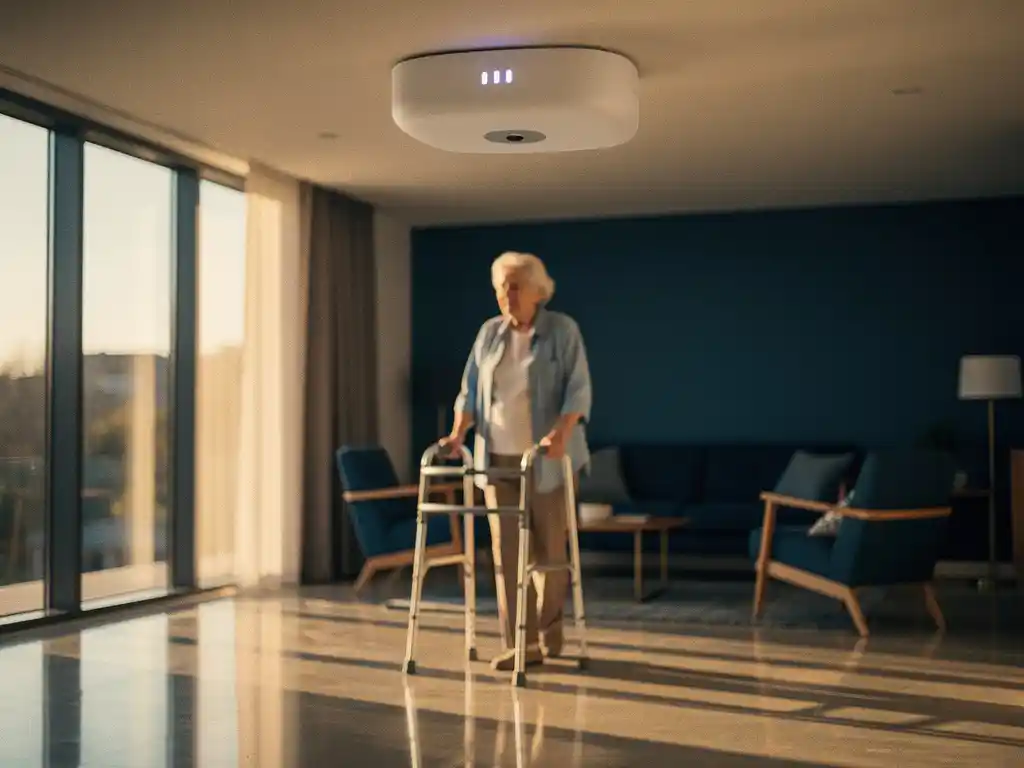
Fall prevention for seniors is becoming increasingly important as the aging population grows and healthcare organizations face staffing shortages. Modern technologies utilize artificial intelligence to prevent and detect falls, but the accuracy of these systems varies significantly. For healthcare providers, it is essential to understand how reliable these fall prevention systems are and which factors influence their performance.
In this article, we answer the most frequently asked questions about the accuracy of modern fall prevention technology, so healthcare organizations can make informed choices when selecting the right solution for their facility.
What is the average accuracy of modern fall prevention systems?
Modern fall prevention systems achieve an accuracy of 85% to 98%, depending on the technology used and implementation. AI-powered systems with computer vision generally perform best, while older sensor technologies, such as pressure mats and accelerometers, show lower accuracy percentages.
Accuracy is measured based on two important factors: the detection rate of actual falls and the number of false alarms. Advanced AI systems can correctly detect up to 98% of all falls while dramatically reducing the number of false alarms. This is a significant difference from traditional systems, which often struggle with reliability.
It is important to note that accuracy also depends on the specific environment in which the system is used. Hospitals and elderly care facilities have different challenges, such as varying lighting conditions and different types of patient movements.
How do AI-powered fall detection systems work in elderly care facilities?
AI-powered fall detection systems continuously analyze video footage using machine learning algorithms that recognize human movement patterns. These systems distinguish normal activities from sudden fall incidents by monitoring movement, speed, and body postures, without requiring care staff to view the footage.
The process begins with cameras strategically placed in patient rooms. The AI software analyzes residents’ movements in real time and learns to recognize normal behavioral patterns. When the system detects an abnormal movement pattern indicating a fall, it immediately sends an alarm to care staff.
Residents’ privacy remains protected because the footage is analyzed exclusively by AI. Care staff only receive a notification when help is actually needed, which reduces their workload while shortening response time.
What is the difference between fall detection and fall prevention technology?
Fall detection technology identifies falls after they have occurred and immediately sends an alarm, while fall prevention technology recognizes risk situations before a fall takes place and warns of potentially dangerous situations. Both technologies complement each other in a complete care system.
Fall detection systems focus on rapid response after an incident. They recognize when someone has fallen and ensure help arrives quickly on scene. This reduces the time someone lies helpless on the ground, which is crucial to prevent complications.
Fall prevention systems, on the other hand, analyze behavioral patterns and environmental factors to identify risk situations. They can, for example, warn when someone gets up at night and walks unsteadily, or when someone is in a dangerous position. This proactive approach helps prevent falls before they happen.
How many false alarms do modern fall prevention systems produce?
Advanced modern fall prevention systems produce an average of one false alarm per 30 to 90 days, with the most accurate AI systems generating only one false alarm per 92 days. This is a dramatic improvement over older technologies, which can cause multiple false alarms daily.
False alarms are a critical factor when evaluating fall prevention systems, because too many unnecessary notifications lead to alarm fatigue among care staff. When employees are overwhelmed with false alarms, they may start ignoring real emergencies or respond more slowly.
The reduction of false alarms is achieved through advanced algorithms that better distinguish between normal activities and real emergencies. Machine learning models are trained on thousands of hours of movement data, making them increasingly better at recognizing actual fall incidents.
Which factors influence the accuracy of fall detection systems?
The accuracy of fall detection systems is influenced by environmental factors such as lighting and camera positioning, patient-specific factors such as mobility and behavior, and technical aspects such as the quality of AI algorithms and system calibration.
Environmental factors play a crucial role in performance. Poor lighting, shadows, or obstacles can limit detection capability. Cameras must be strategically placed to provide optimal coverage without creating blind spots.
Patient-specific variables, such as different walking patterns, use of mobility aids, or unusual movements due to medication, can affect accuracy. Modern systems learn to recognize these individual patterns and adapt accordingly.
Technical factors such as camera resolution, data processing speed, and the quality of machine learning models ultimately determine how well the system performs in real-world conditions.
How we help with fall prevention for seniors
We offer market-leading AI solutions specifically developed for fall prevention in elderly care facilities. Our system combines advanced computer vision technology with machine learning to achieve 98% accuracy, with only one false alarm per 92 days.
Our solutions offer:
- 24/7 monitoring without privacy invasion
- Direct alerting within seconds of detection
- Simple plug-and-play installation
- Full compliance with privacy regulations
- Proven results at international healthcare organizations
By implementing our unique AI technology, healthcare organizations can better address their staffing shortages while improving resident safety. Would you like to learn more about how our fall prevention solutions can support your care facility? Contact us for a personal conversation about your specific needs.
Frequently Asked Questions
How long does implementation of an AI fall prevention system take in our care facility?
Implementation takes an average of 2-4 weeks, depending on the size of your facility. The installation itself is plug-and-play and can be completed within a few days. The additional time is used for calibrating the system, training staff, and testing accuracy in your specific environment.
What are the costs of a modern fall prevention system compared to traditional methods?
While the initial investment is higher than traditional sensors, AI systems save significant costs long-term through fewer fall incidents, reduced staff deployment for monitoring, and lower insurance claims. Return on investment is usually achieved within 12-18 months through the reduction of fall-related care costs.
Can residents turn off the system or cover the cameras?
Modern systems have built-in safeguards against tampering and detect when cameras are blocked or turned off. The system automatically sends a notification to staff when monitoring is interrupted. For residents who object to monitoring, alternative solutions such as wearable sensors can be considered.
How does the system handle residents who use wheelchairs or mobility aids?
Advanced AI systems are trained to recognize various mobility aids and adapt their algorithms accordingly. The system learns each resident's normal movement patterns, including the use of wheelchairs, walkers, or walking sticks, and can distinguish between normal use and potential fall risks.
What happens if the internet or power goes out?
Professional fall prevention systems have backup provisions such as batteries and local storage to continue functioning during power outages. During internet outages, systems can temporarily operate locally and synchronize data once connection is restored. Critical alarms are always stored locally and sent once connection returns.
How can we convince staff to accept and use the new system?
Successful implementation requires good communication about the benefits: less workload through reliable alarms, faster response times, and better patient safety. Organize demonstrations, involve staff in the testing phase, and show concrete results from other facilities. Training and gradual rollout help with acceptance and confidence in the technology.
Related Articles
- How does technology support risk-based care?
- How does healthcare technology contribute to better decision-making?
- Why is continuous monitoring a key to future-proof care?
- Wat is de implementatietijd voor valpreventie voor ouderen systemen?
- How does intelligent software change the healthcare infrastructure?