


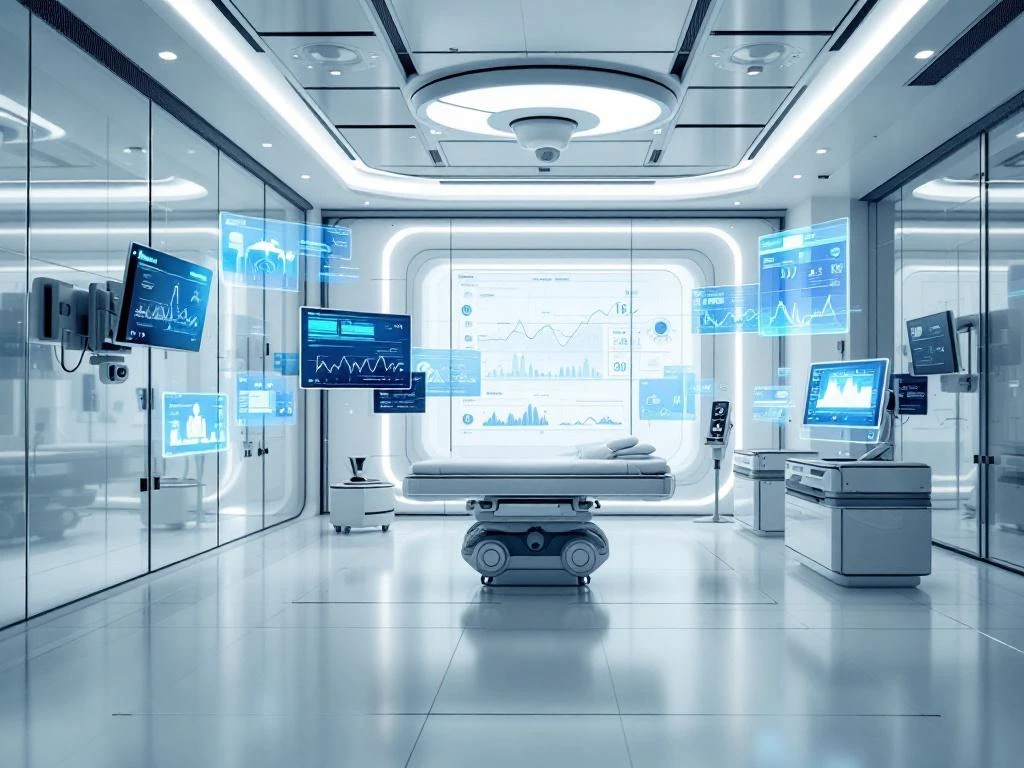
Future-proof care monitoring combines AI technology with privacy-friendly solutions to address staff shortages and improve patient safety. It involves smart systems that monitor 24/7 without human intervention, where fall detection and automatic alarm systems ensure fast response times. This modern approach helps healthcare organizations work more efficiently while maintaining quality of care.
Why is care monitoring becoming increasingly important for healthcare organizations?
Healthcare organizations face a dual challenge: staff shortages are growing while care demand increases annually by approximately 6% due to an aging population. Traditional monitoring methods require constant human supervision, which is no longer feasible with current staffing levels.
The aging population creates explosive growth in the number of people requiring care. At the same time, it becomes increasingly difficult to attract and retain qualified healthcare staff. This combination makes it impossible to maintain traditional one-on-one care delivery.
Modern care monitoring offers a solution by automating routine observations. Where previously a healthcare worker had to check every two hours whether a patient was safe, smart systems can now monitor continuously. This gives staff the space to focus on direct patient care and more complex tasks that do require human attention.
Traditional methods like motion sensors or pressure mats generate too many false alarms, leading to alarm fatigue. Modern AI systems are much more accurate and only disrupt healthcare staff’s work when something is actually wrong.
Which technologies make care monitoring truly effective?
AI in healthcare revolves around computer vision and machine learning that recognize visual patterns without human interpretation. These technologies can perform fall detection, bed position monitoring, and movement analysis with reliability that far exceeds traditional sensors.
Computer vision analyzes images in real-time and recognizes unusual movement patterns or dangerous situations. The system learns from thousands of different scenarios and becomes increasingly better at distinguishing real emergency situations from normal movements.
The key technologies are:
- Fall detection – Recognizes within seconds when someone falls
- Bed position monitoring – Checks whether patients are lying safely
- Movement analysis – Detects unusual behavioral patterns
- Automatic alarm systems – Send only relevant notifications to staff
The accuracy of modern systems is the major difference. While old technologies generate dozens of false alarms daily, advanced AI systems can run for months with only sporadic false notifications. This makes the difference between a system that disrupts work and a system that supports work.
How do you ensure care monitoring remains privacy-friendly?
Privacy-friendly care monitoring processes images locally without people ever seeing them and complies with strict standards like ISO 27001 and NEN 7510. The system only analyzes movement patterns and doesn’t transmit images, keeping patient privacy fully protected.
The biggest privacy problem with traditional cameras is that people view the images. Modern AI systems solve this by fully automating image processing. The software “sees” what happens but directly translates this into data about movement and safety, without ever storing or displaying an image.
Important privacy safeguards are:
- Local processing – Images never leave the room
- No storage – No video recordings or photos saved
- Automated analysis – No human review of images
- Compliance certification – Meets healthcare sector standards
Technology can actually strengthen privacy by reducing the need for physical checks. A patient needs to be disturbed less often by staff coming to check, because the system monitors continuously. This gives people more peace and privacy while safety increases.
Compliance with ISO 27001 and NEN 7510 standards ensures that all data processing meets the highest requirements for information security in healthcare. These certifications are not optional but require regular audits and strict procedures.
What are the practical benefits of smart care monitoring for your organization?
Smart care monitoring provides faster response times in emergency situations, fewer false alarms that disrupt work, and gives healthcare staff more time for direct patient care. This leads to better workload distribution, increased patient safety, and significant cost savings.
The most direct benefits are seen in daily work:
- Response time – Alerted within seconds of real emergencies
- Less stress – Staff know continuous monitoring is in place
- More efficient deployment – Time freed up for more complex care tasks
- Better patient experience – Fewer unnecessary disruptions
Cost savings arise because you achieve the same safety level with fewer staff, or because you can monitor more patients with the same staff. Additionally, you prevent costly accidents through faster detection of dangerous situations.
For healthcare organizations, this means you can better handle staff shortages without compromising quality. You can even improve care quality because staff can focus on tasks where human attention truly makes a difference.
Implementation is usually simpler than expected. Modern systems work plug-and-play and require minimal training. Staff only need to learn how to respond to the (reliable) alarms the system generates.
How we help with future-proof care monitoring
We develop Kepler Night Nurse and NurseAssist: AI solutions that watch over patients 24/7, with only one false alarm per 92 days. Our systems are plug-and-play to install and comply with all privacy and security requirements for the healthcare sector.
Our solutions offer concrete benefits:
- Exceptional accuracy – 1000 times more reliable than traditional systems
- Complete privacy – Images are never viewed by humans
- Direct implementation – No complex installation or training required
- International experience – Proven in healthcare organizations throughout Europe
We have specifically developed our system for the challenges your organization faces: staff shortages, increasing care demand, and the need for reliable monitoring. Our 25 specialists in machine learning and computer vision ensure the technology continues to improve.
Want to know how our future-proof care monitoring can help your organization? Contact us for a personal demonstration of Kepler Night Nurse and NurseAssist. We’ll show you how AI in healthcare works in practice and what benefits it delivers immediately. Discover more about our innovative AI monitoring solutions at KeplerVision.
Frequently Asked Questions
How quickly can AI care monitoring systems become operational?
Modern systems are operational within 1-2 days. The hardware is easily installed and the AI learns the environment within hours.
What happens if the monitoring system fails?
Professional systems have built-in backup functions and automatically notify staff when problems occur. Existing procedures remain as safety nets.
How accurate is the system with mobility-limited patients?
AI systems are trained on diverse movement patterns, including wheelchair users and mobility aids. The system learns individual patterns and adapts accordingly.