


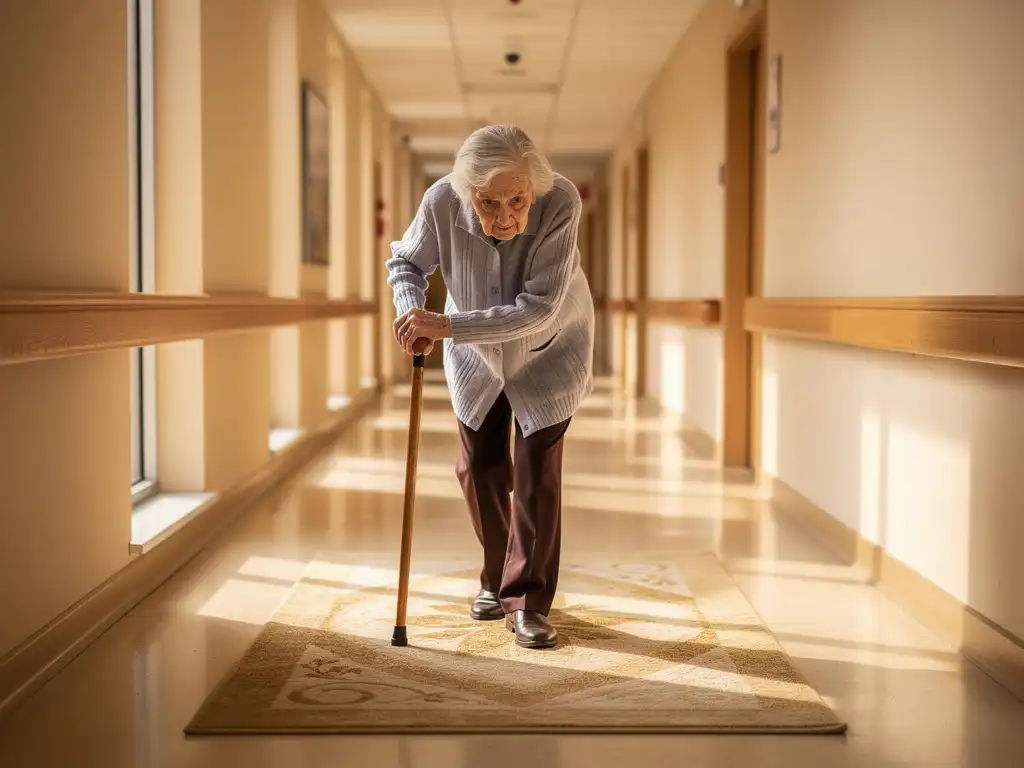
Falls are one of the greatest health risks for elderly people in care facilities. Every year, millions of seniors fall, which can lead to serious injuries, prolonged hospital stays, and a reduced quality of life. Modern AI technology offers new possibilities to minimize these risks through proactive monitoring and rapid detection.
For elderly care facilities, fall prevention is not only a matter of patient safety, but also of staff efficiency and cost savings. By investing in effective fall prevention, care facilities can better protect their residents while reducing the workload for their staff.
What is fall prevention and why is it crucial in elderly care facilities?
Fall prevention for elderly people encompasses all measures and technologies aimed at reducing the risk of falling and limiting the consequences of falls. This is achieved by identifying risk factors, making environments safer, and providing quick assistance when a fall does occur.
In elderly care facilities, fall prevention is crucial because residents often have multiple risk factors, such as medications that cause dizziness, mobility problems, and cognitive decline. Statistics show that approximately 30% of people over 65 fall at least once per year, and this percentage rises to 50% for people over 80.
The consequences of falls are often serious. Hip fractures, head injuries, and other wounds can lead to long recovery periods, permanent loss of function, and in some cases even death. Furthermore, falls can have psychological consequences, such as fear of falling again, which can lead to reduced activity and social isolation.
How does modern AI technology for fall detection work in practice?
Modern AI technology for fall detection uses advanced computer vision algorithms to monitor residents’ movement patterns 24/7. The software analyzes video footage in real time and can distinguish between normal movements and potentially dangerous situations, such as falls, within seconds.
The system works with machine learning models that have been trained on thousands of hours of movement data. These algorithms recognize specific patterns that indicate a fall, such as sudden downward movements, unusual body postures, or prolonged inactivity on the ground. When a fall is detected, an alarm is automatically sent to care staff.
What distinguishes modern AI systems from traditional fall detection is their accuracy. While older technologies often suffer from many false alarms, advanced AI systems can achieve a false alarm ratio of only one per 92 days. This means that care workers are only alerted when help is actually needed.
What benefits does automated fall prevention offer for care workers?
Automated fall prevention significantly reduces the workload on care workers by taking over continuous monitoring. Staff no longer need to be constantly physically present in every room to watch residents, giving them more time for direct care and personal attention.
The system also provides faster response times than traditional methods. While a resident who has fallen without automatic detection might remain unnoticed for hours, AI monitoring ensures that help is activated within seconds. This not only shortens the resident’s suffering but also prevents complications that can arise from lying on the ground for extended periods.
Additionally, automated fall prevention helps optimize staff deployment. Through data analysis, care facilities can recognize patterns in fall incidents and deploy their staff more strategically during peak hours. This leads to more efficient work schedules and better distribution of workload within the team.
How is privacy ensured with AI monitoring in care facilities?
Privacy in AI monitoring is ensured because the footage is analyzed exclusively by software and never viewed by human eyes. The system processes video data locally and only sends alarm notifications to care workers, without storing or sharing sensitive visual material.
Modern AI systems comply with strict privacy standards, such as ISO 27001 and NEN 7510, which are specifically developed for healthcare. These certifications guarantee that patient data is handled securely and that robust security measures are implemented to prevent unauthorized access.
The privacy-by-design principle means that residents maintain their dignity while still receiving the protection they need. Care workers only enter the room when the system detects a legitimate reason for intervention, respecting residents’ privacy and preventing unnecessary disturbances.
How Kepler Vision Technologies helps with fall prevention for elderly people
We at Kepler Vision Technologies offer a complete AI solution for fall prevention in elderly care facilities. Our Kepler Night Nurse software combines advanced fall detection, fall prevention, and lying position recognition in one integrated system that watches over your residents 24/7.
Our solution offers concrete benefits for your care facility:
- Detection of falls within seconds, with only one false alarm per 92 days
- Complete privacy guarantee: footage is never viewed by humans
- Plug-and-play installation that is easy to plan and configure
- Compliance with ISO 27001 and NEN 7510 standards
- International experience with care organizations throughout Europe
By implementing our AI technology, you can significantly improve the safety of your residents while reducing the workload for your staff. Contact us to discover how our fall prevention solution can transform your care facility and provide your residents with the protection they deserve.
Frequently Asked Questions
How long does the implementation of an AI fall prevention system take in our care facility?
The implementation of Kepler Night Nurse takes an average of 2-4 weeks, depending on the size of your facility. Thanks to plug-and-play technology, no complex infrastructure is needed – only standard wifi and electricity. Our team handles the complete installation, configuration, and training of your staff.
What are the costs of AI fall prevention and how does this compare to traditional methods?
While the initial investment may seem higher, AI fall prevention saves significant costs in the long term through fewer fall incidents, shorter recovery periods, and more efficient staff deployment. Many care facilities see their investment paid back within 12-18 months through reduced hospital and rehabilitation costs.
Can residents turn off the system or refuse to be monitored?
Yes, residents always retain their autonomy and can choose not to be monitored. The system can be turned on or off per room. However, we advise discussing the benefits extensively, as most residents and families appreciate the extra safety once they understand how the system works.
How accurate is fall detection and what happens with a false alarm?
Our AI achieves 99% accuracy with only one false alarm per 92 days. With a false alarm, staff briefly checks the situation and can easily mark the incident as ‘false alarm’ in the system. This data helps the AI improve further and reduce future false alarms.
Does the system also work for residents with dementia or other cognitive conditions?
Yes, the system is particularly effective for residents with dementia, who have a higher fall risk. The AI recognizes unusual movement patterns and can signal early when someone tries to get out of bed or moves unsafely. This helps intervene preventively before a fall occurs.
Can we integrate the system with our existing care software and alarm systems?
Kepler Night Nurse can be integrated with most existing care systems via standard APIs. Alarms can be forwarded to your current call systems, EHR software, or mobile devices of care workers. Our technical team investigates in advance which integrations are possible for your specific systems.
What happens to the data the system collects and how long is it stored?
The system processes video footage locally and does not permanently store sensitive visual material. Only metadata about incidents (time, location, alarm type) is stored according to your internal retention policy and GDPR requirements. All data remains within your own network and is never shared with external parties.
Related Articles
- What is the impact of staff shortages on productivity?
- What are the migration costs to new fall prevention systems for the elderly?
- How does fall prevention for seniors work in practice?
- How does AI-based care monitoring differ from traditional systems?
- What makes healthcare monitoring future-proof?
This content was generated with the help of AI and it may contain mistakes