


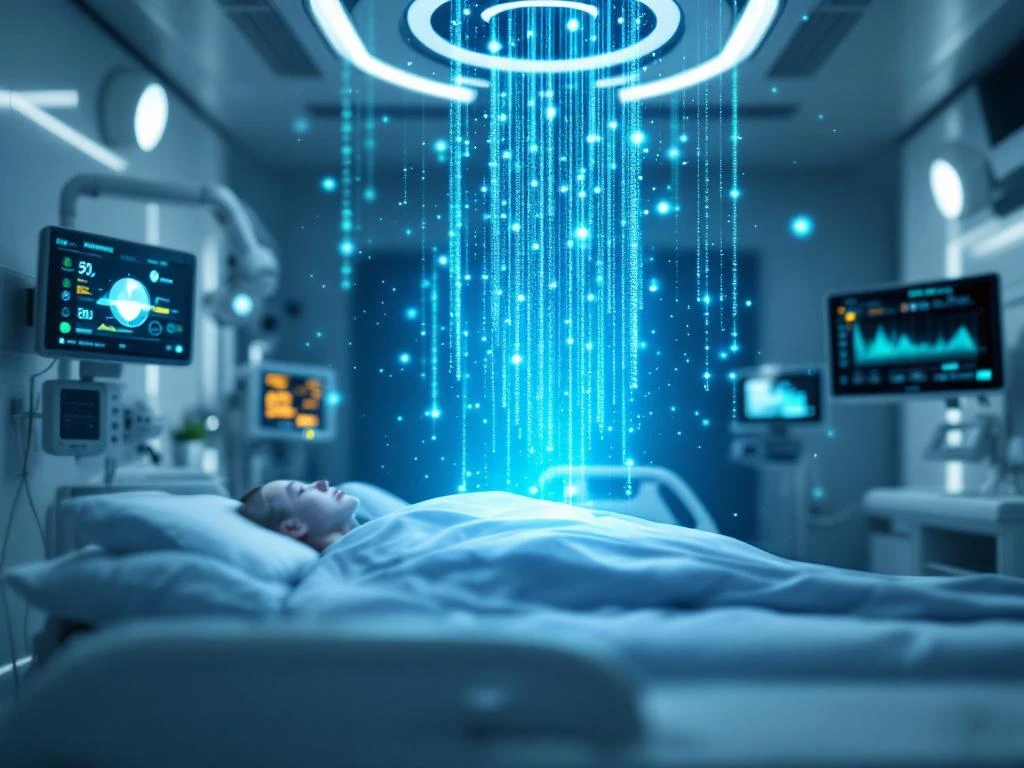
Data plays an increasingly important role in the future of healthcare monitoring by enabling AI in healthcare for automatic patient monitoring. Modern systems continuously analyze information to detect unsafe situations, support healthcare staff, and improve the quality of care while ensuring privacy is maintained.
What exactly is data-driven healthcare monitoring?
Data-driven healthcare monitoring uses artificial intelligence to automatically analyze patient data and alert healthcare staff during important events. This differs from traditional care methods, where staff must manually check and observe.
Traditional healthcare monitoring relies on visual checks by healthcare staff who regularly visit patients. This means problems are only noticed during scheduled rounds. Data-driven monitoring, on the other hand, works continuously and can respond immediately to changes.
Practical examples of this technology are systems that analyze movement patterns to predict fall risks, or cameras that automatically detect when someone has fallen. The software processes visual material without people needing to view the images, which protects privacy.
This modern approach is becoming increasingly important because healthcare organizations are dealing with staff shortages while demand for care is increasing. AI in healthcare offers a solution by taking over routine monitoring from overburdened staff.
How does data help solve staff shortages in healthcare?
Data and AI technology support healthcare staff by automatically performing routine monitoring, allowing employees to focus on direct patient care instead of continuous observation. This significantly increases efficiency.
Automation takes over various tasks that normally consume a lot of time. Healthcare workers no longer need to constantly check whether patients are safe, because smart systems do this 24/7. When help is actually needed, they receive an immediate notification.
Concrete examples of automation in practice:
- Fall detection that alerts within seconds after an incident
- Movement analysis that notices unusual patterns
- Automatic monitoring of lying positions and activity
- Smart alarm systems that minimize false alerts
Through this technology, fewer healthcare workers can safely monitor more patients. They are only disturbed when action is truly needed, which reduces stress and increases job satisfaction.
What role does privacy play in the use of healthcare data?
Privacy is a fundamental aspect of healthcare data, because patients must have trust that their personal information is handled safely. Modern technology can ensure privacy without compromising care quality, through smart data processing.
The biggest privacy challenge is that traditional surveillance systems often make recordings that can be viewed by humans. This feels invasive to patients and can create resistance to monitoring technology.
Modern solutions address this by:
- Having images analyzed directly by AI without human intervention
- Not storing visual material, only relevant events
- Automatic deletion of data after processing
- Strict access controls for systems and data
Trust develops when patients understand that technology protects them without violating their privacy. Transparency about how systems work and what data is used helps with acceptance of these new forms of care.
What are the biggest advantages of automatic healthcare monitoring?
Automatic healthcare monitoring offers faster response times during emergency situations, fewer false alarms, continuous 24/7 monitoring, and measurably better patient outcomes through early detection of problems. These advantages lead to increased safety and efficiency.
Faster response times mean that help can be deployed within seconds after a fall or other emergency situation. Traditional systems require someone to be physically present to notice problems, which can cost valuable time.
Measurable improvements in care quality include:
- Immediate warnings for falls, without waiting time
- Drastic reduction of false alarms that distract staff
- Continuous monitoring without interruptions
- Better documentation of incidents for analysis
- Reduced workload for healthcare staff
Continuous 24/7 monitoring guarantees that patients are always protected, even at night or during busy periods. This gives both patients and families more peace of mind about the quality of care.
How we help with data-driven healthcare monitoring
We develop AI solutions that use data for accurate fall detection and patient monitoring, with privacy as a central focus. Our systems generate on average only one false alarm per 92 days and protect patient data by never having images viewed by humans.
Our concrete advantages for healthcare organizations:
- Immediate fall detection within seconds after an incident
- Privacy-protecting technology without human intervention
- Exceptional accuracy with minimal false alarms
- 24/7 monitoring that helps solve staff shortages
- Simple installation and configuration
Our software watches over patients in elderly care facilities and hospitals, where healthcare workers are only alerted when actual help is needed. This increases efficiency and significantly reduces workload.
Would you like to know how our AI solutions can support your healthcare organization? Contact Kepler Vision for more information about implementation and the benefits for your specific situation.
Frequently Asked Questions
How accurate is AI fall detection?
Our AI achieves over 98% accuracy with only one false alarm per 92 days on average.
How is patient privacy protected?
AI analyzes images directly without human viewing. No recordings are stored and data is automatically deleted.
How long does implementation take?
Implementation takes 2-4 weeks including installation, calibration, and staff training.
Related Articles
- What is the impact of staff shortages on productivity?
- How do you create a culture where workload is open for discussion?
- How is the government addressing the staff shortage?
- How does AI support continuous care without physical presence?
- Why is innovation a strategic theme within healthcare?
This content was generated with the help of AI and it may contain mistakes