


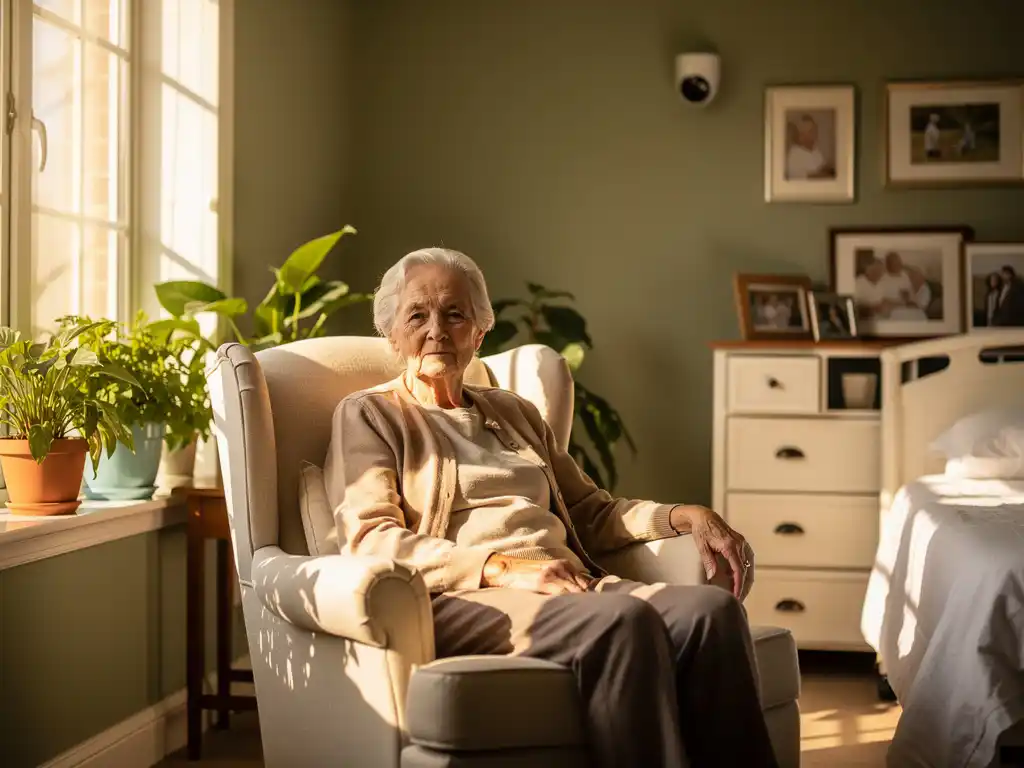
Fall prevention for elderly individuals is becoming increasingly important as the aging population grows and healthcare organizations face staffing shortages. Cloud-based technologies offer innovative solutions that enable 24/7 monitoring without violating residents’ privacy. This modern approach to fall prevention transforms how elderly care facilities can manage risks and ensure the safety of their residents.
The benefits of cloud-based fall prevention extend from improved accuracy to significant cost savings, while simultaneously respecting elderly individuals’ privacy. By combining artificial intelligence and advanced algorithms with cloud infrastructure, healthcare organizations can act proactively instead of reactively responding to fall incidents.
What is cloud-based fall prevention and how does it work?
Cloud-based fall prevention is a technology that uses artificial intelligence to detect and prevent fall risks in elderly individuals through cloud infrastructure. The system analyzes movement patterns, body postures, and behavioral changes in real time to identify potential fall situations before they occur.
The technology works by placing cameras and sensors in living and care environments that continuously collect data about residents’ movements. This information is then sent via a secure internet connection to cloud servers, where advanced AI algorithms analyze the data. The system recognizes patterns that may indicate increased fall risk, such as unsteady walking movements, sudden direction changes, or unusual activity patterns.
When the system detects a potentially dangerous situation, it immediately sends an alert to care staff. This proactive approach enables staff to take preventive measures before a fall occurs, rather than only responding after the incident has taken place.
Why is fall prevention so important for elderly care facilities?
Fall prevention is crucial for elderly care facilities because falls are the most common cause of injury in elderly individuals and can lead to serious complications, hospitalizations, and even death. Approximately one in three elderly people falls annually, and this percentage rises to 50% for people over 80 years old.
The consequences of falls extend beyond just physical injury. Falls can lead to loss of confidence and independence in elderly individuals, resulting in reduced mobility and social isolation. For healthcare organizations, fall incidents also mean significant costs due to additional medical care, longer stays, and potential legal liability.
Staff shortages in elderly care make the problem even more urgent. With growing care demand of 6% per year and difficulties in hiring new staff, care workers cannot always maintain continuous supervision of all residents. Effective fall prevention helps address this challenge by providing automated monitoring that supports existing staff.
How does cloud technology improve the accuracy of fall detection?
Cloud technology improves the accuracy of fall detection by providing access to powerful computing capacity and advanced machine learning algorithms that would not be available locally. Modern cloud-based systems can achieve accuracy of only one false alarm per 92 days, which is 1,000 times better than traditional technologies.
The cloud makes it possible to collect and analyze large amounts of data from multiple locations, allowing the system to continuously learn and improve. As more data is processed, the algorithms become increasingly accurate in distinguishing between real emergency situations and normal daily activities. This continuous improvement is only possible thanks to the scalable computing power of cloud infrastructure.
Additionally, cloud-based systems can receive real-time updates of new algorithms and improvements without having to replace on-site hardware. This ensures that all locations always have access to the most advanced detection technology, which benefits the reliability and effectiveness of the system.
What cost savings does cloud-based fall prevention offer?
Cloud-based fall prevention offers significant cost savings by preventing fall incidents, reducing hospitalizations, and optimizing staff deployment. The average costs of a fall in elderly individuals can amount to thousands of dollars in medical care and rehabilitation.
By proactively preventing falls instead of reactively treating them, healthcare organizations can avoid these high costs. The system also helps deploy staff more efficiently, as care workers only need to respond when a risk situation is actually detected. This reduces unnecessary checks and allows staff to focus on other important care tasks.
The cloud-based approach also eliminates the need for expensive local IT infrastructure and maintenance. Organizations don’t need to manage their own servers or employ IT specialists for system management. Monthly subscription costs are often significantly lower than the total ownership costs of traditional systems, while simultaneously providing better functionality.
How is privacy ensured with cloud-based monitoring?
Privacy is ensured with cloud-based monitoring through advanced encryption, strict access controls, and compliance with international privacy standards such as ISO 27001 and NEN 7510. Images are processed by AI algorithms without humans ever seeing them, which protects residents’ privacy.
The technology works with edge computing principles, where only relevant data is forwarded to the cloud and personal images are processed locally. This means that sensitive visual information is not unnecessarily stored or transmitted. All data transmission occurs via encrypted connections that meet the highest security standards.
Healthcare organizations maintain complete control over their data and can determine who has access to which information. The system logs all access and activities for audit purposes, ensuring transparency and accountability. Residents and their families can be assured that their privacy is respected while they benefit from improved safety and care.
How Kepler Vision Technologies helps with fall prevention for elderly individuals
We at Kepler Vision Technologies offer a unique solution for fall prevention in elderly care facilities with our advanced AI technology that watches over residents 24/7. Our software combines fall detection, fall prevention, and lying position recognition in one integrated system that:
- Generates only one false alarm per 92 days, which is 1,000 times more accurate than traditional systems
- Sends alerts to care staff within seconds when risks are detected
- Ensures privacy because images are never viewed by humans
- Is easy to install thanks to our plug-and-play concept
- Complies with privacy standards ISO 27001 and NEN 7510
Our international experience with healthcare organizations throughout Europe shows that effective fall prevention not only saves lives but also delivers significant cost savings. Would you like to learn more about how our cloud-based fall prevention can help your healthcare organization? Contact us for a personal demonstration of our technology.
Frequently Asked Questions
How long does it take to implement cloud-based fall prevention in our care facility?
The implementation of cloud-based fall prevention typically takes 2-4 weeks, depending on the size of your facility. Thanks to the plug-and-play concept, cameras can be quickly installed and minimal IT support is needed. After installation, the system is operational within a few hours and care staff can immediately benefit from 24/7 monitoring.
What happens if the internet connection fails? Does the system still work?
During an internet outage, the system continues to function locally thanks to edge computing technology. Fall detection and alerts continue to work, only the cloud-based data analysis is temporarily interrupted. As soon as the connection is restored, all data is automatically synchronized and full functionality is available again.
How do residents typically react to cameras in their living environment?
Most residents accept the cameras well when it is explained that they enhance their safety without violating their privacy. Because images are never viewed by humans and are only analyzed by AI, residents usually feel comfortable. It is important to communicate transparently about how the system works and what benefits it offers.
Can we integrate the system with our existing care software and alarm systems?
Yes, modern cloud-based fall prevention systems are designed for integration with existing care systems via APIs and standard protocols. Alerts can be forwarded to your current alarm system, electronic patient record, or mobile apps that care workers use. This ensures a seamless workflow without additional manual steps.
What training do our care staff need to use the system?
Care staff usually need only a short training of 1-2 hours to use the system effectively. The interface is intuitively designed and most actions are automated. Training focuses mainly on interpreting alerts, adjusting settings per resident, and optimally utilizing reporting functions.
How does the system handle residents who use wheelchairs or walking aids?
Advanced AI algorithms are trained to recognize various mobility aids and take them into account during risk analysis. The system can distinguish between normal movements with a wheelchair and potentially dangerous situations. Specific settings can be configured for each resident based on their individual mobility and risk profile.
Related Articles
- How does a good employer deal with work pressure?
- What is the future of the labor market amid persistent staff shortages?
- How do you optimize workflows with fall prevention for elderly people?
- What compliance requirements apply to fall prevention for the elderly?
- How can healthcare institutions strategically deploy innovation?
This content was generated with the help of AI and it may contain mistakes