


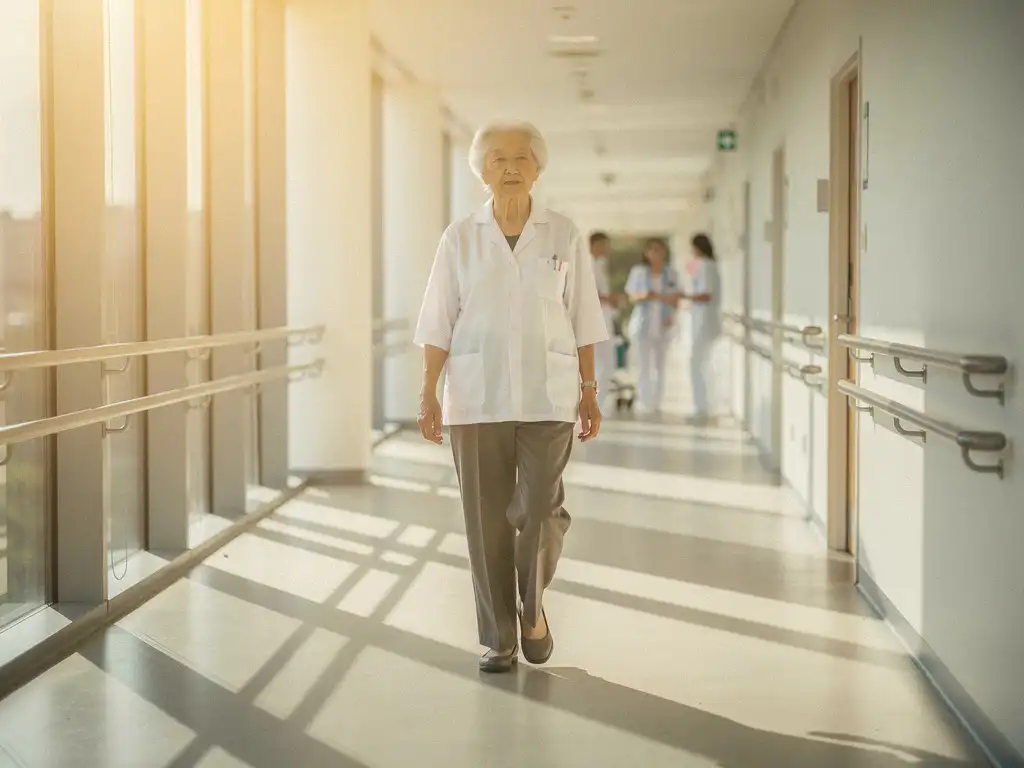
Falls are one of the greatest health risks for elderly people, with serious consequences for both their wellbeing and healthcare costs. Fall prevention for the elderly offers a proactive approach to minimize these risks and significantly improve quality of life.
Through modern technology and preventive measures, healthcare organizations can not only increase the safety of their residents, but also realize significant long-term savings on healthcare costs. This article explores the multifaceted benefits of effective fall prevention systems.
What is fall prevention and why is it important for the elderly?
Fall prevention for the elderly is a systematic approach that identifies risk factors and implements measures to prevent falls before they occur. This includes both technological solutions and physical adaptations of the living environment.
Falls pose a critical health risk because elderly people often have more fragile bones and recover more slowly from injuries. Statistics show that a fall is often the starting point of a rapid decline in health and independence. Therefore, prevention is much more effective than reactive action after an incident.
Modern fall prevention systems use advanced sensors and artificial intelligence to analyze movement patterns and recognize risk situations. This enables caregivers to intervene proactively before a fall actually occurs.
What health benefits does fall prevention offer for the elderly?
Fall prevention for the elderly provides direct health benefits by drastically reducing the risk of bone fractures, head injuries, and other fall-related injuries. This preservation of physical integrity is crucial for maintaining mobility and independence.
Additionally, effective fall prevention has positive psychological effects. Elderly people who feel safe in their environment experience less anxiety and stress, which contributes to better overall health. This increased mental peace often translates into better sleep and a more active lifestyle.
Fall prevention also helps maintain cognitive functions. When elderly people feel safe to move around, they remain physically and mentally more active. This activity stimulates the brain and can slow the progression of dementia and other cognitive conditions.
How can fall prevention improve the quality of care?
Fall prevention improves the quality of care by enabling caregivers to act proactively instead of reactively responding to incidents. This results in more targeted and effective care interventions that better align with individual needs.
Through continuous monitoring, care teams can recognize patterns in residents’ behavior and mobility. These insights enable them to develop personalized care plans that specifically target each resident’s unique risk factors.
Modern fall prevention systems also reduce the workload on care staff through automated alerting and monitoring. This allows caregivers to spend their time more effectively on direct patient care instead of constant surveillance, which benefits the overall quality of care.
What are the financial benefits of fall prevention systems?
Fall prevention systems generate significant financial savings by preventing costly medical treatments, hospital admissions, and rehabilitation programs that result from fall incidents. This preventive investment often pays for itself within a few years.
The costs of a fall can escalate enormously when considering acute medical care, long-term rehabilitation, and possibly permanent care needs. A hip fracture, for example, can lead to months of hospitalization and intensive physiotherapy, which exponentially increases healthcare costs.
Additionally, fall prevention systems reduce personnel costs through more efficient deployment of care capacity. When less time is spent treating fall incidents, the same staff can effectively care for more residents, which increases operational efficiency.
How does modern AI technology work for fall prevention?
Modern AI technology for fall prevention continuously analyzes movement patterns and behavior to identify risk situations before a fall occurs. These systems use advanced algorithms that learn from historical data to make increasingly accurate predictions.
The technology works through computer vision and machine learning algorithms that can detect subtle changes in gait patterns, balance, and movement fluidity. These early warning signals enable caregivers to take preventive measures before an incident occurs.
An important advantage of AI-driven fall prevention is the privacy-friendly approach where images are analyzed without human observation. This means that residents maintain their privacy while still benefiting from continuous protection and monitoring.
How Kepler Vision Technologies helps with fall prevention for the elderly
We offer advanced AI solutions specifically developed to take fall prevention for the elderly to a higher level. Our technology combines the benefits discussed in this article into one integrated system that delivers proven results.
Our Kepler Night Nurse and NurseAssist systems provide:
- 24/7 monitoring with only one false alarm per 92 days
- Direct detection of risk situations and unsafe movements
- Privacy-friendly technology where images are never viewed by humans
- Seamless integration into existing care processes
- Proven ROI through reduced care costs and increased efficiency
Through our unique combination of fall detection, fall prevention, and lying position recognition, we help healthcare organizations optimally protect their residents. Discover how our AI technology can improve your quality of care while saving costs by contacting us for a personal demonstration.
Frequently Asked Questions
How long does it take for a fall prevention system to deliver a positive ROI?
Most fall prevention systems pay for themselves within 1-3 years, depending on the size of the care facility and the number of prevented fall incidents. A single prevented hip fracture can save thousands of euros in care costs, making the investment quickly profitable.
Can residents find the fall prevention system disruptive to their daily life?
Modern AI-driven fall prevention systems work completely in the background without physical devices that residents need to wear. The cameras are discreetly placed and the technology operates silently, allowing residents to continue their normal routine without hindrance or awareness of monitoring.
What happens if the system gives a false alarm?
Advanced systems like Kepler Vision have only one false alarm per 92 days thanks to refined AI algorithms. When an alarm sounds, care staff are immediately informed via their existing communication systems, so they can assess the situation and take action if necessary.
How is residents' privacy protected with camera-based fall prevention?
Privacy is protected because images are analyzed exclusively by AI algorithms and never viewed by human eyes. The systems generate only anonymous data about movement patterns and risks, while all image material is processed locally and not stored or shared.
Which spaces in a care facility are most suitable for fall prevention systems?
Fall prevention systems are most effective in high-risk areas such as bathrooms, bedrooms, hallways, and common areas where most fall incidents occur. Priority lies with spaces where residents are alone and where direct help is not always available.
How does fall prevention technology integrate with existing care management systems?
Modern fall prevention systems are designed for seamless integration with existing care software and alarm systems. They can directly connect to nursing stations, mobile devices of care staff, and electronic patient records for a streamlined workflow.
What are the main implementation challenges and how can they be addressed?
The biggest challenges are often staff training and acceptance of new technology. Successful implementation requires thorough training of care staff, clear communication about benefits to residents and families, and a gradual rollout starting with pilot areas to build confidence.
Related Articles
- How do you retain staff during a labor shortage?
- What are the risks of structural understaffing?
- What is the impact of fall prevention for elderly people on staff planning?
- How do you prevent privacy violations in fall prevention for seniors?
- What is the impact of care technology on the quality of care?
This content was generated with the help of AI and it may contain mistakes