


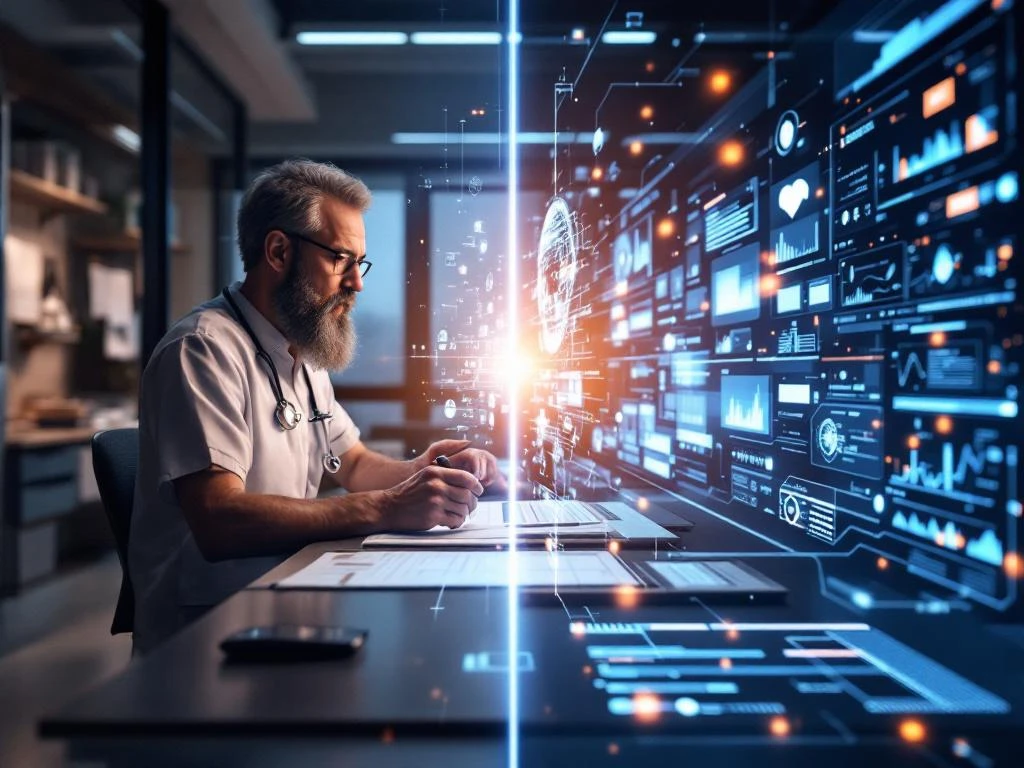
Healthcare technology improves the quality of care by enhancing patient safety, supporting healthcare staff, and making processes more efficient. AI in healthcare plays an important role in this by enabling 24/7 monitoring and faster diagnoses. These technologies help healthcare organizations perform better, despite staff shortages and increasing care demands.
What is healthcare technology and how is it changing healthcare delivery?
Healthcare technology encompasses all digital tools that support healthcare delivery, from electronic health records to AI in healthcare for monitoring and diagnosis. These technologies transform traditional care methods into smarter, more efficient processes that benefit both patients and healthcare staff.
The shift from manual to automated processes is visible everywhere. Where healthcare workers previously had to be constantly physically present for monitoring, smart systems can now continuously watch over patients. This doesn’t mean human care disappears, but that technology takes over routine tasks, allowing healthcare staff to focus on direct patient care.
Modern healthcare technology works at different levels:
- Preventive care through early problem detection
- Diagnostic support with AI analysis
- Treatment monitoring via smart sensors
- Administrative automation for more efficient processes
What concrete benefits does healthcare technology offer to patients?
Patients experience direct benefits through faster help, better monitoring, and more comfort during their care journey. Technology ensures increased safety, because problems are noticed and treated earlier. This leads to better health outcomes and more confidence in healthcare delivery.
The practical benefits are noticeable in patients’ daily lives. Smart monitoring means you don’t constantly have to wait for check-ups: the system automatically keeps an eye on you. If something happens, such as a fall or a change in your condition, you get help immediately.
Important benefits for patients:
- Faster response in emergency situations
- Less invasive monitoring that respects privacy
- Better accessibility of care, even at night
- More time for personal attention from healthcare staff
- More accurate diagnoses through AI support
These technologies also give patients more autonomy. You need to be less dependent on constant physical check-ups, but know that someone is always watching.
How does healthcare technology help healthcare staff in their daily work?
Healthcare technology relieves healthcare staff by automating routine tasks and reducing workload. AI in healthcare takes over monitoring, giving staff more time for direct patient care and complex tasks that require human expertise.
For healthcare workers, this means a fundamental change in their workday. Instead of constantly making rounds for check-ups, they are only alerted when action is actually needed. This reduces stress and prevents exhaustion from constant alertness.
Practical support for healthcare staff:
- Automatic alerting in emergency situations
- Fewer administrative tasks through digitalization
- Better planning through data insights
- Decision-making support through AI analysis
- More efficient communication between teams
The result is that healthcare workers can deploy their expertise where it’s needed most. Technology handles basic monitoring, while people focus on empathy, complex care delivery, and decisions that require human judgment.
What are the challenges in implementing healthcare technology?
The implementation of healthcare technology brings challenges, such as high initial costs, staff training, and concerns about privacy and security. Resistance to change within healthcare organizations and technical integration problems can slow down the process.
The biggest obstacles are often practical in nature. Healthcare organizations work with limited budgets and must carefully consider which investments deliver the most value. Additionally, staff must gain confidence in new technology and learn how to use it effectively.
Common implementation challenges:
- Budget constraints and uncertain return on investment
- Training and acceptance by existing staff
- Meeting privacy and security requirements
- Integration with existing systems
- Changing work processes and organizational culture
Successful implementation requires a phased approach, where technology is gradually introduced. Involve staff in the process, invest in good training, and choose reliable suppliers that guarantee compliance and support.
How we help with healthcare technology for better care quality
We offer AI in healthcare solutions that directly contribute to better care quality through 24/7 monitoring, fall detection, and privacy protection. Our technology supports healthcare staff with accurate alerting and helps address staff shortages.
Our approach focuses on practical problems that healthcare organizations experience daily. With our AI healthcare monitoring solutions, you no longer have to choose between safety and privacy: our systems monitor patients without images being viewed by humans.
Concrete benefits of our solutions:
- Fall detection within seconds, with minimal false alarms
- 24/7 monitoring without privacy invasion
- Plug-and-play installation without complex integration
- Compliance with ISO 27001 and NEN 7510 standards
- Support for staff shortages
Want to know how our AI-driven healthcare technology can help your organization? Contact us for a personal conversation about the possibilities to improve care quality in your situation.
Frequently Asked Questions
How long does it take for healthcare staff to adapt to new healthcare technology?
Most healthcare staff adapt to new technology within 2-6 weeks with proper training and gradual implementation.
Are AI healthcare systems reliable for patient monitoring?
Modern AI systems achieve 95-98% accuracy and continuously improve through machine learning and feedback.
Can patients maintain privacy with healthcare monitoring technology?
Yes, patients retain control over their monitoring preferences while maintaining safety through alternative measures when needed.
Related Articles
- How large is the staffing shortage in healthcare in 2025?
- What certifications are required for fall prevention technology for seniors?
- What integrations are possible with fall prevention systems for elderly people?
- How can smart technology help with risk reduction in healthcare?
- What role does automation play in future healthcare processes?
This content was generated with the help of AI and it may contain mistakes