


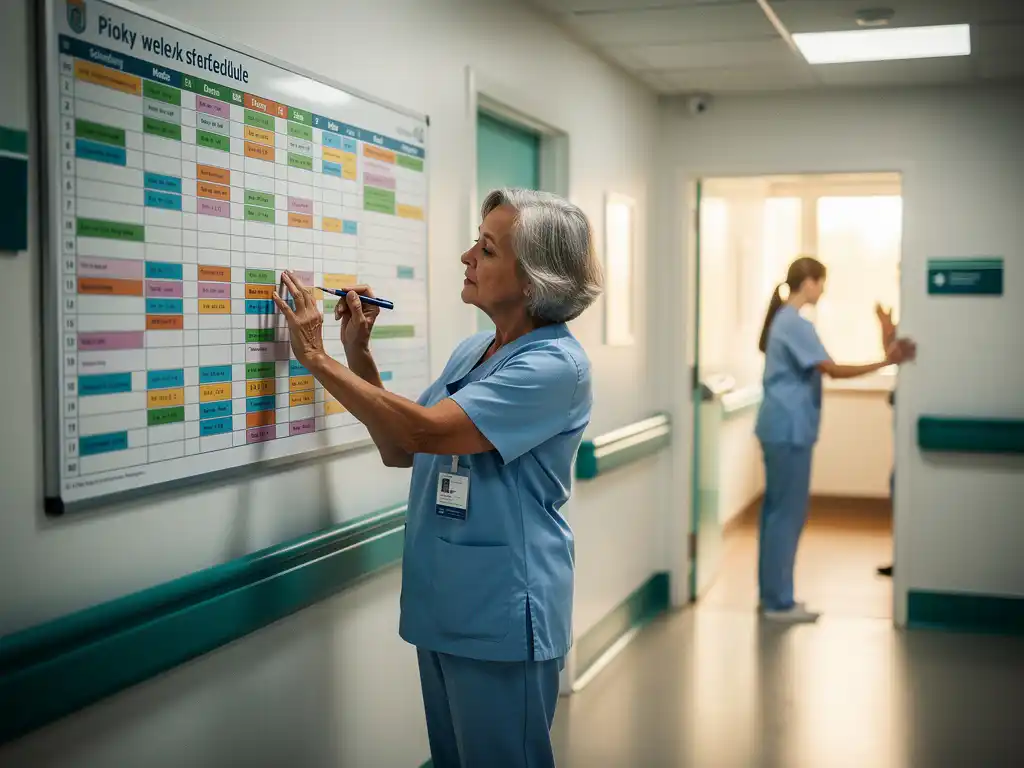
Staff scheduling is the process by which a care organization determines how many employees are needed, when they are deployed, and what tasks they perform. It helps address staff shortages by making available capacity visible and distributing it more intelligently across care demand. In this article, we answer the most frequently asked questions about staff scheduling in healthcare, from the challenges involved to the role of AI technology in care teams.
What problems does staff shortage cause in healthcare?
Staff shortages in healthcare lead to employee overload, longer response times in emergencies, and a lower quality of care for clients. Care organizations struggle to fill vacancies while demand for care continues to grow every year, creating a structurally unsustainable situation for teams already working at their limits.
The consequences are felt at multiple levels. Employees work overtime more frequently, leading to burnout and higher absenteeism rates. Clients receive less personal attention, and emergencies such as fall incidents are sometimes detected too late. For elderly care facilities, this is particularly acute: demand for senior care is growing by approximately six percent per year, while the supply of care staff is not keeping pace. This makes effective staff scheduling not just desirable, but essential.
How does staff scheduling work in a care organization?
Staff scheduling in a care organization works by matching available employees to the expected care demand per day, shift, and department. A scheduler takes into account contracted hours, leave, competencies, and the care needs of individual clients. The goal is to ensure the right person is always present at the right time.
In practice, staff scheduling begins with an analysis of care needs. How many clients are there, what care do they require, and at what times is demand highest? Based on this, shifts are composed and employees are rostered. Modern scheduling software supports this process by automatically accounting for labor regulations and by highlighting where gaps arise. A good schedule is flexible enough to respond quickly to sick leave or unexpected care demands.
What are the biggest challenges in staff scheduling for elderly care?
The greatest challenges in staff scheduling for elderly care are the structural staff shortage, the fluctuating care needs of clients, and the high demands placed on continuity of care. Schedulers must constantly balance available capacity against care needs, without a buffer of extra staff to draw on.
In practice, care organizations face the following bottlenecks:
- Tight labor market: Vacancies remain open for long periods and new employees are difficult to find or retain.
- High absenteeism: Workload and emotional strain lead to increased burnout, putting further pressure on scheduling.
- Unpredictable care demand: Client conditions can change rapidly, making the required staffing difficult to plan in advance.
- Night shifts and weekend shifts: These are the hardest to fill, yet supervisory responsibilities are heaviest precisely at these times.
- Administrative burden: Schedulers spend a great deal of time on manual rostering, at the expense of strategic workforce management.
This combination of factors makes staff scheduling in elderly care one of the most complex challenges in the sector.
How can technology help address staff shortages in healthcare?
Technology helps address staff shortages in healthcare by automating tasks that currently demand a great deal of time and attention from employees. This includes monitoring clients overnight, detecting fall incidents, and reducing unnecessary check rounds. This allows available staff to focus their time on care that genuinely requires human presence.
Scheduling software is a first step: it makes rosters more efficient and provides insight into where capacity falls short. But technology goes beyond scheduling alone. AI-driven monitoring solutions can continuously watch over clients and alert care staff only when action is truly needed. This reduces the number of unnecessary room checks, lowers workload, and simultaneously increases client safety. Particularly during night shifts, when staffing levels are at their lowest, automated monitoring offers a valuable addition to the human team.
What is the difference between staff scheduling and workforce management?
Staff scheduling focuses on the operational deployment of employees: who works when, where, and for how many hours. Workforce management encompasses a broader range of responsibilities, including recruitment, training, performance appraisal, and the long-term development of employees. Both are indispensable, but they operate at different levels within a care organization.
A useful way to see the distinction:
- Staff scheduling answers the question: “Who is on the floor tomorrow?”
- Workforce management answers the question: “How do we ensure we have enough well-trained staff two years from now?”
In practice, the two are closely connected. Good staff scheduling identifies shortages early that workforce management must resolve through recruitment or additional training. Conversely, workforce management has a direct impact on the available capacity that schedulers must work with. Care organizations that align both functions effectively are better positioned to tackle staff shortages in a structural way.
When is it time to invest in AI support for care teams?
It is time to invest in AI support for care teams when staff shortages are structurally leading to safety risks, employee overload, or reduced quality of care. If schedules are chronically understaffed, night shifts are undermanned, or incidents are being detected too late, technological support is not a luxury — it is a necessity.
Concrete signs that the time is right for AI support:
- Employees report that they cannot adequately monitor all clients simultaneously.
- Fall incidents or other emergencies are being discovered too late.
- Night shifts are structurally running on minimum staffing.
- Absenteeism is rising due to high workload and stress.
- Recruitment of new staff is not producing sufficient results.
AI is not a replacement for care staff, but a way to deploy their time and attention more effectively. By taking over routine monitoring tasks, AI gives the team the space to do what they do best: delivering person-centered care.
How Kepler Vision Technologies helps address staff shortages in healthcare
At Kepler Vision Technologies, we develop AI software that directly supports care organizations in managing the consequences of staff shortages. Our solutions Kepler Night Nurse and Kepler NurseAssist continuously monitor clients and patients, so care staff only need to act when it is truly necessary. These are the key benefits for your organization:
- 24/7 monitoring without additional staff: Our AI detects fall incidents and unsafe situations immediately and sends an alert to the care worker within seconds.
- Exceptionally low error rate: We generate only one false alarm every 92 days, significantly reducing employee workload compared to older technologies.
- Privacy guaranteed: Images are never viewed by humans. Staff only enter a room when our software requests it.
- Simple implementation: Thanks to the plug-and-play design, our software can be planned, configured, and installed quickly.
- Safety and compliance: We comply with ISO 27001 and NEN 7510 standards and hold an international portfolio of 21 patents.
Would you like to know how we can support your care team in addressing staff shortages? Visit our website for more information, or contact us directly to discuss what our AI solutions can mean for your organization.
Frequently Asked Questions
How do I start improving staff scheduling in my care organization?
Begin with a thorough analysis of your current situation: map out care demand by department, shift, and time of day, and compare this with available capacity. Identify the biggest bottlenecks, such as structurally understaffed night shifts or departments with high absenteeism. Based on that analysis, you can make targeted investments in scheduling software, better rostering systems, or technological support such as AI monitoring to relieve the pressure.
What are common mistakes in staff scheduling in healthcare?
A common mistake is purely reactive scheduling: rosters are only adjusted once a problem has already arisen, rather than proactively anticipating expected peaks in demand or absenteeism. Other pitfalls include failing to adequately account for the individual care needs of clients, ignoring signs of employee overload, and holding on to manual rostering systems for too long. Care organizations that avoid these mistakes are better able to guarantee continuity of care, even in a tight labor market.
How do I account for sick leave when drawing up a schedule?
Use historical absenteeism data to calculate a realistic expected absence rate per department and season, and build this in as a buffer in your planning. Modern scheduling software can process this automatically and, in the event of unexpected absences, immediately show which employees are available to step in. It also helps to have a flexible pool of on-call workers or career changers available who can be deployed at short notice.
Is AI monitoring not too intrusive for clients and their privacy?
Privacy is a legitimate concern, but modern AI monitoring solutions such as Kepler Night Nurse are specifically designed with privacy protection as a core principle. Images are not viewed by humans and are not stored; the AI analyzes movements and situations locally and only sends an alert when action is required. Care organizations that use this technology do so in compliance with strict standards such as ISO 27001 and NEN 7510, which provides reassurance to both clients and staff.
How do I convince my management to invest in AI support for the care team?
Support your proposal with concrete figures: calculate the costs of the current staff shortage — such as overtime, staffing agencies, and the consequences of incidents — and set these against the investment in AI technology. Show that AI is not a replacement for staff, but a means of deploying their time more efficiently and reducing safety risks. Pilot projects in a single department can help make results visible before discussing a broader rollout.
What is the difference between scheduling software and AI monitoring solutions, and do I need both?
Scheduling software focuses on efficiently rostering employees and managing capacity, while AI monitoring solutions support the actual delivery of care on the floor by continuously watching over clients. The two complement each other: scheduling software ensures the right people are present at the right time, and AI monitoring ensures those people can use their time as effectively as possible. For care organizations with structural understaffing, particularly during night shifts, the combination of both is most effective.
How long does it take before AI support has a noticeable effect on employee workload?
With a plug-and-play solution like that of Kepler Vision Technologies, the technology is typically installed and operational quickly, after which staff notice within the first few weeks that the number of unnecessary check rounds and false alarms decreases. The structural effect on workload and absenteeism usually becomes visible within a few months, as employees adapt to the new way of working and consistently use the time saved for direct client care. Good support for the team during implementation significantly accelerates this process.
Related Articles
- Which risk factors increase the need for fall prevention in older adults?
- What are the costs of falls without fall prevention for the elderly?
- What is the impact of care technology on the quality of care?
- What does real-time care monitoring mean for healthcare institutions?
- How does technology help with early detection of health risks?
This content was generated with the help of AI and it may contain mistakes