
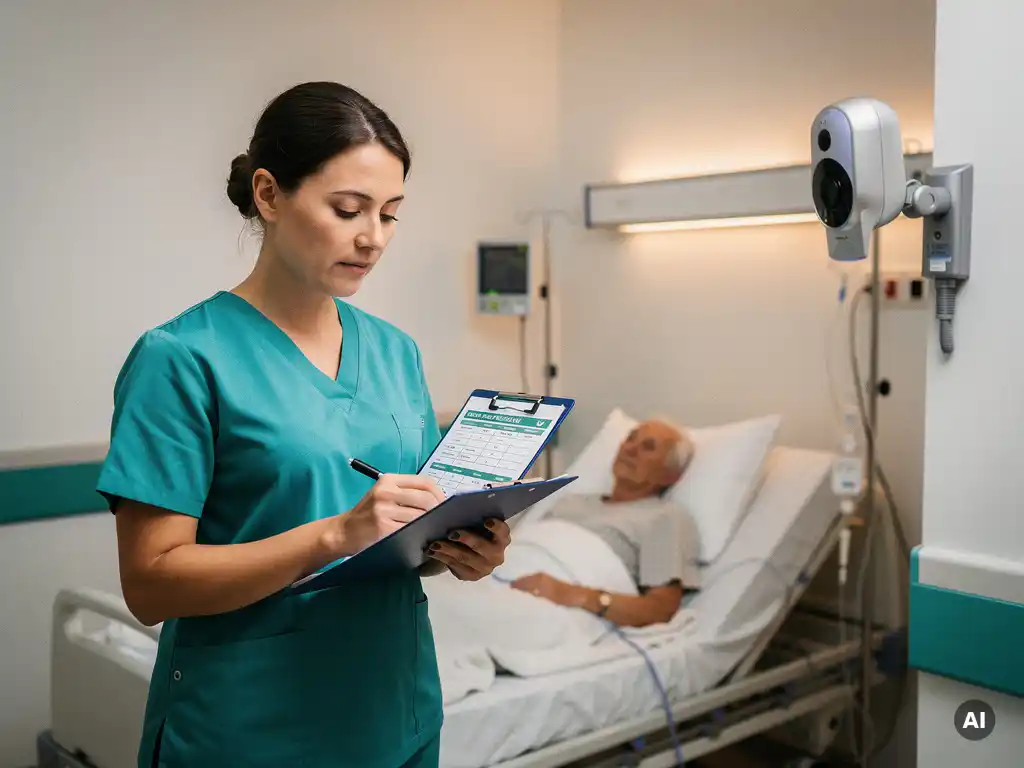
When comparing suppliers of AI patient monitoring systems, four criteria are decisive: the accuracy of fall detection, the level of privacy protection, the ease of implementation, and the degree of compliance with applicable standards. Care organizations struggling with staff shortages and increasing care demands need a system that reliably alerts, safeguards patient privacy, and becomes operational quickly. In this article, we answer the most frequently asked questions to help you make a well-informed choice.
What criteria determine the quality of an AI monitoring system?
The quality of an AI monitoring system for patients is determined by four key factors: detection accuracy, the number of false alarms, privacy safeguards, and the degree of integration with existing care processes. A system that scores strongly on all these points effectively supports care staff without creating additional workload.
When evaluating systems for patient monitoring, it is important to look beyond marketing promises. Ask suppliers for concrete performance data and independent validation. Relevant quality criteria include:
- Detection accuracy: How well does the system recognize dangerous situations such as falls, restless behavior, or risky lying positions?
- False alarm frequency: How often does the system trigger an alarm that does not correspond to an actual emergency?
- Privacy protection: Are images processed without human intervention, and does the system comply with GDPR and sector-specific standards?
- Scalability: Can the system be easily expanded to multiple rooms or locations?
- Certifications: Does the supplier hold recognized security certifications such as ISO 27001 or NEN 7510?
How reliable are a system’s fall detection and alerting capabilities?
The reliability of fall detection and alerting can be measured by two indicators: the percentage of actual fall incidents the system detects (sensitivity) and the number of false alarms it generates. A system that produces too many false alarms leads to alarm fatigue among care staff and undermines trust in the technology.
Traditional motion sensors and older camera systems generate relatively many false notifications. Modern AI systems that use computer vision and machine learning are able to distinguish between normal movements and genuinely dangerous situations. This results in a dramatically lower number of unnecessary alarms.
Ask every supplier for documented performance figures from real-world practice, not just from laboratory research. Also look at response time: how quickly does a care worker receive a notification after an incident has been detected? Every second counts in a fall incident.
How does an AI monitoring system protect patient privacy?
A good AI monitoring system protects patient privacy by processing images exclusively automatically, without staff or third parties viewing them. Care personnel are only alerted when the system detects an unsafe situation, so the patient is not continuously observed by people.
Privacy is a particularly sensitive topic in the care sector. Patients and residents have the right to dignity and personal space, even when they require monitoring. When comparing systems, the following privacy safeguards are essential:
- Images are processed by algorithms, not viewed by staff or external parties
- Data is stored in accordance with GDPR requirements and sector-specific standards
- The supplier holds certifications such as ISO 27001 and NEN 7510
- A clear data processing agreement is available
- Patients and/or their representatives are informed about the use of the system
What is the difference between AI monitoring and traditional camera surveillance?
The fundamental difference between AI monitoring and traditional camera surveillance is that AI systems automatically analyze images and only raise an alert during an actual incident, whereas traditional surveillance requires staff to actively watch the footage. AI monitoring thereby reduces workload, improves privacy, and increases response speed.
Traditional camera surveillance brings several disadvantages in a care context. It requires continuous human attention, which is barely feasible given staff shortages. Moreover, patients experience it as a violation of their privacy when they know someone is watching. And in the event of an incident, response time depends on how attentive the staff member is at that moment.
AI-based patient monitoring resolves these issues by continuously and automatically analyzing footage, without human intervention in image processing. Care staff are only called upon when the situation requires it. This makes care not only safer, but also more efficient and more respectful to the patient.
What questions should you ask a supplier before purchasing?
Before purchasing an AI monitoring system, it is essential to question suppliers on accuracy, privacy, compliance, ease of implementation, and support. Good suppliers can answer all these questions concretely and transparently with evidence from real-world practice.
Use the following questions as a guide in your supplier conversations:
- What is the demonstrable detection accuracy of your system, and how many false alarms does it generate on average per month?
- Are images stored or viewed by people, and if so, under what circumstances?
- What security certifications do you hold, such as ISO 27001 or NEN 7510?
- How does installation and configuration proceed, and how much time does it take per room or location?
- What support do you offer after implementation, and how quickly do you respond to technical issues?
- Do you have references from comparable care organizations that I can consult?
- How is the system updated and improved as the AI evolves?
How does the implementation of AI patient monitoring work in practice?
The implementation of an AI patient monitoring system ideally follows a plug-and-play approach: the system is configured and installed without major modifications to the existing infrastructure. After a brief setup phase, the system is operational and care workers can immediately make use of the automatic alerting.
In practice, a successful implementation consists of several steps. First, an inventory is made of the spaces and the desired monitoring coverage. The hardware is then placed and configured to the specific situation of the facility. This is followed by a test phase in which the system is calibrated and staff are trained in using the notifications and the dashboard.
An important consideration during implementation is communication toward patients and residents. Transparency about the use of AI monitoring contributes to acceptance and trust. Also ensure clear agreements about responsibilities: who handles which type of alarm, and how is escalation managed?
How Kepler Vision Technologies helps with AI patient monitoring
At Kepler Vision Technologies, we develop AI software that supports care organizations in addressing staff shortages and improving patient safety. Our solutions are specifically designed for elderly care facilities and hospitals looking for reliable, privacy-friendly monitoring.
What sets us apart:
- Exceptionally low false alarm frequency: Our system generates on average only one false alarm every 92 days, which is a thousand times better than traditional technologies
- Complete privacy protection: Images are never viewed by people; care staff only enter the room when our system requests it
- Broad detection capabilities: In addition to fall detection, we also offer fall prevention and lying position recognition
- Robust compliance: We are certified according to ISO 27001 and NEN 7510, and hold a portfolio of 21 patents
- Simple implementation: Our plug-and-play concept ensures fast and smooth installation without major modifications to existing infrastructure
Want to know how we can support your care organization? Discover our AI monitoring solutions and contact us for a no-obligation conversation.
Frequently Asked Questions
How long does it take for an AI monitoring system to be fully operational after installation?
The lead time from installation to a fully operational system varies by supplier and location, but modern plug-and-play systems are typically configured and active within one to a few days per location. After the technical installation, a brief calibration phase follows in which the system is fine-tuned to the specific room and situation. Also allow for a short onboarding period for staff, so they become familiar with the dashboard and the alerting processes.
What are the most common mistakes care organizations make when selecting an AI monitoring system?
A common mistake is focusing too strongly on the purchase price without taking into account the total long-term costs, such as maintenance, updates, and support costs. In addition, organizations often forget to ask suppliers for independently validated real-world performance figures rather than laboratory results. Finally, communication toward patients and their families is regularly overlooked, which can hinder acceptance of the system.
Is additional Wi-Fi or network infrastructure needed for AI patient monitoring?
This depends on the chosen system and the existing infrastructure of the care facility. Some systems process images locally on the device itself (edge computing), which reduces dependence on a stable network connection and also benefits privacy. It is advisable to explicitly ask the supplier what network requirements apply and whether any adjustments to the existing IT infrastructure are needed before installation begins.
How do patients and residents typically respond to the presence of an AI monitoring camera in their room?
Acceptance among patients and residents is generally greater when they are well informed about how the system works and what it does and does not record. It is important to emphasize that images are not viewed by staff or third parties, but are processed exclusively automatically. Transparent communication, preferably also toward family members or legal representatives, and involving residents in the decision contribute greatly to understanding and trust.
Can an AI monitoring system be integrated with existing care information systems or alerting platforms?
Many modern AI monitoring systems offer integration options with existing care information systems (CIS), nurse call systems, or communication platforms via standard API connections. This ensures that alarms reach the right staff member directly via the communication device already in use, such as a pager, smartphone, or tablet. Ask the supplier specifically which systems and protocols are supported and whether custom integrations are possible.
What happens to the data if we decide to stop using a supplier?
This is a critical question that is often asked too late. Make sure the data processing agreement clearly specifies what happens to stored data upon termination of the contract: will data be deleted, returned, or archived, and within what timeframe? A reliable supplier offers transparent and GDPR-compliant agreements on this and ensures a controlled offboarding without sensitive patient data being left unattended.
Is AI patient monitoring also suitable for smaller care facilities or home care organizations?
Yes, modern AI monitoring systems are often scalable and can be deployed from a single room to hundreds of locations. For smaller care facilities or home care organizations, it is especially important to pay attention to the flexibility of the subscription model and the minimum technical requirements for installation. Some suppliers offer specific packages for small-scale care, where the entry threshold in terms of cost and technology has been deliberately kept low.
Related Articles
- How to Choose the Right AI Patient Monitoring for a Healthcare Organization
- How do you measure workload within a team?
- How often should a fall risk assessment be performed?
- What is the average response time for fall prevention alarms for seniors?
- How does AI support continuous care without physical presence?
This content was generated with the help of AI and it may contain mistakes