


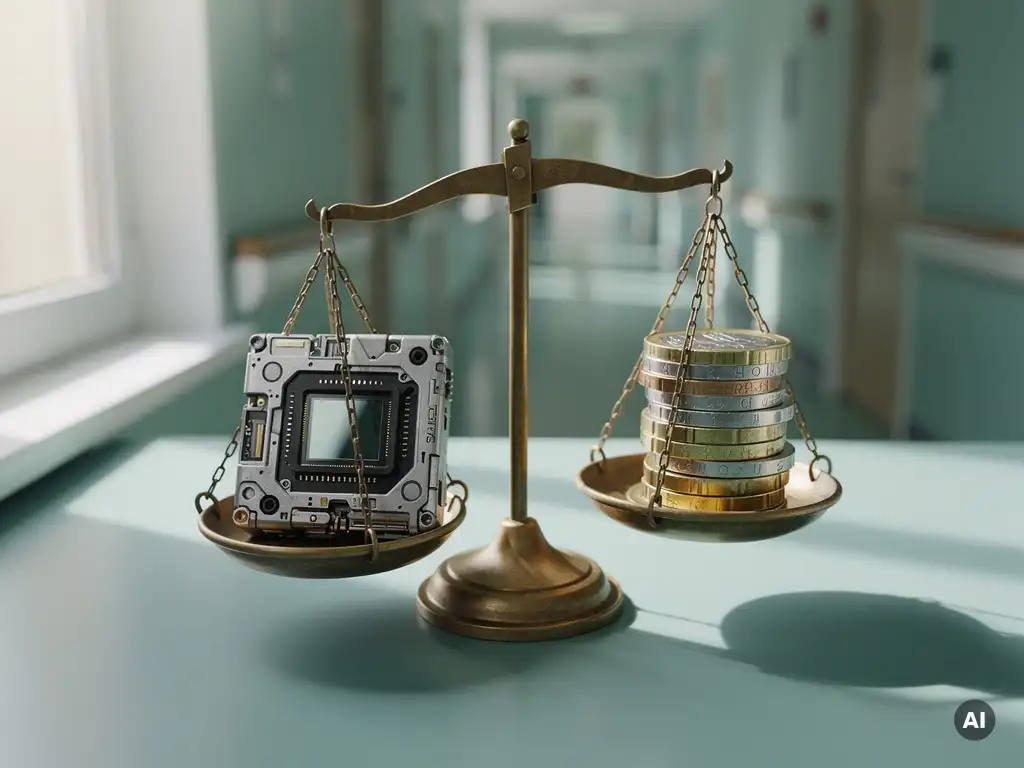
The implementation costs of AI fall detection in a nursing home typically range from a few thousand to tens of thousands of euros, depending on the number of rooms, the chosen software, and the required hardware. Recurring licensing and maintenance costs add to this, but in most cases are more than offset by savings on staffing and the prevention of fall incidents. In this article, we answer the most frequently asked questions about costs, implementation, and return on investment.
What factors determine the cost of AI fall detection?
The cost of AI fall detection for elderly residents is determined by three main factors: the number of rooms or beds to be monitored, the required hardware such as cameras or sensors, and the software license. Larger facilities often benefit from economies of scale, while smaller nursing homes pay relatively more per room.
In addition to the size of the facility, the following factors also play a role:
- Type of hardware: Some systems work with existing camera infrastructure, while others require specific sensors or depth cameras.
- Integration with existing systems: Connecting with an electronic client record (ECD) or nurse call system may incur additional costs.
- Installation complexity: The structural layout of the building and network quality affect installation time and therefore costs.
- Support and training: Some providers charge separately for onboarding and staff training, while others include this in the total package.
A plug-and-play approach, where the software can be quickly configured and installed, can significantly reduce initial costs by requiring less technical implementation time.
What are the recurring costs after the initial implementation?
After the initial installation, the recurring costs of AI fall detection consist primarily of an annual or monthly software license, technical support costs, and any hardware updates. These costs vary by provider, but typically amount to a fixed fee per room or per location per year.
Specifically, you can expect the following recurring cost items:
- Software license: A subscription fee that provides access to the AI software, updates, and new features.
- Technical support: Helpdesk and proactive maintenance to ensure system availability.
- Hardware maintenance: Replacement or calibration of sensors and cameras over time.
- Compliance updates: Adjustments to the software when laws and regulations change, for example regarding data protection.
When comparing providers, it is wise to always calculate the total cost of ownership over multiple years, not just the initial investment.
How much staff can AI fall detection save in a nursing home?
AI fall detection for elderly residents can significantly ease the burden of night shifts in a nursing home. Because the software continuously monitors and only alerts when an actual incident occurs, care staff need to make fewer preventive check rounds. In practice, this means fewer staff members need to be scheduled simultaneously for supervisory tasks.
The exact staffing savings depend on current staffing levels and the type of care, but the benefits are wide-ranging:
- Fewer unnecessary room rounds thanks to reliable automated monitoring.
- Care staff can focus on direct caregiving instead of preventive supervision.
- Night shifts can be scheduled more efficiently, which increases job satisfaction and reduces turnover.
- Faster response to real incidents, meaning fewer staff members are needed simultaneously to resolve situations.
In a sector where demand for care is growing by approximately 6% per year while the supply of care staff lags behind, every efficiency gain is of great value. AI fall detection does not fully solve the staffing shortage, but it significantly eases the pressure on the existing team.
How long does the implementation of AI fall detection take?
The implementation of AI fall detection in a nursing home takes an average of a few days to a few weeks, depending on the size of the location and the chosen solution. Systems with a plug-and-play concept are typically operational within a few days, while more complex integrations with existing care systems take more time.
A typical implementation process looks as follows:
- Preparation: Network inspection, determining camera positions, and coordination with the IT department.
- Hardware installation: Placing sensors or cameras in the selected rooms.
- Software configuration: Setting alarm thresholds, alarm routes, and connections with nurse call systems.
- Training: Familiarizing care staff with the system and alarm response procedures.
- Go-live and monitoring: A short startup period during which the system is fine-tuned based on the real-world situation.
A phased rollout, where one or two departments are equipped first, shortens the lead time and makes it easier to evaluate the system before the entire facility transitions.
When does a nursing home recoup its investment?
A nursing home typically recoups its investment in AI fall detection within one to three years. The payback period is determined by savings on staffing, the reduction of fall incidents and the associated care costs, and the avoidance of costs associated with fall-related injuries.
Falling is one of the most costly incidents in elderly care. A fall with injury can lead to hospitalization, rehabilitation, and a more intensive care need. When AI fall detection detects falls more quickly or even prevents them, these costs decrease structurally. Combine that with savings on night shifts and the higher staff satisfaction that leads to lower turnover, and the business case quickly becomes concrete.
To calculate the payback period for your specific situation, it is useful to track the following data:
- Current costs of fall incidents per year (care, administration, liability).
- Staff costs for night and supervisory duties.
- Turnover costs due to workload and staff dissatisfaction.
What privacy and compliance requirements apply to AI fall detection?
AI fall detection in nursing homes must comply with the General Data Protection Regulation (GDPR), and providers active in healthcare must also comply with the NEN 7510 standard for information security in healthcare. Image processing in care facilities is sensitive and requires explicit safeguards for residents’ privacy.
Key compliance requirements are:
- GDPR compliance: Personal data may only be processed for the purpose for which it was collected, with a valid legal basis.
- NEN 7510: The Dutch standard for information security in healthcare, comparable to ISO 27001 but specific to the healthcare sector.
- Data minimization: Systems may not process more data than is strictly necessary for the monitoring function.
- No human viewing of images: Privacy-friendly systems process images exclusively in an automated manner, without staff or third parties viewing the images.
This last point is in practice a crucial distinction. Systems where human eyes watch camera footage rightfully provoke resistance from residents and their families. Technology that analyzes images only by machine and only alerts when an actual incident occurs respects the dignity and privacy of residents considerably better.
How we help with AI fall detection in nursing homes
We at Kepler Vision Technologies develop AI software specifically designed for the challenges of elderly care. Our solution offers nursing homes a reliable, privacy-friendly way to automate fall detection without compromising resident safety. Specifically, we offer:
- Kepler Night Nurse: 24/7 automated monitoring with immediate alerting upon a fall, so care staff can respond within seconds.
- Exceptionally low error rate: Only one false alarm per 92 days, which drastically reduces the workload on staff compared to older technologies.
- Privacy by design: Images are never viewed by humans. Care staff only enter the room when the software indicates a reason to do so.
- ISO 27001 and NEN 7510 certified: Full compliance with applicable information security standards in healthcare.
- Simple implementation: Plug-and-play concept that is quick to plan, configure, and install, even in existing buildings.
Would you like to know what AI fall detection can mean for your facility and how quickly the investment pays off? Discover our solutions and get in touch for a no-obligation conversation.
Frequently Asked Questions
Can AI fall detection also be used during the day, or is it only suitable for nighttime monitoring?
AI fall detection works 24 hours a day, 7 days a week — not just at night. Although the night shift is the most obvious application due to limited staffing, continuous monitoring also adds value during the day. Think of moments when staff are occupied with other care tasks and a resident is unattended in their room. The system always alerts immediately upon an incident, regardless of the time of day.
What if a resident objects to cameras or sensors in their room?
This is a frequently asked and legitimate concern. Privacy-friendly systems, such as those that use automated image analysis without human viewing, significantly lower the threshold. In practice, an open conversation with residents and family members — explaining that no one views the images and the system only alerts upon an incident — helps to overcome resistance. It is also advisable to document in the care plan how monitoring is arranged and on what legal basis.
How does the system handle false alarms, and what is the impact on staff?
False alarms are one of the biggest pain points with older detection technologies: too many false alerts lead to alarm fatigue, where staff start taking notifications less seriously. Modern AI systems are trained on large datasets to accurately interpret movements and distinguish a fall from, for example, someone bending over or lying down. A low error rate — such as one false alarm per 92 days — is a concrete and comparable benchmark to request from providers.
Is AI fall detection also suitable for smaller residential care locations or home care settings?
Yes, although the business case is most immediately visible for large nursing homes, there are also solutions available that scale to smaller locations. Plug-and-play systems are particularly attractive for smaller facilities because they do not require extensive IT infrastructure. For home care, additional privacy and logistical considerations apply, but the range of suitable monitoring solutions is growing there as well.
What questions should I ask when comparing AI fall detection providers?
Ask providers specifically about: the average error rate (false alarm ratio), certifications in the area of information security (ISO 27001, NEN 7510), whether images are processed by machine or by humans, what is included in the license price (support, updates, training), and what the average implementation time is at comparable facilities. A trial period or reference visit to an existing customer also provides valuable real-world insights.
Are there subsidies or funding options available for purchasing AI fall detection?
There are various funding options that care facilities can use. For example, the government’s Stimuleringsregeling E-health Thuis (SET) offers subsidies for digital care innovations during certain periods, and there are regional funds and health insurer initiatives that support pilots with care technology. It is advisable to ask the provider whether they have experience with applying for subsidies and whether they can provide support in this area, as the availability of schemes changes regularly.
How do I involve care staff in the introduction of AI fall detection to minimize resistance?
Involve staff as early as possible in the process — preferably already in the selection phase — and communicate clearly about the goal: the system supports them, it does not replace them. Practical training and a short adjustment period during which staff learn to trust the system are essential. Experiences from colleagues at other facilities that are already working with the system are often more convincing than technical specifications.
Related Articles
- How does delegating help reduce workload?
- What is the role of the manager in managing workload?
- How do you prevent staff shortages in your organization?
- What is work pressure and what are the causes?
- Hoe verbeter je de acceptatie van valpreventie voor ouderen bij bewoners?
This content was generated with the help of AI and it may contain mistakes