


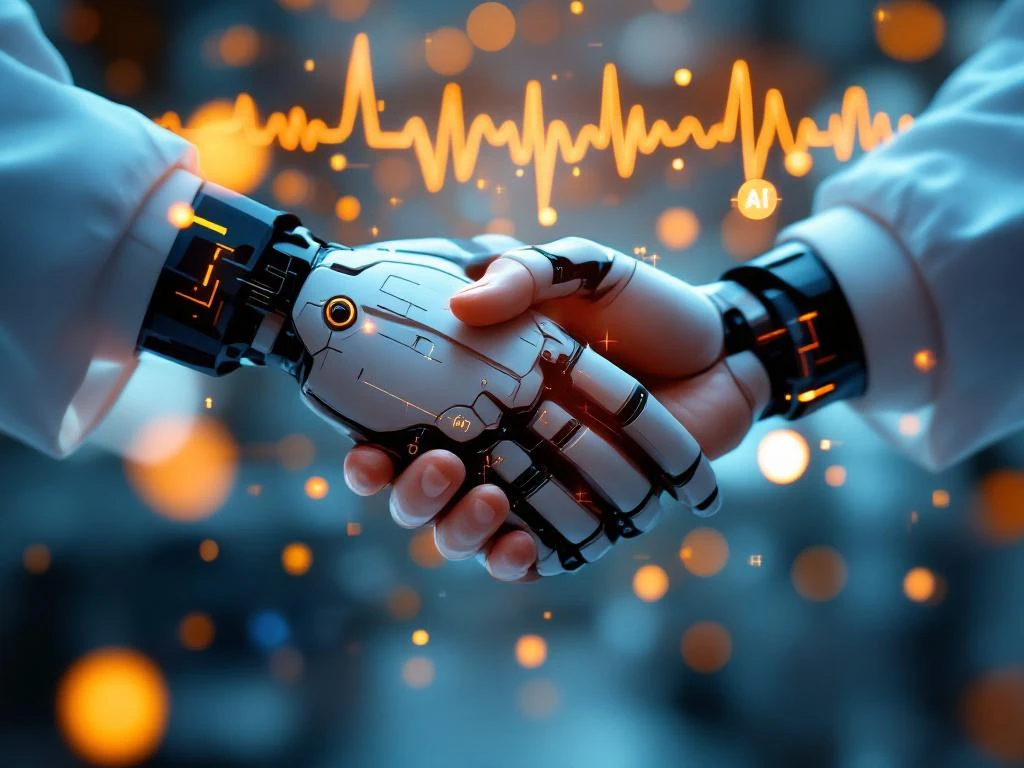
AI in healthcare improves collaboration between technology and healthcare providers by offering smart systems that support and relieve staff. The technology takes over time-consuming tasks such as monitoring and administration, giving healthcare workers more time for direct patient care. This helps healthcare organizations address staff shortages while simultaneously improving the quality of care through accurate, continuous patient monitoring.
What is AI in healthcare and why is it important?
AI in healthcare is artificial intelligence that helps healthcare staff monitor, diagnose, and treat patients. It encompasses smart systems that recognize patterns, make predictions, and automatically respond to situations that require attention.
Healthcare organizations are increasingly investing in AI solutions because they face growing staff shortages while demand for care increases annually. AI offers a practical way to address this challenge.
The main benefits of AI in healthcare are:
- Increased efficiency through automation of routine tasks
- More accurate monitoring and faster problem detection
- Support for healthcare staff in decision-making
- Continuous monitoring without human intervention
- Better distribution of available staff
AI systems work as an extra pair of eyes and hands that never get tired. They can recognize patterns that humans might miss and alert when action is needed.
How does AI solve staff shortages in healthcare?
AI helps address staff shortages by taking over time-consuming tasks that normally require significant attention from healthcare workers. Smart systems can automate continuous monitoring, administrative tasks, and routine checks, allowing staff to focus on direct patient care.
Automatic monitoring is one of the most effective applications. Instead of healthcare workers having to manually check every few hours whether patients are safe, AI systems do this continuously. They immediately detect when someone needs help and only then send an alert.
This has several benefits for healthcare organizations:
- Less time spent on routine checks
- Faster response in emergency situations
- Ability to care for more patients with the same staff
- Reduced workload and stress for healthcare workers
- Better work-life balance through more efficient work processes
Smart alarm systems ensure that healthcare staff are only disturbed when action is actually needed. This prevents unnecessary interruptions and helps employees stay focused on their most important tasks.
Which AI applications work best in hospitals and healthcare facilities?
Fall detection, patient monitoring, and predictive analytics are the most effective AI applications in healthcare facilities. These systems have proven value because they directly contribute to patient safety and operational efficiency.
Fall detection works particularly well in elderly care facilities and hospitals. AI systems can detect within seconds when someone falls and automatically summon help. This significantly shortens the time between incident and assistance.
The most successful AI applications in different healthcare settings are:
Elderly Care Facilities
- Automatic fall detection and fall prevention
- Monitoring of sleep patterns and movement
- Medication reminders and compliance tracking
Hospitals
- Patient monitoring on wards
- Prediction of patient deterioration
- Automation of administrative processes
Psychiatric Clinics
- Behavioral monitoring and risk detection
- Analysis of patient interactions
- Support in therapy evaluation
These applications work best because they offer clearly measurable benefits and are relatively easy to implement without major changes to existing work processes.
How does AI ensure patient privacy and safety?
Modern AI systems in healthcare ensure privacy by processing images and data locally, without humans ever viewing them. The systems work with advanced encryption and comply with strict regulations such as GDPR and NEN 7510 standards.
Privacy protection in AI systems works at different levels. The main protection measures are:
- Local data processing without cloud storage of sensitive images
- Automatic deletion of image material after processing
- Encryption of all data during transport and storage
- Access control and audit trails for all system activities
- Regular security audits and compliance checks
An important advantage of modern AI solutions is that healthcare workers only need to enter the patient room when the system requests it. This means less privacy disruption and more dignity for patients.
Compliance with regulations is ensured through:
- ISO 27001 certification for information security
- NEN 7510 compliance for Dutch healthcare institutions
- GDPR-compliant data processing and storage
- Transparent documentation of all data processes
These security standards ensure that patient data remains safe while healthcare organizations still benefit from the advantages of AI technology.
How Kepler Vision helps with AI collaboration in healthcare
Kepler Vision offers plug-and-play AI solutions that help healthcare organizations solve staff shortages through continuous patient monitoring. Our systems Kepler Night Nurse and NurseAssist work 24/7 and immediately detect when patients need help.
Our AI solutions distinguish themselves through:
- Exceptional accuracy with only one false alarm per 92 days
- Complete privacy protection without human review of images
- Easy installation without major system changes
- International compliance with ISO 27001 and NEN 7510 standards
- Proven results in healthcare facilities throughout Europe
Kepler Night Nurse watches over clients in elderly care facilities and detects falls, movement patterns, and unsafe situations. NurseAssist supports hospital staff with patient monitoring and helps prioritize care tasks.
Our systems are developed based on 21 international patents and are used by healthcare organizations that want to invest in reliable privacy-friendly AI technology.
Want to know how AI monitoring can help your healthcare organization? Contact us for a demonstration of our solutions and discover how we can work together to address staff shortages while improving the quality of care.
Frequently Asked Questions
How long does it take to implement AI systems?
Implementation typically takes 2-4 weeks, including installation and staff training.
Does AI replace healthcare staff?
No, AI supports staff by handling routine monitoring, allowing them to focus on direct patient care.
Is patient privacy protected with AI monitoring?
Yes, modern AI processes data locally without humans viewing images, complying with GDPR and healthcare standards.
Related Articles
- What are the benefits of intelligent care systems?
- How is innovation changing the way healthcare is delivered?
- What innovations make healthcare safer and more efficient?
- How does technology change the relationship between healthcare provider and client?
- What are the opportunities of artificial intelligence for healthcare institutions?