

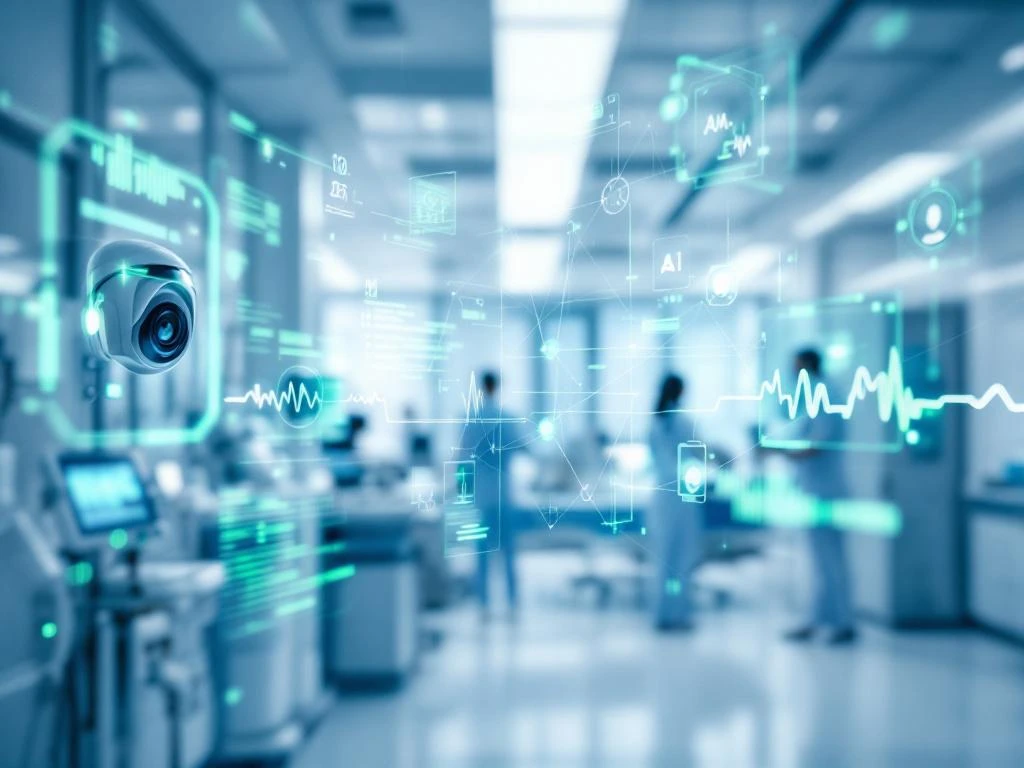
Technology plays an increasingly important role in early warning systems through continuous monitoring and direct alerts in risk situations. AI in healthcare helps solve staff shortages through automatic detection of emergency situations, such as falls or changes in patient condition. Modern systems combine computer vision, sensors and machine learning for reliable monitoring that supports healthcare workers and improves patient safety.
What is early warning in healthcare and why is it becoming increasingly important?
Early warning in healthcare means timely recognition of risk situations before they lead to serious problems. It involves detecting falls, changes in health or emergency situations, so that healthcare workers can intervene quickly.
The benefits of timely intervention are significant. When you notice a fall immediately, you prevent someone from lying on the floor for hours. This considerably reduces the risk of injuries and complications. Quick help often means better recovery and less trauma for patients.
Staff shortages make early warning extra relevant for modern healthcare institutions. With fewer hands available, healthcare workers cannot be everywhere at once. Automatic monitoring fills these gaps by providing continuous surveillance, even at night when fewer staff are present.
The increasing demand for care strengthens this need even further. More patients means more risks to monitor. Technology helps healthcare institutions deliver quality care despite pressure on the system.
Which technologies enable early warning in healthcare institutions?
Computer vision systems, AI monitoring, sensors and wearables form the foundation for modern early warning systems. These technologies work together to automatically recognize risk situations and immediately raise alarms when necessary.
AI in healthcare analyzes patterns and behavior to detect anomalies. Machine learning algorithms learn what normal behavior is and signal when something unusual happens. This can be a sudden fall, but also subtle changes in movement patterns that indicate health problems.
Computer vision systems use cameras to process visual information. They can track movements, detect falls and even analyze body postures. The advantage is that they require no physical contact with patients.
Sensors and wearables measure various parameters, such as heart rate, movement and sleep patterns. These devices provide continuous feedback about patients’ condition and can signal trends that indicate deterioration.
Modern systems combine these technologies for maximum reliability. By using different data sources, they can minimize false alarms while reliably detecting real emergency situations.
How does fall detection technology work in practice?
Fall detection systems use computer vision and AI to analyze movement patterns and directly recognize falls. They distinguish normal movements from sudden falls by measuring the speed and direction of movement, then raise alarms within seconds.
The technology works through continuous analysis of video images. Machine learning algorithms are trained on thousands of examples of normal movements and fall incidents. They recognize patterns such as sudden downward acceleration, unusual body posture on the ground or prolonged lying still.
Modern systems minimize false alarms by analyzing multiple factors simultaneously. They look not only at movement, but also at context, such as time of day, location in the room and movement patterns preceding the incident.
The best fall detection systems achieve very high accuracy through advanced AI techniques. They continuously learn and adapt to specific environments and users. This results in reliable detection with minimal disruption to daily routine.
When a fall is detected, healthcare workers immediately receive a notification on their mobile device or in the central control room. This rapid communication ensures that help can be on site within minutes.
What are the benefits of automated monitoring for healthcare workers?
Automated monitoring supports healthcare staff by providing continuous surveillance without physical presence. Healthcare workers only receive alerts when help is actually needed, which saves time and reduces stress, while patient safety increases.
Continuous monitoring means that no emergency situation goes unnoticed. Even at night or during busy periods, the system keeps watch. This gives healthcare workers confidence that they will be immediately alerted when intervention is needed.
Timely warnings help prioritize tasks. Instead of performing routine checks, healthcare workers can spend their time on patients who actually need attention. This significantly improves the efficiency of the care process.
Reducing routine checks means more time for direct patient care. Healthcare workers can focus on conversations, treatments and personal attention. This increases the quality of care and job satisfaction.
Stress is reduced because healthcare workers know that technology helps them miss nothing. They need to worry less about what’s happening in rooms where they’re not present. This peace of mind improves their wellbeing and work performance.
How do modern healthcare technologies ensure privacy and security?
Modern healthcare technologies protect privacy by processing images without people viewing them. AI systems only analyze movement patterns and behavior, while personal images are automatically encrypted and secured according to strict healthcare standards, such as ISO 27001 and NEN 7510.
Privacy-protecting technologies ensure that patient data remains secure. Edge computing processes information locally on devices, so sensitive data doesn’t need to travel over networks. Encryption protects all data during storage and transmission.
Compliance with healthcare standards, such as ISO 27001 and NEN 7510, guarantees that systems meet the highest security standards. These certifications require extensive security measures, regular audits and continuous monitoring of all systems.
Access control ensures that only authorized personnel have access to systems and data. Multi-factor authentication, role-based access and audit trails track who viewed which information when.
Transparency about data processing helps build trust. Patients and their loved ones know exactly how their privacy is protected and can trust that technology improves their safety without compromising their dignity.
How Kepler Vision helps with early warning in healthcare
We develop AI healthcare monitoring solutions that watch over patients 24/7 and immediately alert during emergency situations. Our Night Nurse and NurseAssist software detect falls within seconds and generate on average only one false alarm per 92 days, allowing healthcare workers to focus on real emergencies.
Our advantages for healthcare institutions:
- Ultra-reliable detection – fall detection with unprecedented accuracy
- Privacy-first design – images are never viewed by humans
- Immediate alerts – healthcare workers receive notification within seconds
- Simple implementation – plug-and-play installation without complex configuration
- International certification – fully compliant with ISO 27001 and NEN 7510
Implementation is simple thanks to our plug-and-play concept. You don’t need to modify complex infrastructure. Our systems integrate seamlessly into existing care processes and support your staff directly from day one.
Would you like to know how our AI solutions can help your healthcare institution with early warning? Contact us for a personal demonstration and discover how technology can improve your quality of care. More information can be found at Kepler Vision.
Frequently Asked Questions
How accurate are AI fall detection systems?
Advanced AI systems achieve very high accuracy with only one false alarm per 92 days on average, continuously learning to improve detection reliability.
Is patient privacy protected with AI monitoring?
Yes, AI systems only analyze movement patterns without humans viewing images. All data is encrypted and meets strict healthcare standards like ISO 27001.
How quickly can AI systems detect emergencies?
Modern AI monitoring systems detect falls and emergencies within seconds, immediately alerting healthcare workers for rapid response.
Related Articles
- What are the consequences of staff shortages for patients and clients?
- How is the government addressing the staff shortage?
- Which sectors are struggling the most with staff shortages?
- What are the risk factors for fall prevention?
- What exactly is fall prevention for the elderly?
This content was generated with the help of AI and it may contain mistakes