


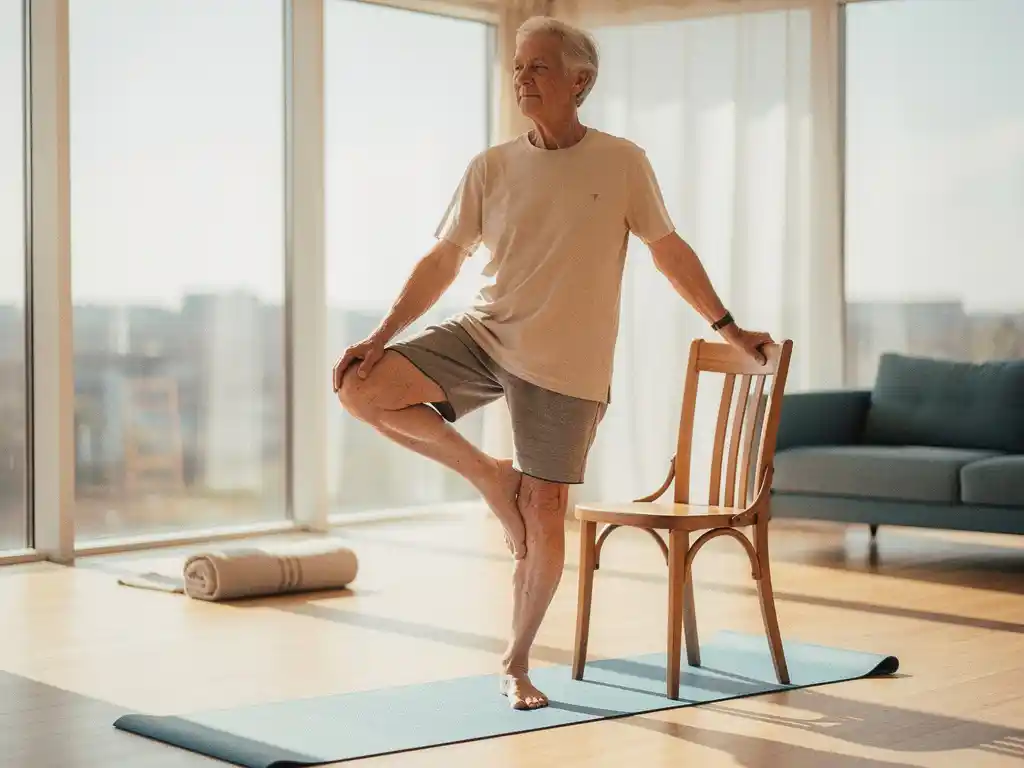
Falls are one of the biggest health risks for seniors, but with the right fall prevention exercises, you can improve your balance and strength at home. By exercising regularly, you significantly reduce your risk of falling and maintain your independence longer. Modern technology can also play a role in monitoring fall risks, but the foundation lies in actively working on your physical condition.
This guide provides you with practical exercises that you can safely perform at home, without special equipment. From simple balance exercises to strength training for your legs: you’ll discover which movements are most effective for fall prevention in seniors.
What are fall prevention exercises and why are they important?
Fall prevention exercises are specific movements and exercises that improve your balance, strength, coordination and flexibility to reduce the risk of falling. These exercises focus on strengthening muscles that are crucial for stability and training your sense of balance.
The importance of these exercises becomes clear when we look at the statistics. Falls are the leading cause of injury in seniors, and one in three people over 65 falls at least once a year. By doing fall prevention exercises regularly, you can reduce your fall risk by as much as 30%.
The exercises work in different ways: they strengthen the core muscles that keep you upright, improve your muscles’ reaction time to sudden movements, and train your proprioception. This is your ability to sense where your body is in space, which is essential for maintaining balance.
Which balance exercises can I safely perform at home?
Safe balance exercises for home include standing on one leg, heel-to-toe walking, and standing up from a chair. Always start with support from a sturdy chair or wall to ensure safety.
The single-leg stand is a fundamental exercise: stand next to a chair, hold the backrest, and lift one foot slightly. Try to stay standing for 10-30 seconds before switching legs. When this becomes easier, you can let go of the support.
In heel-to-toe walking, you place your heel directly in front of the toes of the other foot, as if walking on an imaginary line. Take 10-20 steps forward and backward. This exercise mimics the natural walking pattern and improves your dynamic balance.
The sit-to-stand exercise trains functional strength: sit on a sturdy chair, cross your arms over your chest, and stand up without using your hands. Repeat this 10-15 times. This movement corresponds to daily activities while strengthening your leg muscles.
How do I strengthen my leg muscles to prevent falls?
You can strengthen your leg muscles at home by doing calf exercises, sideways leg lifts, and wall squats. These exercises target the quadriceps, hamstrings, calves, and hip muscles, which are essential for stability.
Calf exercises are done by standing on your toes while holding a chair for support. Hold this position for 3 seconds and then slowly lower. Repeat this 10-15 times. Strong calf muscles help with push-off during walking and recovering your balance.
For sideways leg lifts, stand behind a chair and lift one leg sideways while keeping your torso straight. This exercise strengthens the hip muscles, which help prevent you from falling sideways. Alternate between both legs and do 10-15 repetitions per side.
Wall squats are safer than regular squats: lean with your back against a wall, slide down until your thighs are parallel to the ground, and push yourself back up. Start with 5-10 repetitions and build up slowly. This exercise strengthens all major leg muscles at once.
What is the difference between static and dynamic balance exercises?
In static balance exercises, you remain in one position, such as standing on one leg, while dynamic balance exercises involve movement, such as heel-to-toe walking or turning your head while balancing.
Static exercises are ideal for beginners because they are less complex and give you time to find your balance. Examples include standing on one leg, balancing on your toes, or standing with eyes closed. These exercises improve your proprioception and strengthen the small stabilizing muscles.
Dynamic exercises mimic real situations where you need to maintain your balance during movement. Think of walking while moving your head, stepping up on an elevation, or turning while walking. These exercises are more functional because they correspond to daily activities.
For optimal fall prevention, you need both types. Start with static exercises to build a strong foundation and gradually add dynamic movements. This way you stay stable in both quiet and moving situations.
How often should I do fall prevention exercises to see results?
For effective fall prevention, you should exercise at least 3 times per week, with sessions of 20-30 minutes. Consistency is more important than intensity, so it’s better to do regular short sessions than sporadic long workouts.
You usually notice the first results after 4-6 weeks of regular training. Your balance improves gradually and you feel more confident when walking and standing. After 12 weeks of regular training, most improvements in strength and balance are clearly noticeable.
An effective weekly schedule combines different types of exercises: Monday balance exercises, Wednesday leg strength training, and Friday a combination of both. Rest between workouts is important for muscle recovery and to prevent overexertion.
Listen to your body and adjust the intensity. Start with easy exercises and gradually increase the difficulty level. If you experience pain or dizziness, stop and consult your doctor before continuing with the exercises.
How we help with fall prevention
At Kepler Vision Technologies, we understand that fall prevention for seniors goes beyond just exercises. Our advanced AI technology provides 24/7 monitoring and support:
- Our Kepler Night Nurse detects falls within seconds and immediately alerts care staff.
- Fall prevention by recognizing risky situations before a fall occurs.
- Privacy is guaranteed because images are never viewed by humans.
- Only one false alarm per 92 days: 1,000 times more reliable than other technologies.
While you work on your strength and balance at home with the exercises from this article, our technology provides an extra layer of safety. Want to learn more about how we help care organizations with fall prevention? Discover our innovative solutions and experience how AI and human care together provide the best protection against fall incidents.
Frequently Asked Questions
Can I do fall prevention exercises if I have already fallen before?
Yes, fall prevention exercises are especially important if you have already fallen before. Start carefully with simple exercises and always keep support at hand. First consult with your doctor or physical therapist to create a safe exercise program that fits your specific situation.
What should I do if I feel dizzy during the exercises?
Stop the exercise immediately and sit down or hold onto a sturdy support. Dizziness can have various causes, such as low blood pressure or balance problems. Contact your doctor if this occurs regularly during exercise.
Are there certain medications that increase my fall risk?
Yes, some medications such as sleeping pills, blood pressure medications, and certain pain relievers can cause dizziness or muscle weakness. Discuss with your doctor or pharmacist which medications you use and whether these affect your fall risk. Never adjust your medication yourself.
How can I make my home safer against falls?
Remove loose rugs, ensure good lighting, install handrails on stairs and in the bathroom, and keep walkways clear of obstacles. Wear shoes with good grip and avoid slippery soles. A safe living environment is just as important as good physical condition.
Can I do these exercises with arthritis or joint pain?
Yes, but adapt the exercises to your limitations. Start with gentle movements and use warm compresses before training to reduce stiffness. Consult with a physical therapist for modified exercises that take your joint problems into account.
When should I seek professional help for fall prevention?
Seek professional help if you have fallen in the past six months, are regularly dizzy, have trouble getting up from a chair, or if you are afraid of falling. A physical therapist can assess your fall risk and create a personal exercise program.
Related Articles
- What are the legal rules regarding workload in the Netherlands?
- How does aging affect the labor shortage?
- What are the risk factors for fall prevention?
- What role does environmental modification play in fall prevention for older adults?
- Why is innovation a strategic theme within healthcare?
This content was generated with the help of AI and it may contain mistakes