


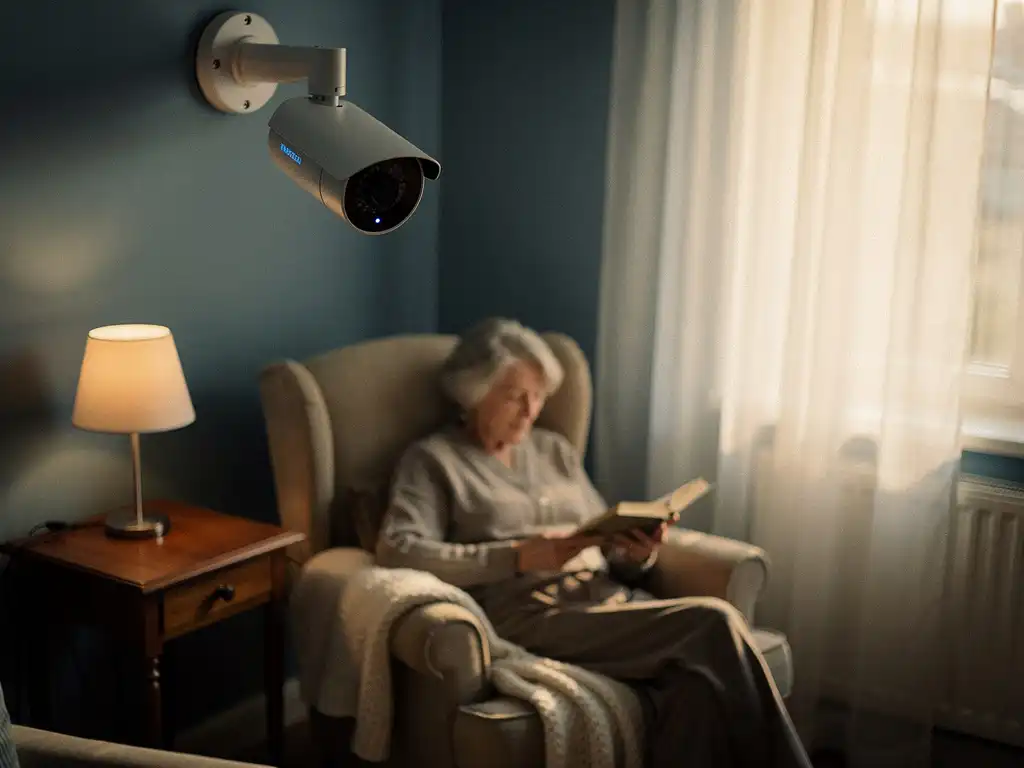
Fall prevention for elderly people is becoming increasingly important as care demands increase and staff shortages grow larger. Modern fall prevention systems promise 24/7 monitoring, but many organizations struggle with an abundance of false alarms that overburden care staff.
False positives in fall prevention systems can make the difference between effective care and frustration for both staff and residents. Understanding this challenge and choosing the right technology is crucial for successful implementation of fall prevention in care facilities.
What are false positives in fall prevention systems?
False positives in fall prevention systems are false alarms where the system incorrectly detects that someone has fallen, while no fall has actually occurred. These erroneous alerts arise when the technology interprets normal movements or situations as a fall incident.
Typical situations that lead to false positives include quickly sitting down or lying down, picking up objects from the floor, sudden movements while getting dressed, or even shadows that are interpreted by cameras as falling persons. With traditional systems, even pets or moving objects like wheelchairs can cause false alarms.
The problem is exacerbated because many systems cannot distinguish between different types of movements. A sudden downward movement is automatically marked as a fall, regardless of the context or the manner in which the movement occurs.
Why do traditional fall systems generate so many false positives?
Traditional fall prevention systems generate many false positives because they are based on simple motion detection and preset parameters, without the intelligence to understand context or analyze complex movement patterns.
These older technologies often work with basic sensors, such as accelerometers in wearable devices, or simple camera systems that only detect movement changes. They lack the sophistication to distinguish between a real fall and normal daily activities.
Moreover, traditional systems are often set too sensitively to avoid missing real falls, resulting in an abundance of false alarms. Some systems generate as many as 10 to 15 false positives per day, meaning care staff are constantly interrupted for situations that require no medical attention.
The limited processing power of older systems also means they cannot learn from previous situations or adapt to individual residents’ movement patterns.
How can AI technology drastically reduce false positives?
AI technology reduces false positives through advanced machine learning algorithms that can distinguish real fall patterns from normal movements, analyzing the context of the situation instead of just motion detection.
Modern AI systems use computer vision to analyze human movements in detail. They can recognize how a person moves before, during, and after a potential fall. This means the system can distinguish between someone who consciously sits down and someone who falls uncontrollably.
The power of AI lies in its ability to learn from thousands of hours of movement data. The system is trained on real fall situations and learns the subtle differences between different types of movements. This allows very accurate systems to be developed that generate only one false alarm per 92 days.
Additionally, AI systems can learn individual movement patterns and adapt to the specific needs and habits of each resident, further improving accuracy.
What impact do false positives have on care staff and residents?
False positives have a devastating impact on care staff by causing alarm fatigue: personnel become increasingly less responsive to alarms because they know most alerts are false, which paradoxically reduces safety.
For care staff, frequent false alarms mean their work is constantly interrupted. Each false positive requires a staff member to stop their current task, go to the resident, and check the situation. With 10 to 15 false positives per day, this can lead to frustration and reduced efficiency.
Residents also experience negative effects from false positives. Frequent, unnecessary checks can violate their privacy and cause stress. Moreover, this can lead to resistance to using fall prevention technology, which endangers overall safety.
At the organizational level, false positives lead to higher costs through wasted staff time and potentially to abandoning fall prevention technology, which actually undermines the original objectives of better care and increased efficiency.
How do you choose a fall prevention system with minimal false positives?
Choose a fall prevention system with minimal false positives by focusing on AI-based technology that can demonstrate specific accuracy statistics, preferably systems that generate less than one false alarm per month.
When evaluating systems, it’s essential to ask for concrete figures. Ask suppliers for specific data on false positive rates and don’t be put off with vague claims about “high accuracy.” A reliable system should be transparent about its performance.
Also consider the technology behind the system. AI-based computer vision systems generally perform much better than traditional sensor-based solutions. Look for systems that use machine learning and can learn from individual movement patterns.
Test the system if possible during a trial period. This gives you the opportunity to evaluate actual performance in your specific environment before proceeding to full implementation.
How Kepler Vision Technologies helps with fall prevention for elderly people
We at Kepler Vision Technologies have tackled this challenge by developing advanced AI technology that drastically reduces the number of false positives. Our solution generates only one false alarm per 92 days, which is 1,000 times better than traditional systems.
Our advantages for care organizations:
- Unprecedented accuracy with minimal false positives
- 24/7 monitoring without privacy violation
- Direct alerts within seconds of real falls
- Simple plug-and-play installation
- Full compliance with ISO 27001 and NEN 7510 standards
Discover how our fall prevention technology can help your care organization reduce false positives and improve care quality. Contact us for a no-obligation demonstration of our solution.
Frequently Asked Questions
How long does implementation of an AI-based fall prevention system take?
Implementation of an AI-based fall prevention system typically takes 2-4 weeks, depending on the size of the care facility. The installation itself is often plug-and-play and can be completed within a few days, but time is mainly spent on staff training and fine-tuning the system for the specific environment.
What are the costs of false positives for an average care facility?
False positives cost an average care facility approximately $15,000-25,000 per year through wasted care staff time. With 10 false positives per day and 5 minutes per check, nearly an hour per day is lost to unnecessary alarms. This translates to approximately 300 hours per year of wasted labor time.
Can residents turn off the fall prevention system if they have privacy concerns?
Modern AI-based fall prevention systems like those from Kepler Vision work without privacy violation by only analyzing movement patterns without storing images. However, residents can always indicate when they don’t want to be monitored, although this may affect their safety. Transparent communication about how the system works often helps address privacy concerns.
How accurate must a fall prevention system be to be effective?
An effective fall prevention system must detect at least 95% of real falls with a maximum of 1-2 false positives per week. Systems that generate more than 5 false positives per day lead to alarm fatigue and are often ignored by care staff, which completely undermines effectiveness.
What happens if the fall prevention system misses a real fall?
While no system is 100% perfect, modern AI systems have a detection rate of more than 95% for real falls. If a fall is missed, traditional emergency procedures remain in effect, such as regular check rounds and residents being able to raise alarms themselves. It’s important that fall prevention is seen as a supplement to, not a replacement for, existing care protocols.
How do we train our care staff to effectively handle fall prevention alarms?
Effective training includes explaining how the system works, when alarms should be taken seriously, and how quickly to respond to different types of alerts. Staff must learn to trust accurate systems and know that false positives are minimal. Regular evaluations and feedback on system performance help maintain alertness and confidence.
Related Articles
- What are the causes of the staff shortage in the healthcare sector?
- How do you recognize excessive workload due to understaffing?
- What privacy aspects are important in fall prevention for the elderly?
- What technology is used in fall prevention for the elderly?
- How does AI support continuous care without physical presence?
This content was generated with the help of AI and it may contain mistakes