


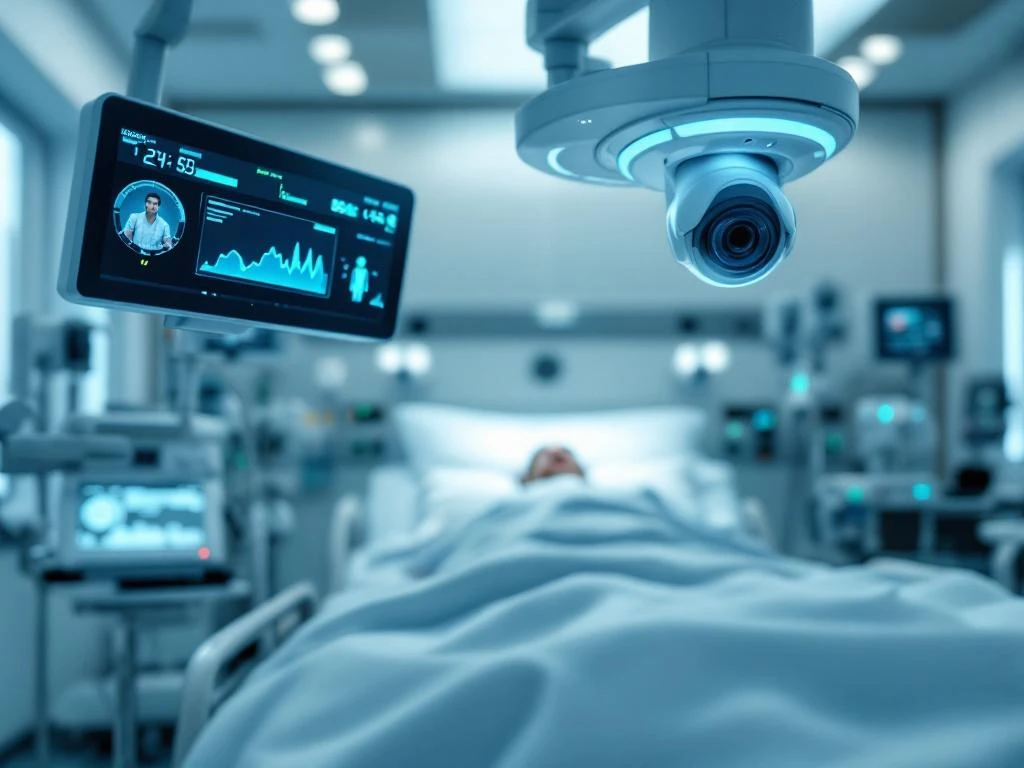
Healthcare institutions are increasingly investing in smart monitoring because they face growing staff shortages and rising care demand. AI in healthcare provides a solution through automatic monitoring that supports staff without violating patient privacy. This technology helps healthcare institutions work more efficiently while improving the quality of care.
What challenges drive healthcare institutions to seek smart monitoring?
Healthcare institutions struggle with three main problems that together create a perfect storm. Staff shortages make it difficult to attract and retain sufficient healthcare workers, while demand for care continues to rise annually due to an aging population.
The staff shortage in healthcare is becoming increasingly problematic. Many healthcare institutions cannot fill open positions, leading to higher workload for existing staff. This situation creates a vicious cycle: overworked employees leave the sector, making the shortage even greater.
At the same time, care demand is increasing by approximately 6% per year. More elderly people need care and patients live longer with more complex conditions. This means healthcare institutions must do more with fewer people.
The combination of these factors leads to safety risks. When staff are overloaded, important signals can be missed. Patients who fall or are in distress may not be noticed quickly enough. This forces healthcare institutions to seek technological solutions that can support staff.
What exactly is smart monitoring and how does it work in practice?
Smart monitoring uses AI technology, sensors and cameras to automatically monitor patients without human intervention. The system analyzes movements and behavior to detect unsafe situations and alert staff when necessary.
The technology works with advanced cameras that analyze images without people having to view these images. AI in healthcare recognizes patterns and movements that may indicate problems. The system learns what normal behavior is and what is abnormal.
Practical applications include:
- Fall detection: The system recognizes when someone falls and immediately sends an alarm to healthcare workers.
- Movement monitoring: Unusual movement patterns are detected, for example when someone lies still too long.
- Automatic alarm systems: Only relevant warnings are sent to prevent false alarms.
- Bed position detection: The system checks whether patients are lying safely.
The great advantage is that healthcare workers are only alerted when something is actually wrong. They don’t need to constantly walk around to check if everything is going well.
What benefits do healthcare institutions see immediately after implementing smart monitoring?
Healthcare institutions experience immediate measurable improvements in response times and patient safety. The main benefit is that help can be provided within seconds when someone falls or is in distress, instead of this only being discovered during the next round.
The benefits are concrete and immediately noticeable:
Faster response times: Staff are immediately alerted in emergency situations. This prevents patients from lying on the ground for long periods after a fall, which reduces the risk of injury.
Fewer false alarms: Modern systems are so accurate that they give far fewer unnecessary warnings than older technologies. This prevents alarm fatigue among staff.
More efficient staff use: Healthcare workers can better spend their time on direct patient care instead of preventive rounds. They know the system will alert them if something happens.
Cost savings: Fewer fall incidents mean fewer injuries and shorter hospital stays. Staff can also be deployed more effectively.
These benefits directly translate to better quality of care. Patients feel safer, families have more confidence and healthcare workers experience less stress because they know important situations don’t go unnoticed.
How do healthcare institutions handle privacy and security with smart monitoring?
Privacy and security are top priorities with smart monitoring. Healthcare institutions must comply with strict regulations such as GDPR and specific healthcare standards such as ISO 27001 and NEN 7510. The most important principle is that images are never viewed by humans.
The technical measures that healthcare institutions take are extensive:
Edge computing: Image analysis happens locally on the cameras themselves, so raw images never leave the system. Only signals about detections are forwarded, no image material.
Data encryption: All communication between systems is encrypted. Data cannot be intercepted or misused by unauthorized persons.
Access control: Only authorized staff can operate the system. There are strict protocols for who has access to what information.
No image storage: The system does not store videos or photos. It analyzes images in real-time and then deletes them. Only metadata about detections is kept for reporting.
For patients, this means their privacy is better protected than with traditional methods. Nobody watches through cameras and no images are stored that can be viewed later. Healthcare workers only enter the room when the system indicates this is necessary.
How Kepler Vision helps healthcare institutions with smart monitoring
Kepler Vision offers healthcare institutions two powerful solutions: Kepler Night Nurse and Kepler NurseAssist. These systems combine advanced AI in healthcare with exceptional accuracy and complete privacy protection for optimal patient care.
Our solutions offer unique benefits:
- Extreme accuracy: Only one false alarm per 92 days, which is 1,000 times better than traditional technologies.
- 24/7 monitoring: Continuous surveillance without interruptions or human intervention.
- Fall detection and fall prevention: Not only detects falls, but also recognizes risky situations before they escalate.
- Bed position detection: Automatically checks whether patients are lying safely and comfortably.
- Privacy-first design: Images are never viewed by humans and do not leave the system.
- Plug-and-play installation: Easy to plan, configure and install, without complex infrastructure changes.
Our 21 international patents and compliance with ISO 27001 and NEN 7510 standards guarantee that you’re investing in proven, secure technology. We already successfully help international healthcare organizations solve staff shortages while improving quality of care.
Want to know how our smart monitoring can help your healthcare institution? Contact us for a personal demo and discover how AI in healthcare can solve your challenges.
Frequently Asked Questions
How long does implementation take?
Implementation typically takes 2-4 weeks depending on your facility size. Our plug-and-play solution requires minimal infrastructure changes.
How accurate is the AI system?
Our systems achieve 99.9% accuracy with only one false alarm per 92 days, making them 1,000 times more reliable than traditional technologies.
What are the cost savings?
Investment costs are typically recovered within 12-18 months through reduced incidents, improved staff efficiency, and lower insurance claims.