

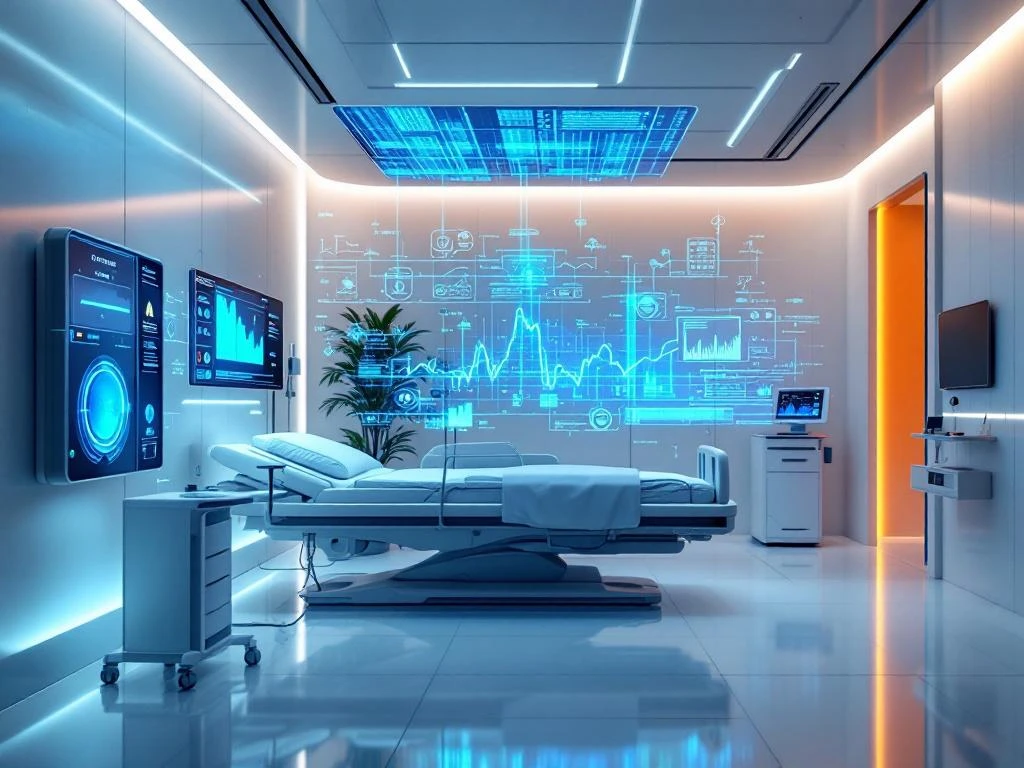
Healthcare monitoring is shifting from reactive to predictive because traditional systems respond too slowly to current healthcare challenges. Predictive monitoring uses AI in healthcare to prevent problems before they occur, while reactive systems only sound alarms after an incident. This shift helps healthcare organizations better manage staff shortages and increasing care demand through more efficient use of available resources.
What is the difference between reactive and predictive healthcare monitoring?
Reactive healthcare monitoring only responds after an incident has occurred, such as a fall or medical emergency. Predictive monitoring analyzes patterns and behavior to prevent problems before they happen. The difference lies in timing: responding versus preventing.
Reactive monitoring is all about quick response after an event. Think of traditional alarm buttons that patients press after a fall, or sensors that detect movement when someone is already on the ground. The system alerts care staff, but the damage has already been done.
Predictive monitoring works differently. AI in healthcare continuously observes behavioral patterns and detects deviations that may indicate increased risk. The system recognizes, for example, unusual movements that often precede a fall, or changes in sleep patterns that indicate health problems.
This technology learns from data to become increasingly better at predicting risk situations. This allows care staff to intervene preventively instead of reacting after the fact.
Why can healthcare organizations no longer rely solely on reactive monitoring?
Healthcare organizations can no longer rely solely on reactive monitoring due to three major challenges: staff shortages, an annual care demand growing by 6%, and the inefficiency of traditional systems. Reactive care has simply become too slow for modern healthcare needs.
The staffing shortage in healthcare grows larger every year. At the same time, demand for care services increases due to aging populations and more complex care needs. This combination ensures that care staff are constantly under pressure and cannot always respond immediately to alarms.
Traditional monitoring systems also generate many false alarms. This leads to ‘alarm fatigue,’ where care personnel become less alert to warnings. The result: real emergencies are missed or noticed too late.
Reactive monitoring also means that damage has already occurred before help arrives. With falls, this can lead to serious injuries, longer recovery periods, and higher care costs. For healthcare organizations with limited resources, this is unsustainable.
How does predictive monitoring work in practice?
Predictive monitoring works through continuous observation of patients via cameras and sensors, where AI systems recognize patterns and detect deviations. The technology analyzes movements, behavior, and environmental factors to assess risks before incidents occur.
The system begins by learning normal behavioral patterns of each patient. It records how someone normally walks, sleeps, or performs daily activities. This information forms a baseline against which new behavior is measured.
In fall prevention, AI in healthcare recognizes, for example, uncertain movements, changes in walking patterns, or situations where someone stands up too quickly. The system can also include environmental factors, such as obstacles on the floor or poor lighting.
When the system detects increased risk, it sends a warning to care staff. This gives them the opportunity to intervene preventively, for example by assisting the patient, removing obstacles, or paying extra attention during risk moments.
The technology continuously improves through machine learning. Each situation teaches the system to recognize new patterns, making predictions increasingly accurate.
What benefits does predictive healthcare monitoring offer to care staff?
Predictive healthcare monitoring offers care staff four important benefits: fewer false alarms, more efficient use of time and energy, better distribution of workload, and more room for actual patient care. This improves both working conditions and quality of care.
The most important benefit is the dramatic reduction of false alarms. Modern AI systems are so accurate that they generate only one false alarm per 92 days. This means care staff are only warned when something is actually wrong.
Through preventive warnings, care staff can better plan their time. Instead of constantly being reactive with emergency situations, they get the chance to provide proactive care. This reduces stress and gives more control over the workday.
The technology also helps with prioritizing tasks. The system indicates which patients need extra attention based on risk analyses. This allows care teams to focus their limited time on patients who are most vulnerable.
For care staff, this ultimately means more time for human contact and personal care. The AI takes over continuous monitoring, so they can concentrate on tasks that truly require human attention.
How Kepler Vision helps with the transition to predictive healthcare monitoring
Kepler Vision helps healthcare organizations transition to predictive monitoring with our Kepler Night Nurse and NurseAssist systems. These AI in healthcare solutions provide 24/7 monitoring with exceptional accuracy and complete privacy protection for patients and residents.
Our systems offer concrete benefits that are immediately noticeable in daily care delivery:
- Extreme accuracy: only one false alarm per 92 days, which is 1,000 times better than traditional systems
- Complete privacy: images are never viewed by humans; care staff only receive warnings when necessary
- Immediate fall detection: within seconds after a fall, care staff receive a notification
- Fall prevention: the system recognizes risky situations before incidents occur
- Easy implementation: the plug-and-play concept makes installation quick and simple
Our solutions are developed with input from care professionals and comply with all privacy standards, such as ISO 27001 and NEN 7510. The system integrates seamlessly into existing care processes, without additional burden for staff.
Want to know how predictive healthcare monitoring can help your organization? Contact us for a personal demonstration and discover how our AI technology can improve care delivery in your facility.
Frequently Asked Questions
How long does implementation take?
Kepler Vision systems are operational immediately after installation, but need 2-4 weeks to learn behavioral patterns for optimal accuracy.
How is patient privacy protected?
Images are never viewed by humans. AI analyzes movements in real-time and converts them to anonymous data, complying with ISO 27001 standards.
What are the cost savings?
While initial investment is higher, predictive systems save money through fewer incidents and efficient staff use. ROI typically occurs within 12-18 months.