

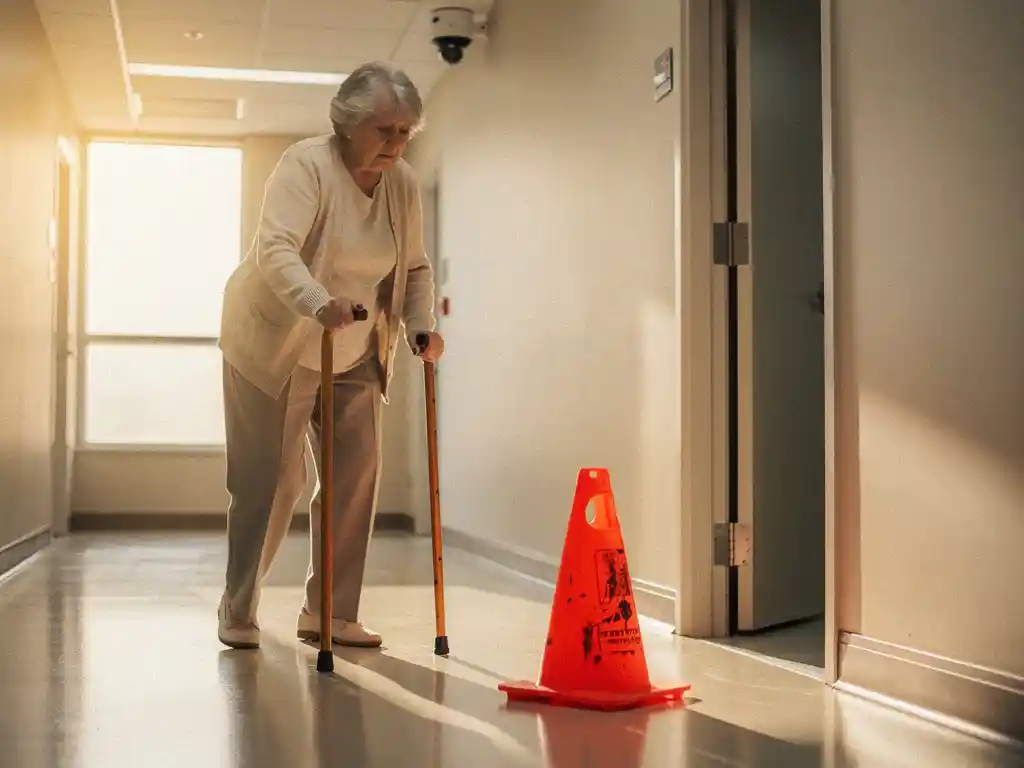
Falls are one of the biggest concerns in elderly care, with serious consequences for both residents and caregivers. Modern technology offers two important approaches to address this problem: fall detection and fall prevention. While both concepts focus on the safety of elderly people, they work in fundamentally different ways and each offer unique benefits for care organizations.
Understanding the difference between these two approaches is crucial for care organizations looking to invest in fall-related technologies. By making the right choice, they can not only improve the safety of their residents, but also relieve their staff and save costs.
What is fall detection and how does it work in elderly care?
Fall detection is a technology that automatically alerts when someone has fallen, so caregivers can respond immediately. These systems continuously monitor residents’ movements and recognize specific patterns that indicate a fall.
Modern fall detection systems use various technologies to identify falls. Camera-based systems analyze movement patterns and body postures, while wearable sensors detect sudden accelerations and changes in orientation. The most advanced systems combine artificial intelligence with computer vision to distinguish between normal movements and actual fall incidents.
The major advantage of fall detection lies in the fast response time. Within seconds after a fall, care staff receive an alarm, drastically reducing the time between the incident and medical help. This can be life-saving, especially with serious injuries such as hip fractures or head trauma.
What does fall prevention mean and what methods exist?
Fall prevention for elderly people encompasses all measures and interventions aimed at preventing falls before they occur. This proactive approach focuses on identifying and addressing risk factors that can lead to falls.
Various methods exist for fall prevention. Physical interventions include adapting the living environment, such as installing handrails, improving lighting, and removing tripping hazards. Medical interventions focus on optimizing medication, treating balance disorders, and strengthening muscles through physical therapy.
Technological fall prevention uses sensors and AI to recognize risky situations before a fall occurs. These systems can, for example, detect when someone is walking unsteadily, sitting too long on the edge of the bed, or showing unusual movement patterns that indicate an increased fall risk.
What is the main difference between fall detection and fall prevention?
The main difference between fall detection and fall prevention lies in the moment of intervention: fall detection responds after a fall, while fall prevention intervenes before a fall occurs. Fall detection is reactive and focuses on rapid assistance; fall prevention is proactive and focuses on reducing risks.
Fall detection systems are designed to alert as quickly as possible when a fall has occurred. Their effectiveness is measured by detection accuracy and response time. A false alarm can lead to unnecessary concerns and additional workload for staff.
Fall prevention systems, on the other hand, focus on early detection of risk situations. They analyze behavioral patterns, mobility, and environmental factors to predict potential fall moments. Their success is measured by the actual reduction in the number of fall incidents over time.
How does a care organization choose between fall detection and fall prevention systems?
The choice between fall detection and fall prevention depends on the specific objectives, budget, and resident population of the care organization. Organizations with a high fall risk among residents may benefit from fall detection for rapid response, while organizations focused on long-term care may derive more benefit from fall prevention.
Important considerations when choosing include the severity of fall incidents in the facility, available staff and budget, and technical infrastructure. Organizations with limited night staff may benefit more from fall detection to be able to respond quickly to incidents.
Most modern care organizations, however, do not choose an ‘either-or’ approach, but implement a combined strategy. By deploying both fall prevention and fall detection, they create a comprehensive safety system that works both proactively and reactively.
What benefits does AI technology offer for fall-related care?
AI technology revolutionizes fall-related care by enabling more accurate detection, predictive analyses, and automated monitoring. Artificial intelligence can recognize complex patterns that are difficult for human observers to detect.
The biggest advantages of AI in fall care are high accuracy and low false alarm rates. Advanced AI systems can distinguish between normal daily activities and actual fall risks, drastically reducing unnecessary alarms.
AI also enables continuous monitoring without compromising residents’ privacy. Through image analysis instead of direct observation, caregivers can maintain 24/7 surveillance without compromising residents’ dignity. Additionally, AI can learn from historical data to make increasingly better predictions about fall risks.
How Kepler Vision Technologies helps with fall detection and fall prevention
We offer advanced AI solutions that integrate both fall detection and fall prevention into one system. Our Kepler Night Nurse software combines the advantages of both approaches by offering 24/7 monitoring with unprecedented accuracy.
Our technology offers several key advantages:
- Fall detection within seconds, with only one false alarm per 92 days
- Fall prevention by recognizing risky situations and behavioral patterns
- Sleep position recognition for optimal care delivery
- Privacy-friendly monitoring without human observation
- Simple plug-and-play installation
Through our unique combination of fall detection and fall prevention, care organizations can optimally protect their residents while relieving their staff. Would you like to know more about how our AI technology can help your care organization? Contact us for a personal conversation about the possibilities.
Frequently Asked Questions
How long does it take to implement a fall detection or fall prevention system in our care facility?
The implementation of modern AI systems like Kepler Night Nurse typically takes 2-4 weeks, depending on the size of your facility. Thanks to plug-and-play technology, the technical installation is often completed within a few days, after which staff is trained and the system is optimized for your specific situation.
What are the typical costs of fall detection versus fall prevention systems?
Fall detection systems often have lower initial costs but may have higher operational costs due to false alarms. Fall prevention systems usually require a higher investment but save costs in the long term by preventing fall incidents and associated care costs. A combined system usually offers the best cost-benefit ratio.
How accurate are AI systems in recognizing falls and can they distinguish between different types of incidents?
Modern AI systems achieve detection accuracy of more than 95% and can distinguish between real falls, near-falls, and normal movements such as sitting down or lying down. Advanced systems like Kepler Night Nurse have only one false alarm per 92 days, which significantly reduces the workload for care staff.
What privacy aspects should I consider when implementing camera-based fall systems?
Modern AI systems analyze movement patterns without storing identifiable images. The technology works with anonymous data analysis and complies with GDPR legislation. Residents and family can rest assured that their privacy is protected while safety is ensured.
How do I train my care staff to effectively handle fall detection and fall prevention alarms?
Effective training includes recognizing different alarm types, prioritizing urgency, and properly responding to prevention warnings. It’s important to develop clear protocols and regularly practice with scenarios. Most suppliers offer comprehensive training modules and ongoing support.
Can fall systems be integrated with existing care technology such as EHR systems?
Yes, modern fall systems can usually be integrated with existing Electronic Health Record (EHR) systems, nurse call systems, and other care technology. This integration ensures automatic registration of incidents and helps build a complete picture of resident safety.
What happens if the system has a technical malfunction or goes offline?
Professional fall systems have built-in backup mechanisms and immediately alert staff to technical problems. Most systems work locally and are not dependent on internet connections for basic functionality. In case of malfunction, the system automatically switches to a safe mode with direct notifications to care staff.
Related Articles
- What are the causes of the staff shortage in the healthcare sector?
- What are the consequences of staff shortages for businesses?
- How do you schedule staff more effectively to prevent understaffing?
- What are the forecasts for the staffing shortage in healthcare by 2030?
This content was generated with the help of AI and it may contain mistakes