

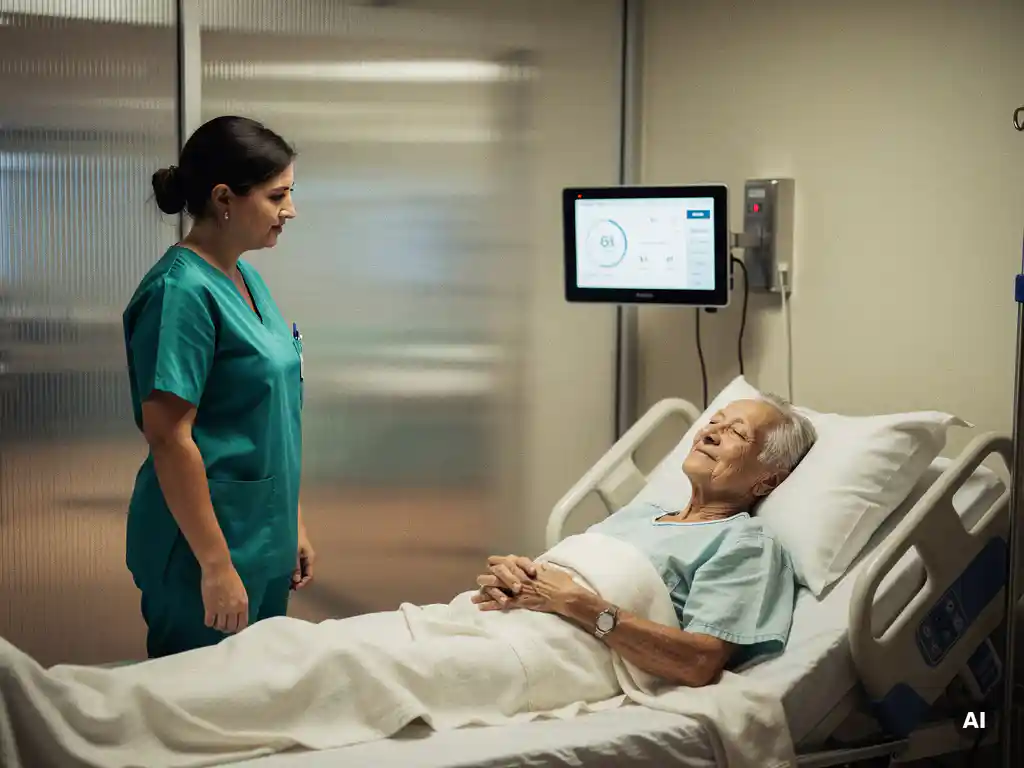
The most relevant KPIs for AI patient monitoring are: detection accuracy (including the number of false alarms), response time after an alert, reduction of staff workload, and compliance with privacy standards. These metrics give healthcare organizations a concrete picture of how effectively a monitoring system performs in practice. In this article, we answer the most frequently asked questions about measuring AI monitoring in healthcare.
Which metrics indicate the quality of healthcare monitoring?
The quality of healthcare monitoring is measured across four core areas: detection accuracy, response time, staff efficiency, and privacy compliance. Together, these metrics provide a complete picture of how well a patient monitoring system performs, both technically and organizationally.
Many healthcare organizations focus exclusively on the number of registered incidents, but that is only part of the story. A good monitoring system is evaluated on what it prevents, not just on what it detects. Think of the number of falls prevented, the average time between an incident and the first care response, and the extent to which staff are relieved of unnecessary check rounds.
Quality in healthcare monitoring is also inextricably linked to reliability. A system that continuously generates false alarms quickly loses the trust of care staff. This makes the false positive rate one of the most critical indicators of the usability of a monitoring solution in day-to-day care practice.
How do you measure the accuracy of an AI fall detection system?
The accuracy of an AI fall detection system is measured using two key figures: sensitivity (the percentage of actual fall incidents the system detects) and specificity (the percentage of situations the system correctly classifies as non-falls). The number of false alarms per unit of time is the most practically useful KPI.
High sensitivity means the system misses virtually no real falls. High specificity means staff are not unnecessarily called away for situations that require no intervention. Both are essential: a system that flags everything as a fall technically has high sensitivity but is unusable in practice.
False positives as a quality indicator
The number of false positive alerts, also known as false alarms, is a particularly relevant KPI in care practice. When care staff are alerted too frequently for situations that pose no danger, alarm fatigue sets in. This leads to alerts being taken less seriously, with potentially serious consequences.
False negatives as a safety indicator
On the other hand, false negatives — situations where a real fall is not detected — are a direct safety indicator. Even a single missed fall can have serious consequences for a vulnerable patient. Tracking missed incidents, compared against manual reports from care staff, provides insight into the system’s actual detection performance.
What is an acceptable response time after a fall alert?
An acceptable response time after a fall alert in a healthcare facility is preferably under two minutes. The faster a care worker arrives after an incident, the lower the risk of complications such as hypothermia, secondary injuries, or psychological distress for the patient.
Response time consists of two components: the time the system needs to detect an incident and send an alert, and the time a staff member needs to respond and arrive on site. Both components deserve separate measurement. A system that triggers an alarm within seconds, but where staff then take three minutes to respond, has a bottleneck in the organization, not in the technology.
For internal benchmarking, it is useful to track average response time by department, time of day, and type of incident. This reveals patterns that prompt process improvements, such as better distribution of staff during evening and night shifts.
How do you measure the impact of AI monitoring on staff workload?
The impact of AI monitoring on staff workload is measured by comparing the number of unnecessary check rounds, the distribution of care tasks, and the perceived workload of staff before and after implementation. An effective system reduces reactive tasks and gives staff more room for proactive care delivery.
Concrete KPIs for staff workload include:
- The number of nightly check rounds per staff member per shift
- The ratio of reactive to planned care tasks
- Absenteeism and staff turnover within care teams
- Subjective workload perception, measured through periodic employee satisfaction surveys
When AI monitoring works effectively, staff only need to enter a room when the system actually gives reason to do so. This reduces not only the physical burden but also the mental pressure of having to remain constantly vigilant. Over time, this contributes to lower staff turnover, which is a strategic advantage in times of persistent staffing shortages in healthcare.
Which privacy-related indicators are relevant for healthcare organizations?
Relevant privacy-related KPIs for healthcare organizations are: the degree of data minimization (are only necessary data being processed?), compliance with applicable standards such as ISO 27001 and NEN 7510, and the number of privacy-related incidents or data breaches per year.
Privacy in healthcare is not only a legal obligation but also an ethical responsibility toward patients and clients. With AI-based patient monitoring, it is essential that footage is not viewed by humans unless there is an explicit reason to do so. Systems that operate on the basis of automated analysis without human involvement in the image process offer structurally greater privacy protection.
Additional indicators that healthcare organizations can track:
- Results of periodic privacy audits and penetration tests
- Percentage of staff who have completed annual privacy training
- Time elapsed between the discovery of a vulnerability and its resolution
- Presence of an up-to-date processing register in accordance with the GDPR
How do you report AI monitoring KPIs internally to the board and management?
AI monitoring KPIs are most effectively reported internally by translating technical metrics into governance-relevant outcomes: safety improvement, cost savings, and risk reduction. Board members and managers generally do not need technical details, but do need insight into what the figures mean for the organization.
A good internal report combines quantitative data with qualitative context. Do not just present the number of detected fall incidents — also show how many of those incidents were handled more quickly than would have been the case without the system. Link response times to patient outcomes and staff workload to absenteeism figures.
Practical tips for effective KPI reporting to the board and management:
- Use a fixed reporting frequency, preferably monthly or quarterly
- Present trends over time rather than isolated snapshots
- Compare results with the situation before implementation as a baseline
- Explicitly identify which risks have been mitigated and which costs have been avoided
- Link KPIs to the organization’s strategic objectives, such as quality of care and sustainable staff employability
By presenting KPIs in this way, AI monitoring is seen not as a technical tool, but as a strategic investment with demonstrable value for the entire organization.
How Kepler Vision Technologies helps with AI patient monitoring
We at Kepler Vision Technologies have specifically developed our AI solutions to support healthcare organizations across each of the KPI areas mentioned above. Our software combines reliable detection with respect for privacy and measurable impact on staff workload. Concretely, our approach offers:
- Unparalleled detection accuracy: Our software generates only one false alarm every 92 days, significantly reducing alarm fatigue among care staff
- Immediate response: Within seconds of a fall detection, care staff receive an alert, structurally shortening response time
- Privacy by design: Footage is never viewed by humans. Staff only enter a room when the AI gives reason to do so
- Compliance assurance: We comply with ISO 27001 and NEN 7510, ensuring privacy-related KPIs are demonstrably in order
- Measurable staff relief: Unnecessary nightly check rounds are reduced, directly contributing to lower workload and better staff retention
Want to know how our solutions align with the specific challenges of your healthcare organization? Visit our website for more information or contact us for a no-obligation conversation.
Frequently Asked Questions
How long does it take to have reliable KPI data after implementing AI patient monitoring?
After implementation, you generally need at least three to six months to collect statistically reliable KPI data. In the first few weeks, the system is still in an adjustment phase and metrics such as the number of false alarms may temporarily be higher than the eventual norm. Use the first month preferably as a calibration period and only establish a formal baseline measurement for trend comparison after that.
What do you do if the number of false alarms remains structurally too high after implementation?
If the number of false positive alerts remains structurally above an acceptable level, it is advisable to first check environmental factors: changing lighting conditions, moving objects such as curtains or visitor traffic can negatively affect detection accuracy. Then contact the supplier for a recalibration or adjustment of the detection sensitivity. In the meantime, document each false alarm as specifically as possible so that patterns quickly become visible and targeted action can be taken.
How do you involve care staff in monitoring and improving KPIs?
Care staff are the daily users of the system and therefore the most valuable source of qualitative feedback. Organize a brief monthly meeting in which staff can share their experiences regarding response times, alarm reliability, and workload perception. Feed their input back into the quantitative KPI data to get a complete picture, and make improvements visible by actively sharing results with the team.
Are there sector-specific benchmarks for AI monitoring KPIs in healthcare?
National or European benchmarks for AI monitoring KPIs in healthcare are still very much in development, but industry organizations such as ActiZ and Vilans publish guidelines for quality indicators in elderly care that can serve as a reference framework. For response times, many organizations apply an internal standard of a maximum of two minutes, but this varies by care setting and type of incident. It is advisable to benchmark not only against internal benchmarks but also against comparable healthcare organizations using the same system.
How do you handle privacy legislation when you want to share KPI data with external parties, such as regulators or funders?
When sharing KPI data with external parties, it is essential that you share only aggregated and anonymized metrics, never personal or traceable patient data. Ensure that the sharing of data is recorded in a data processing agreement and that the purpose of the data provision is explicitly described in accordance with the GDPR. If in doubt, consult your organization’s Data Protection Officer (DPO) before sharing data externally.
What is the best first step when setting up KPI monitoring for AI patient monitoring?
The best first step is to establish a baseline measurement: map the current situation across the four core areas (detection accuracy, response time, staff workload, and privacy compliance) before the system is active. Without a clear starting point, it is impossible to demonstrate the added value of the system retrospectively. Involve both the IT department, care management, and the Data Protection Officer to create a comprehensive and broadly supported measurement framework.
How do you prevent KPI reports from becoming a paper exercise without real steering?
KPI reports only become effective when they are linked to concrete actions and responsibilities. Assign an owner per KPI who is responsible for follow-up, and establish threshold values at which action is automatically taken, such as an evaluation meeting with the supplier when the number of false alarms rises. Do not present reports as a retrospective, but as a steering instrument: use the data to proactively decide on process adjustments, staff deployment, or technical optimizations.
Related Articles
- Which Certifications and Standards Are Relevant When Purchasing AI Patient Monitoring?
- How to Use Staff Scheduling to Reduce Workload
- How do you measure whether measures to reduce workload are working?
- What are the costs of falls without fall prevention for the elderly?
This content was generated with the help of AI and it may contain mistakes