


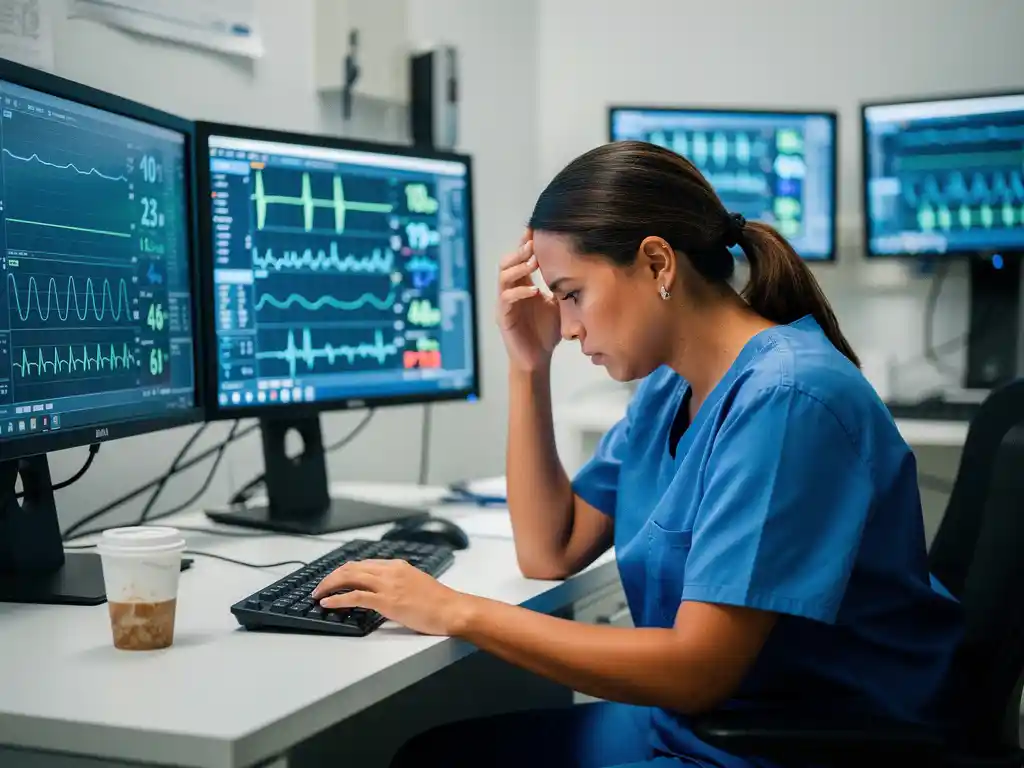
High workload significantly reduces employee engagement. When healthcare workers are consistently given too many tasks and too little time, their emotional connection to their work weakens, absenteeism rises, and the likelihood of staff turnover increases. This is especially true in the healthcare sector, where the combination of staff shortages and growing demand for care makes the pressure particularly intense. In this article, we answer the most frequently asked questions about workload in healthcare and what you can do about it.
What are the consequences of high workload for healthcare workers?
High workload among healthcare workers leads to exhaustion, increased absenteeism, and a greater risk of errors in care delivery. Over time, it raises the likelihood of burnout and staff attrition, which further worsens the staffing situation.
The consequences are wide-ranging and affect both the individual employee and the organization. Healthcare workers who are consistently under high pressure more frequently report physical complaints, sleep problems, and emotional exhaustion. They feel less able to provide quality care, which leads to feelings of guilt and reduced job satisfaction.
For the organization, this means higher sick leave costs, difficulty attracting new staff, and a greater risk of incidents. In elderly care and hospitals, where continuous vigilance is required, the effects of reduced concentration are directly felt in the quality of care.
How does workload affect employee engagement?
Workload affects employee engagement by disrupting the balance between what an employee gives and what they receive in return. When effort consistently outweighs the recognition, autonomy, or sense of purpose an employee experiences, engagement drops sharply.
Engaged employees are motivated, feel connected to their work, and go beyond what is strictly required. High workload undermines exactly those elements. There is no longer any room for reflection, collegiality, or personal development. Work becomes about survival rather than contribution.
Research within the healthcare sector shows that employees who feel overwhelmed are quicker to emotionally distance themselves from their clients or patients. This is a protective mechanism, but it leads to less empathetic care and a sense of lost purpose. That loss of purpose is one of the strongest predictors of intent to leave.
What is the difference between workload and work-related stress?
Workload is the objective amount of work a person must complete within a given time. Work-related stress is the subjective experience that arises when someone feels unable to cope with that workload. Workload is a situation; work-related stress is a response to that situation.
This distinction matters for healthcare organizations. Not every employee experiences the same workload as equally burdensome. Factors such as experience, social support, autonomy, and personality all influence how a person responds. Two employees on the same ward can experience a comparable workload in very different ways.
This means that addressing workload requires more than simply reducing tasks. Building resilience, improving collaboration, and providing clarity around roles and expectations also play a role in preventing work-related stress.
What factors intensify workload in the healthcare sector?
In the healthcare sector, workload is intensified by a combination of staff shortages, growing demand for care, administrative burdens, and the emotional intensity of the work. These factors reinforce one another and make the healthcare sector particularly vulnerable to chronically high workload.
The main contributing factors are:
- Staff shortages: Fewer colleagues means more tasks per employee, fewer breaks, and less time for handovers.
- Growing demand for care: The need for healthcare increases every year, while the supply of healthcare staff fails to keep pace.
- Administrative burden: Healthcare workers spend a significant portion of their time on documentation and reporting rather than direct care delivery.
- Night shifts and irregular schedules: Rotating shifts disrupt circadian rhythms and impair recovery.
- Emotional demands: Working with vulnerable people requires emotional energy that is difficult to quantify but very real to experience.
- Unexpected situations: Fall incidents, sudden deterioration of patients, and emergencies demand immediate action and keep staff in a constant state of heightened alertness.
That last factor in particular — the need to remain continuously alert to unexpected situations — is an underestimated source of workload in elderly care and hospitals.
How can technology reduce workload and improve engagement?
Technology can reduce workload by partially taking over routine tasks and continuous monitoring, freeing healthcare workers to focus on tasks that require human presence and empathy. This improves the quality of work and strengthens engagement.
Smart monitoring systems, for example, take over the continuous vigilance that would otherwise be required of staff. Instead of regularly checking rooms or waiting for an alarm, employees only receive a notification when action is genuinely needed. This reduces unnecessary movement, cuts down on false alarms, and gives staff greater control over their time.
Technology works best as a complement to the healthcare professional, not a replacement. When employees experience technology as something that supports them rather than monitors them, their experience of work improves. They feel less alone in their responsibilities and can devote more attention to the human side of care.
When should a healthcare organization take action against high workload?
A healthcare organization should take action as soon as signs of high workload become persistent. These include rising absenteeism, increasing intent to leave, more workplace incidents, or a decline in employee satisfaction scores. Waiting only makes the damage worse.
Early warning signs that warrant attention include:
- Employees reporting that they can no longer keep up with their workload
- An increase in errors or near-misses
- Absenteeism rates above the sector average
- Difficulty filling schedules due to a lack of available staff
- Low scores on internal employee surveys regarding autonomy and job satisfaction
Taking action means not only implementing internal measures, but also critically examining how work processes are structured. Which tasks can be organized more efficiently? Which responsibilities can be redistributed? And what technological support is available to sustainably reduce the pressure?
How Kepler Vision Technologies helps reduce workload
At Kepler Vision Technologies, we understand how demanding the workload in healthcare can be. Our AI solutions are specifically designed to support healthcare workers, so they can focus on what truly matters: caring for people.
Our software, Kepler Night Nurse and Kepler NurseAssist, takes over the continuous monitoring of clients and patients. In practice, this means:
- Automatic fall detection: Staff receive a notification within seconds of a fall, without needing to remain continuously alert themselves.
- Minimal false alarms: Our technology generates an average of just one false alarm every 92 days, dramatically reducing workload caused by unnecessary interruptions.
- Privacy-first monitoring: Footage is never viewed by people. Staff only enter a room when the software requests it.
- Plug-and-play installation: Easy to plan, configure, and install — no large-scale IT projects required.
- Compliance and security: We are compliant with ISO 27001 and NEN 7510, ensuring privacy and data protection are guaranteed.
Want to find out how we can support your healthcare organization in reducing workload and improving employee engagement? Get in touch with us and discover what our AI solutions can do for your team.
Frequently Asked Questions
How do I get started with addressing workload in my healthcare organization?
Start by mapping the current situation through an employee survey or conversations on the floor. Identify which tasks take the most time and where bottlenecks exist, such as in administration, night shifts, or staff scheduling. Then set priorities: which improvements can be implemented quickly, and which require a longer-term approach? A combination of process optimization and technological support typically delivers the fastest and most sustainable results.
What are the most common mistakes when addressing workload in healthcare?
A common mistake is focusing on treating symptoms rather than the root cause — for example, temporarily bringing in extra staff without improving the underlying work processes. Another pitfall is failing to involve employees themselves in finding solutions: they know best where the pressure is greatest. Finally, technology is sometimes deployed as a replacement for staff rather than as support, which creates resistance and actually reduces engagement.
How can I tell if the workload in my team is too high, even if employees aren't complaining?
Healthcare workers don’t always speak openly about workload, out of loyalty or fear of how managers might react. Look instead for indirect signals: rising absenteeism, an increase in minor errors or near-misses, reduced interaction between colleagues, and declining scores on employee satisfaction surveys. Regular, low-barrier check-ins with team members often provide more insight than formal surveys.
Can reducing administrative burden really make a significant difference for healthcare workers?
Yes, absolutely. Research shows that healthcare workers can spend as much as 30 to 40 percent of their working time on administration and documentation. Every minute spent on that comes at the expense of direct care and recovery time. By digitizing, simplifying, or partially automating documentation processes, employees can spend more time on the work they chose to do — which directly contributes to greater job satisfaction and a reduced sense of workload.
How do I ensure healthcare workers embrace new technology rather than resist it?
Involve employees early in the process, ideally during the selection phase of new technology. Clearly explain what the technology does, what it does not do, and how it will concretely ease their day-to-day work. Provide good training and a point of contact for questions or issues. Employees who experience technology as something that supports rather than monitors or replaces them are significantly more positive about it.
Is it possible to sustainably reduce workload without hiring additional staff?
Yes — while additional staff is of course helpful, there are several effective measures available without direct expansion. These include redistributing tasks so that heavily and lightly burdened employees are deployed more effectively, optimizing schedules to avoid unnecessary peak loads, and implementing smart monitoring technology that partially takes over continuous vigilance. This approach reduces the perceived pressure per employee and makes the existing workforce more sustainably deployable.
What role do managers play in reducing workload on the floor?
Managers play a crucial role: they are often the first to notice signs of overload and the first who can offer support to employees. In practice, this means regularly and openly engaging with the team, creating space for staff to raise concerns without judgment, and actively following up on what is reported. Managers who are visible, who listen, and who take action directly contribute to higher engagement and a lower perceived workload within their team.
Related Articles
- How do you reduce workload without hiring additional staff?
- What are hospitals doing about staff shortages?
- What are the consequences of chronic work pressure?
- What to do if an elderly person falls and hits their head?
- How can technology contribute to early detection in healthcare?
This content was generated with the help of AI and it may contain mistakes