


Kepler Night Nurse on Server
Our AI software enables healthcare facilities to reduce their night staff from three caregivers to one caregiver per 100 clients. The software reduces false alarms by 99%. This helps prevent staff burnout and thus reduces stress.
In addition to fall detection, the technology also includes bed position detection. This technology provides caregivers with crucial information about patients at increased risk of pressure ulcers.
Trusted by international healthcare organizations and hospitals


Our fall detection and fall prevention software
The Kepler Vision state-of-the-art AI software is deployed in healthcare facilities. The software alerts and articulates unsafe situations in the client’s room with unprecedented reliability.
Our fall detection and fall prevention software
The Kepler Vision state-of-the-art AI software is deployed in healthcare facilities. The software alerts and articulates unsafe situations in the client’s room with unprecedented reliability.
Kepler Night Nurse
Using Kepler Night Nurse provides your organization with the following benefits, among others:

Helps prevent staff shortages

Fewer falls

More safety

How Kepler Night Nurse Works
Kepler Night Nurse is an AI-powered software application that uses optical sensors to detect falls, unsafe situations, and nighttime activity in patient and resident rooms. The system continuously analyzes human posture and behavior without recording video, thereby ensuring both security and privacy.
-
An optical sensor is mounted on the ceiling with an unobstructed view of the bed and the surrounding area.
-
If the optical sensor is “dumb,” an additional server running the Kepler Night Nurse software is installed. A single Edge Appliance supports up to 50 optical sensors.
-
If the optical sensor is “smart,” such as the Mobotix C71, the software runs directly on the sensor itself. In that case, no separate server is required.
What happens next:
-
The sensor records a live video stream.
-
No video is recorded or saved.
-
With a smart sensor, all processing takes place on the camera.
-
With a “dumb” sensor, processing takes place on the on-premises Edge Appliance.
-
-
When an event is detected and healthcare staff need to be alerted, Kepler Night Nurse sends a notification to the nurse call system. This system then forwards the notification to the healthcare staff’s handheld devices.
Integration is very easy when using a modern REST interface. Kepler Night Nurse is already integrated with dozens of nurse call systems.
Supported Connection Protocols
The Edge Appliance on which Kepler Night Nurse runs within the customer’s network typically has a direct TCP/IP connection to the nurse call system (although it is also possible to route this connection via the public Internet or through secure tunnels).
Below is a list of the supported protocols:
REST
REST via HTTP(S) is the preferred method for connecting Kepler Night Nurse to a nurse call system.
Custom (tailor-made)
Other connection protocols are possible, but they often require more development time and effort. Furthermore, these protocols do not always offer the same level of reliability and security as REST.
Examples of supported custom protocols:
• Network sockets
• Queues
• EmailSupported Authentication Methods
The integration with the nurse call system can be done with or without authentication, depending on the network environment and customer requirements.
Possible methods:
• HTTP tokens
• HTTP Basic Authentication
• Custom authentication (requires additional development time)REST Endpoint Interface
For the recommended REST protocol, Kepler Night Nurse expects a POST endpoint on the nurse call system to send notifications.
Error Handling
If a notification sent via REST is not delivered successfully, Kepler Night Nurse will retry it twice more, with a 2-second delay between each attempt.
-
- During installation, the system integrator performs the technical configuration of the room. This involves determining the location of the exit door and the bathroom door. This allows Kepler Night Nurse to send an alert if a resident stays in the bathroom too long or leaves the room.
- Using the nurse call system, the caregiver selects, on a room-by-room basis, which alerts should be active, such as fall detection, out-of-bed, sitting on the edge of the bed, and so on.
-
Kepler Night Nurse’s AI understands human forms and movements, similar to how a caregiver observes a resident.
Among other things, the system recognizes:
- Lying down, sitting, standing, walking
- Sitting on the edge of the bed/li>
- Getting out of bed or intending to get out of bed
- Slow-speed falls and high-speed falls
- Presence in bed (in any position)
-
Based on real-time analysis, Kepler Night Nurse’s AI determines whether a situation is normal or requires attention.
For example:
- A resident turns over in bed → No interference
- A pillow falls to the floor → No report
- Resident is sitting on the edge of the bed at night → Immediate report
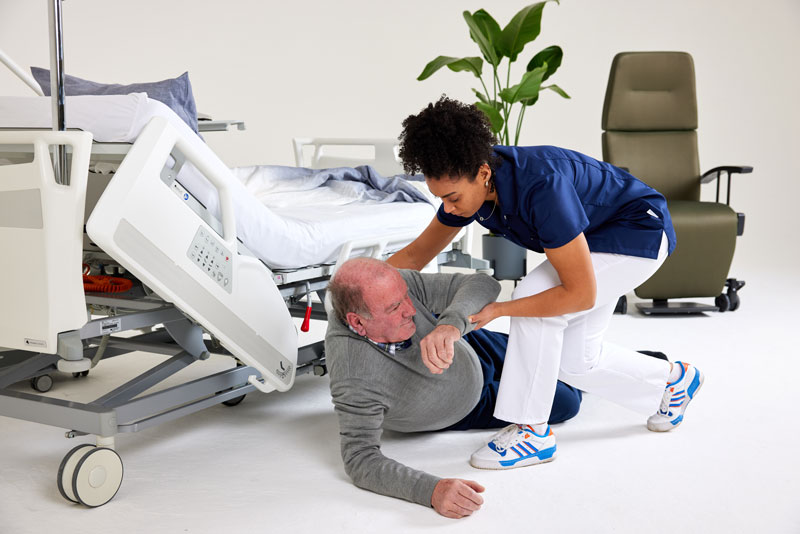
- Resident collapses or falls → Report immediately
This reduces false alarms and increases residents’ safety.
-
When Kepler Night Nurse detects a concerning situation, a notification is sent via the existing communication workflow.
Supported integrations:
- Smartphones
- DECT phones
- Smart pagers
- Nursing Call Systems
- Central Monitoring Dashboards
Alerts may include a privacy-friendly visualization in which the face is blurred, so that healthcare providers can see what is happening without revealing the person’s identity. Because the alerts are highly reliable, visual verification is often unnecessary in practice.
-
Early detection helps employees to:
- Prevent falls by intervening before a resident gets out of bed
- Providing immediate assistance after a fall
- Reducing Unnecessary Room Inspections
- To devote more time to rooms where care is actually needed
This is especially valuable at night, when staffing levels are limited.
-
The system will be improved over time through:
- Updates to detection models and AI software
- New Behavior Recognition (e.g., wandering detection, getting-up-from-chair detection, intruder detection, prolonged lying-down detection)
Healthcare facilities often find that staff members have to walk less , receive fewer false alarms, and are able to provide night care much more efficiently after installation.
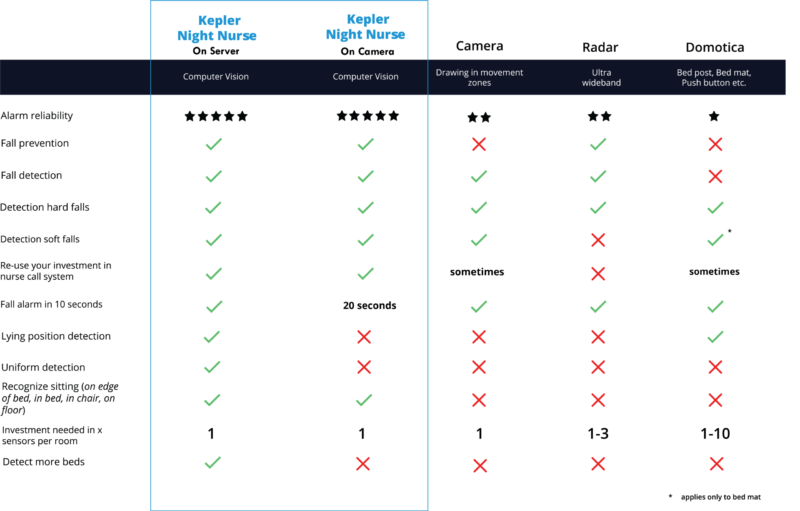
Compared to other systems, Kepler Night Nurse is very accurate and only alerts you when something actually happens. Below is a list of the notifications that can be sent. You can configure these notifications through a self-service portal to determine when and whether they should be displayed.
Fall Alarm

Sitting on the edge of the bed

In bed

Sitting position in bed

Out of bed

Getting out of room

In bathroom

Getting up from chair

Sitting on the ground

Lying Position

Uniform detection
Benefits Kepler Night Nurse
Using Kepler Night Nurse provides your organization with the following benefits, among others:
Helps prevent staff shortages
Fewer falls
More safety
How Kepler Night Nurse Works
Kepler Night Nurse is an AI-powered software application that uses optical sensors to detect falls, unsafe situations, and nighttime activity in patient and resident rooms. The system continuously analyzes human posture and behavior without recording video, thereby ensuring both security and privacy.
-
An optical sensor is mounted on the ceiling with an unobstructed view of the bed and the surrounding area.
-
If the optical sensor is “dumb,” an additional server running the Kepler Night Nurse software is installed. A single Edge Appliance supports up to 50 optical sensors.
-
If the optical sensor is “smart,” such as the Mobotix C71, the software runs directly on the sensor itself. In that case, no separate server is required.
What happens next:
-
The sensor records a live video stream.
-
No video is recorded or saved.
-
With a smart sensor, all processing takes place on the camera.
-
With a “dumb” sensor, processing takes place on the on-premises Edge Appliance.
-
-
When an event is detected and healthcare staff need to be alerted, Kepler Night Nurse sends a notification to the nurse call system. This system then forwards the notification to the healthcare staff’s handheld devices.
Integration is very easy when using a modern REST interface. Kepler Night Nurse is already integrated with dozens of nurse call systems.
Supported Connection Protocols
The Edge Appliance on which Kepler Night Nurse runs within the customer’s network typically has a direct TCP/IP connection to the nurse call system (although it is also possible to route this connection via the public Internet or through secure tunnels).
Below is a list of the supported protocols:
REST
REST via HTTP(S) is the preferred method for connecting Kepler Night Nurse to a nurse call system.
Custom (tailor-made)
Other connection protocols are possible, but they often require more development time and effort. Furthermore, these protocols do not always offer the same level of reliability and security as REST.
Examples of supported custom protocols:
• Network sockets
• Queues
• EmailSupported Authentication Methods
The integration with the nurse call system can be done with or without authentication, depending on the network environment and customer requirements.
Possible methods:
• HTTP tokens
• HTTP Basic Authentication
• Custom authentication (requires additional development time)REST Endpoint Interface
For the recommended REST protocol, Kepler Night Nurse expects a POST endpoint on the nurse call system to send notifications.
Error Handling
If a notification sent via REST is not delivered successfully, Kepler Night Nurse will retry it twice more, with a 2-second delay between each attempt.
-
- During installation, the system integrator performs the technical configuration of the room. This involves determining the location of the exit door and the bathroom door. This allows Kepler Night Nurse to send an alert if a resident stays in the bathroom too long or leaves the room.
- Using the nurse call system, the caregiver selects, on a room-by-room basis, which alerts should be active, such as fall detection, out-of-bed, sitting on the edge of the bed, and so on.
-
Kepler Night Nurse’s AI understands human forms and movements, similar to how a caregiver observes a resident.
Among other things, the system recognizes:
- Lying down, sitting, standing, walking
- Sitting on the edge of the bed/li>
- Getting out of bed or intending to get out of bed
- Slow-speed falls and high-speed falls
- Presence in bed (in any position)
-
Based on real-time analysis, Kepler Night Nurse’s AI determines whether a situation is normal or requires attention.
For example:
- A resident turns over in bed → No interference
- A pillow falls to the floor → No report
- Resident is sitting on the edge of the bed at night → Immediate report
- Resident collapses or falls → Report immediately
This reduces false alarms and increases residents’ safety.
-
When Kepler Night Nurse detects a concerning situation, a notification is sent via the existing communication workflow.
Supported integrations:
- Smartphones
- DECT phones
- Smart pagers
- Nursing Call Systems
- Central Monitoring Dashboards
Reports may include a privacy-friendly visualization in which the face is blurred, so that healthcare providers can see what is happening without revealing the person’s identity.
Because the reports are highly reliable, visual verification is often unnecessary in practice. -
Early detection helps employees to:
- Prevent falls by intervening before a resident gets out of bed
- Providing immediate assistance after a fall
- Reducing Unnecessary Room Inspections
- To devote more time to rooms where care is actually needed
This is especially valuable at night, when staffing levels are limited.
-
The system will be improved over time through:
- Updates to detection models and AI software
- New Behavior Recognition (e.g., wandering detection, getting-up-from-chair detection, intruder detection, prolonged lying-down detection)
Healthcare facilities often find that staff members have to walk less , receive fewer false alarms, and are able to provide night care much more efficiently after installation.
Compared to other systems, Kepler Night Nurse is very accurate and only alerts you when something actually happens. Below is a list of the notifications that can be sent. You can configure these notifications through a self-service portal to specify when and whether they should be displayed.
Fall Alarm
Sitting on the edge of the bed
In bed
Sitting position in bed
Out of bed
Getting out of room
In bathroom
Getting up from chair
Sitting on the ground
Lying Position
Uniform detection
Kepler Night Nurse Compared to Other Systems
-
The system detects unsafe situations within seconds and immediately alerts healthcare workers.
-
No. The monitoring is completely passive and does not require any wearables or buttons.
-
It detects early-stage risk situations, such as sitting on the edge of the bed or attempting to stand up.