


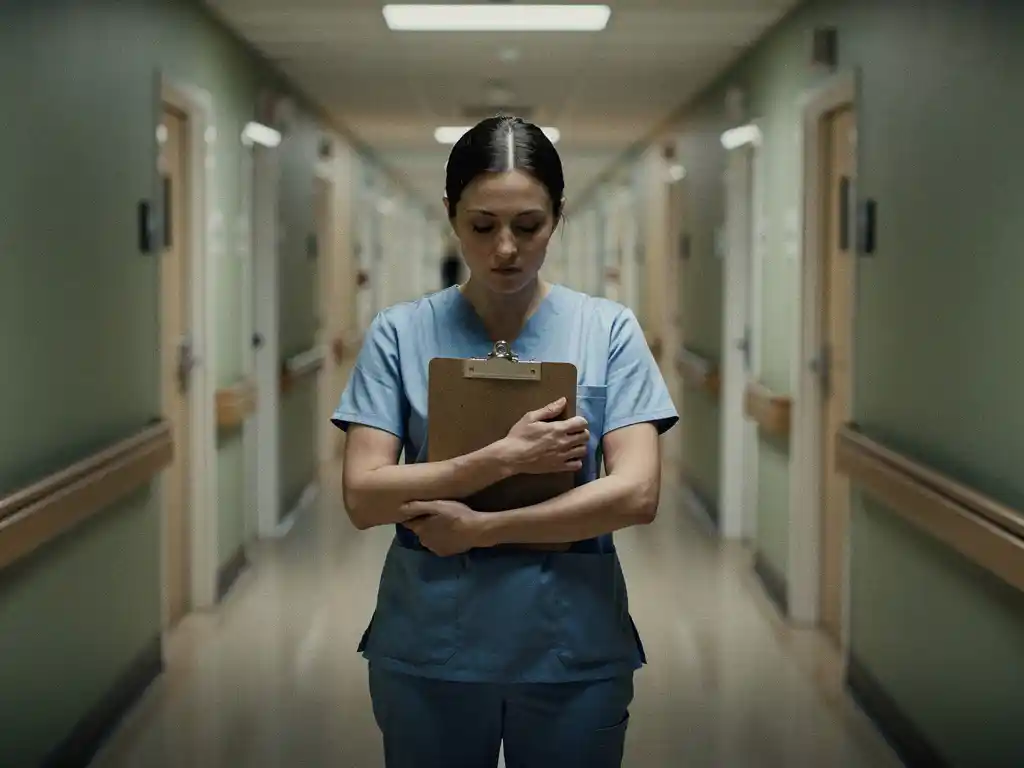
When workload is too high due to understaffing, the first step is combining smart task distribution, process optimization, and technological support. No single measure fully solves the problem, but the combination of a targeted approach and innovative tools makes all the difference. On our website, you can read how AI monitoring provides concrete support to care teams. In this article, we answer the most important questions about workload, staff shortages, and the role of technology in healthcare.
What are the consequences of staff shortages for healthcare workers?
An excessive workload caused by too few staff leads directly to physical and mental overload among healthcare workers. They must care for more clients in less time, have little opportunity to recover between shifts, and regularly feel responsible for situations they cannot fully oversee. This increases the risk of errors, burnout, and ultimately leaving the profession.
The consequences compound over time. Staff who are chronically overloaded call in sick more often. This increases the pressure on remaining colleagues, setting a downward spiral in motion. Beyond the personal toll on employees, this also has direct consequences for the quality of care: clients wait longer for assistance, are checked on less frequently, and face a greater risk of unnoticed emergencies such as a fall.
Emotional exhaustion — commonly referred to as burnout — is one of the most frequent outcomes. Healthcare workers choose this profession out of commitment and empathy. When they are structurally unable to deliver the care they want to provide, they become disillusioned. This makes retaining staff even more difficult.
Why is the staff shortage in healthcare only getting worse?
The staff shortage in healthcare is growing due to a combination of an aging population, increasing demand for care, and a shrinking workforce. Demand for care is rising by approximately 6% per year, while the number of people choosing a career in healthcare is not growing at the same rate. This structural imbalance cannot be resolved through traditional recruitment alone.
The aging population plays a dual role: older people need more care, and the current healthcare workforce is itself aging. A large proportion of today’s care staff is approaching retirement age, accelerating the outflow of workers. At the same time, younger people more frequently choose other sectors, partly due to the high workload and relatively low pay in healthcare.
By 2026, this problem will be felt across all of Europe. Healthcare organizations in the United States, as well as in other countries, are struggling to fill vacancies. International recruitment offers temporary relief but does not address the structural problem. The conclusion is clear: healthcare must work smarter with the people it has.
How can technology help address excessive workload in healthcare?
Technology can help address excessive workload in healthcare by automating routine tasks, improving monitoring, and only alerting care staff when it is truly necessary. This allows workers to focus their time and attention on the moments and situations that require human presence, rather than constantly performing preventive checks.
Consider night shifts in a residential care facility. Without technological support, staff regularly do rounds to check whether clients are safe and sleeping. With AI-powered monitoring, they are only notified when something actually goes wrong. This saves not only time but also mental energy: staff no longer need to remain in a constant state of alertness.
Technology does not replace healthcare workers — it enhances what they are able to do. By using smart systems for monitoring, care professionals can focus on personal contact, complex care needs, and the human side of their work. This makes the profession more attractive and reduces the feeling of being overwhelmed.
What is the difference between traditional monitoring and AI surveillance in healthcare?
Traditional monitoring in healthcare is largely reactive and people-dependent: staff check manually, respond to call buttons, or conduct periodic rounds. AI surveillance is proactive and continuously active, automatically detecting anomalies and only sending an alert when a relevant situation has been identified. The difference lies in speed, accuracy, and the burden placed on staff.
Traditional monitoring: limitations in practice
Conventional systems such as call buttons require the client to take action themselves. In the event of a fall or sudden deterioration, this is often not possible. Camera systems monitored by staff are privacy-sensitive and labor-intensive. Motion sensors generate many false alarms, leading to alarm fatigue: staff respond more slowly because they become accustomed to alerts that mean nothing.
AI surveillance: continuous, accurate, and privacy-conscious
AI-based systems analyze footage automatically, without anyone watching. They recognize dangerous situations such as a fall or an abnormal lying position and immediately send a notification to the appropriate care worker. Accuracy is significantly higher than with traditional technology, drastically reducing the number of unnecessary alarms. This means less disruption, less stress, and better sleep for both clients and staff.
What measures can healthcare organizations take to reduce workload?
Healthcare organizations can reduce workload through a combination of smart scheduling, task differentiation, technological support, and a culture of openness around work pressure. No single measure works in isolation, but together they create a work environment in which staff can remain sustainably employable.
Concrete steps healthcare organizations can take:
- Introduce task differentiation: Not every task needs to be performed by a highly qualified nurse. By distributing tasks based on qualifications, you keep specialized staff available for complex care.
- Optimize scheduling: Smart planning with sufficient recovery time between shifts reduces physical and mental exhaustion. Flexible schedules that align with personal preferences also increase employee satisfaction.
- Use technology for monitoring: Automated surveillance takes over routine checks and ensures that staff are only called upon when truly needed.
- Facilitate open conversations about workload: Staff who feel heard are less likely to disengage. Regular check-ins and accessible reporting channels help identify problems early.
- Invest in training and career development: Staff who see opportunities for growth stay longer. This reduces the constant outflow of workers and the associated recruitment pressure.
When is AI monitoring the right choice for a care facility?
AI monitoring is the right choice for a care facility when the staff shortage is structural, when workload during night or weekend shifts is high, and when the safety of clients can no longer be guaranteed with the current number of staff. It is not a stopgap solution, but a strategic investment in sustainable care delivery.
The facilities that benefit most from AI monitoring are residential care centers with clients at elevated risk of falls, hospitals with patients requiring intensive overnight care, and psychiatric clinics where continuous observation is essential but privacy-sensitive. In all of these situations, automated surveillance provides a reliable complement to human care.
An important consideration is privacy. AI systems that process footage without human viewing comply with the strictest privacy standards and are therefore suitable for use in care settings where patient data must be protected to the highest degree.
How Kepler Vision Technologies helps address excessive workload
We develop AI solutions that help healthcare organizations deliver safe, high-quality care even with reduced staffing. Our software, Kepler Night Nurse, monitors clients 24/7 and immediately detects when someone falls or finds themselves in an unsafe situation. Care staff receive a notification within seconds, so they only need to intervene when necessary.
What our solution offers in practice:
- Fall detection and fall prevention with unparalleled accuracy: just one false alarm every 92 days — 1,000 times better than traditional technologies
- Lying position recognition that proactively identifies unsafe situations
- Privacy by design: footage is never viewed by people; care staff only enter the room when the software requests it
- Simple implementation via a plug-and-play concept, with no complex IT infrastructure required
- Compliance with ISO27001 and NEN7510 for maximum security of patient data
Fewer false alarms mean less disruption, less stress, and more time for real care. Want to find out whether our solution is right for your healthcare organization? Contact us and discover what we can do for you.
Frequently Asked Questions
How do I get started with implementing AI monitoring in my care facility?
Start with a thorough needs assessment: identify which departments or shifts have the highest workload and where safety risks are greatest. Then discuss the options with a provider such as Kepler Vision Technologies, which offers a plug-and-play implementation with no complex IT infrastructure required. A phased rollout — starting with a pilot ward — helps staff become familiar with the technology before scaling up.
How do healthcare workers typically respond to the introduction of AI surveillance?
Resistance is a common initial reaction, as staff sometimes fear that technology will take over their jobs or that they will be constantly observed. It is therefore essential to involve the team early in the decision-making process and to communicate clearly that AI is a supportive tool, not a replacement. Practical experience shows that after an adjustment period, staff come to see the technology as a relief, since it frees them from routine checks and unnecessary night rounds.
What if the AI misses a situation or triggers a false alarm — how reliable is the system really?
No system is 100% infallible, but modern AI surveillance such as Kepler Night Nurse has an exceptionally low error rate: just one false alarm every 92 days, which is a thousand times more accurate than traditional motion sensors. Detection errors are minimized through continuous improvement of the algorithms based on realistic care scenarios. Importantly, AI monitoring is always deployed as a complement to human care, not a replacement — staff remain ultimately responsible.
What about client privacy when using AI camera surveillance?
This is a legitimate concern and one of the most frequently asked questions at care facilities. Systems such as Kepler Night Nurse are designed according to the principle of privacy by design: footage is automatically analyzed by the AI without staff or anyone else ever viewing the recordings. The software complies with ISO27001 and NEN7510, the strictest standards for information security in healthcare. Clients and their relatives must of course be informed and asked for consent prior to installation.
What does AI monitoring cost, and does it outweigh the savings on staffing costs?
The exact costs vary by provider, facility, and scale of implementation, but the return on investment is positive in most cases. Fewer unnecessary night rounds, reduced sick leave due to lower workload, and the prevention of costly fall incidents — including hospitalizations and liability issues — make the investment worthwhile relatively quickly. Always ask providers for a concrete, tailored cost calculation so you can build the business case for your specific situation.
Can AI monitoring be used during the day, or is it purely for night shifts?
While AI surveillance has the greatest impact during night and weekend shifts — when staffing levels are at their lowest — the system can also be valuable during the day. Think of moments when a staff member is temporarily solely responsible for multiple clients, or with clients who have a particularly high fall risk and require extra attention. The technology operates 24/7 and can be deployed flexibly based on the specific needs of the ward.
What steps can I take if my organization is not yet ready for AI, but workload is already too high right now?
Start with measures that can be implemented immediately without major investment: introduce task differentiation, optimize schedules with sufficient recovery time, and create a safe environment where staff can openly discuss workload. At the same time, carefully document the bottlenecks — data on absences, incidents, and staffing levels form a strong business case for future technology investments. This way, you work step by step toward a structural solution while relieving the immediate pressure as much as possible.
Related Articles
- What is a staff shortage and how does it occur?
- How do you choose the best fall prevention solution for seniors?
- How do you secure fall prevention for seniors against cyberattacks?
- What are the benefits of predictive care technology?
- Why is AI seen as a key technology in healthcare?
This content was generated with the help of AI and it may contain mistakes