


After three months, Topaz Vlietwijk can’t imagine life without AI-powered multisensors
What real benefits does AI-supported healthcare technology actually offer in daily practice? That question has been the focus at the Topaz Vlietwijk location over the past three months. During the pilot, nearly 40 existing multisensors were enhanced with AI analysis from Kepler. The pilot focused, among other things, on out-of-bed detection and fall detection. To measure the effect, the results were compared to the situation in which the same multisensors operated without AI analysis.
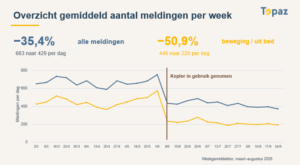
The outcome is clear
35.4% fewer total alerts per available day;
50.9% fewer movement and out-of-bed alerts per available day;
56.5% fewer movement and out-of-bed alerts during the night shift.
The average number of reports fell from 663 to 428 per day: approximately 235 fewer reports per 24-hour period. The number of movement and out-of-bed reports fell from 448 to 220 per day: approximately 229 fewer per 24-hour period. This isn’t just a matter of percentages, but of dozens fewer disruptions to the care process.
Fewer reports, more peace of mind
In the evaluation, staff members indicated that they felt more at ease because they received fewer irrelevant reports. Alarm fatigue also decreased, leaving them with more capacity to focus on situations that actually required care.
No evidence of a systematic decline in safety was found. The AI helps to better distinguish between different situations, so that healthcare workers receive more targeted information when their attention is needed.
From Skeptical to Convinced
When the pilot began, not everyone was immediately convinced. Employees were skeptical and wanted to see for themselves what the technology would actually mean for their daily work.
After three months, that perception changed:
“We were extremely skeptical, and right after we started, we actually wanted to quit right away—we didn’t have any confidence in it. It’s really impressive how, despite that slow start, it became so indispensable so quickly.”
The strength lies in the combination
. The results were achieved through a combination of AI technology, existing multisensors, care processes, and guidance from Topaz and Verkerk Healthcare.
Verkerk Healthcare handled the integration within the existing technology, care processes, and work agreements. This allowed employees to use the technology immediately without having to make major changes to their daily workflows. Topaz was responsible for, among other things, resident assessments, work procedures, and (internal) guidance. During the pilot and the evaluation, the results were measured and jointly translated into practical applications.
It is precisely that combination that makes the difference. Technology must not only function well from a technical standpoint, but also fit within existing work processes and demonstrably add value for the people who use it.
A clear decision after three months of
There was no obligation associated with the pilot from the outset. If the technology failed to add sufficient value, Topaz Vlietwijk could decide not to proceed.
Following the final evaluation, the decision is clear: Topaz Vlietwijk wants to continue using the technology.
The pilot thus demonstrates what a combination of monitoring, technology, and guidance can achieve: fewer unnecessary reports, less alarm fatigue, and a calmer daily work environment.