


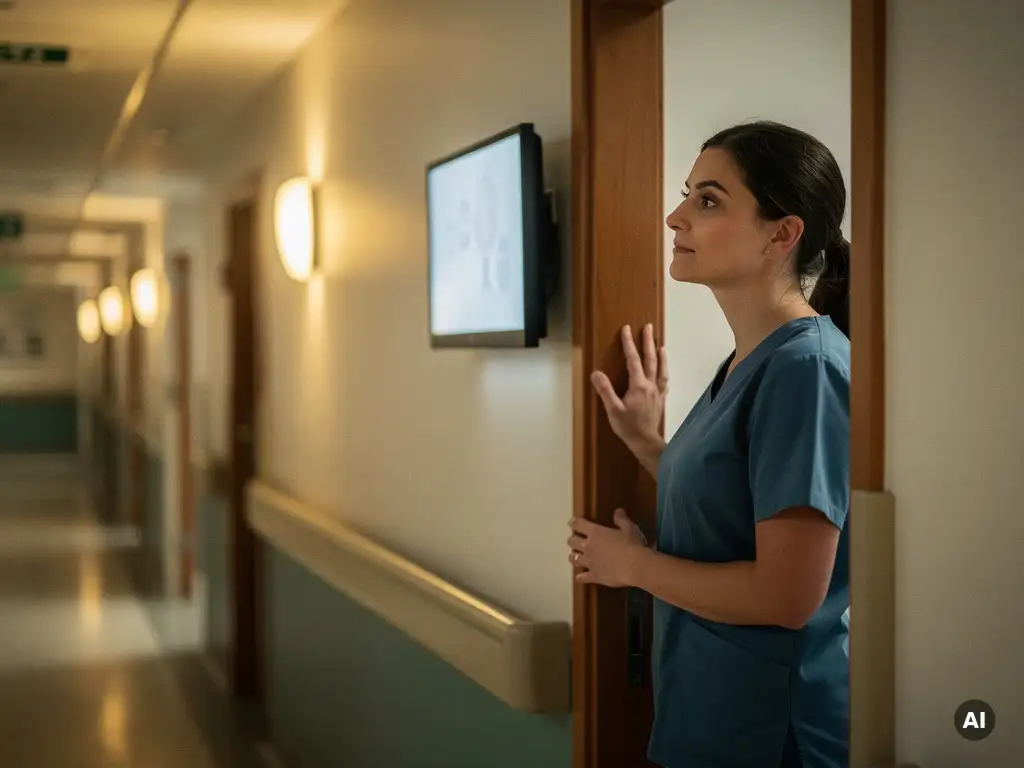
You build buy-in among nurses by involving them early, communicating openly about the role of AI monitoring, and working through a pilot phase together. Technology that care staff experience as a threat will never land well, regardless of how good the software is. Below we answer the most frequently asked questions about implementation, trust, and resistance.
Why do nurses sometimes resist AI monitoring?
Nurses resist AI monitoring because they often experience the technology as oversight of their work rather than support for it. The fear that a system records, evaluates, or even replaces their actions is an understandable and widely heard response. This sense of threat is at the core of the resistance, not the technology itself.
Behind that resistance there are often multiple concerns. Nurses fear that their professional judgment will be subordinated to an algorithm. Others worry about patient privacy or doubt the reliability of the system. When a system generates too many false alarms, staff quickly lose confidence in it.
What makes the situation worse is that AI monitoring is rarely explained properly before the system is introduced. Staff hear about the technology through rumors or a management email, without understanding what the system does and does not do. That information vacuum fills itself with uncertainty and skepticism.
How does the experience of AI monitoring differ by care role?
The experience of AI monitoring varies considerably by care role, because each position has a different relationship with patients and responsibilities. Night care staff, ward nurses, and team leaders each have different stakes in the introduction of patient monitoring technology.
- Night care staff often experience AI monitoring as direct support. They monitor multiple patients simultaneously and cannot be everywhere at once. A system that alerts immediately in the event of a fall gives them peace of mind and makes their work safer.
- Day care staff have less direct contact with the monitoring, but do notice the effects. Fewer undetected incidents means less remedial care and less administrative burden after an incident.
- Team leaders and care coordinators look at the broader workload and scheduling. They want to know how the system integrates into existing workflows and whether it genuinely reduces workload.
- Nurses in patient care are most sensitive to questions about privacy. They are responsible on a daily basis for the trust of patients and want to be certain that monitoring does not harm that relationship.
By communicating and training per role, you increase the likelihood that everyone learns to appreciate the technology in their own way.
When is the best time to involve nurses in the implementation?
The best time to involve nurses is as early as possible, preferably already in the orientation phase before a final decision has been made. The earlier staff experience having a say, the greater the chance that they feel ownership of the change rather than having it imposed on them.
A practical step-by-step plan looks like this:
- Orientation phase: Inform a small group of nurses about the considerations and ask about their experiences with existing pain points, such as missed alarms or high workload at night.
- Selection phase: Involve staff in evaluating possible solutions. Let them think along about what they expect from a monitoring system.
- Pilot phase: Assemble a mixed team of enthusiastic and critical staff members. Critical voices are valuable, because they ask the questions that make the implementation stronger.
- Evaluation phase: Give staff a formal moment to provide feedback before the system is rolled out broadly.
Involving people too late — for example only at the technical installation stage — almost always leads to resistance. Staff then feel that the decision has already been made and that their input is purely symbolic.
What information do care staff need in order to trust AI?
Care staff trust AI monitoring when they understand what the system does, what it does not do, and how it affects their daily work. Abstract explanations about algorithms do not help. Concrete answers to concrete questions do.
The most frequently asked questions that you need to answer proactively are:
- Who views the footage? Care staff want to know whether camera images are viewed by people. Explain clearly how the system works: images are processed by software, not by people.
- How reliable is the system? Provide concrete information about accuracy. Staff who know how rarely a false alarm occurs build trust faster than staff who have to guess.
- What will change in my work? Describe concretely which tasks will be done differently and which tasks will remain the same. Uncertainty about changes to work is a major source of resistance.
- Who is responsible if something goes wrong? Nurses want to know whether they are liable if the system misses a situation. Make the division of responsibility clear.
- How are patients informed? Care staff feel co-responsible for patient privacy. Explain how informed consent works.
How do you ensure a successful pilot phase with your team?
A successful pilot phase starts with a clear goal, a mixed team, and a safe environment for giving honest feedback. The pilot is not a technical test, but a human test: does this system work in our practice, with our people?
Ensure the following preconditions are in place:
- Set a clear duration. A pilot without an end date feels like a permanent introduction. Staff cooperate better when they know that their experiences will genuinely influence the decision.
- Designate an internal point of contact. A colleague who can answer questions and pass on experiences is more valuable than an external helpdesk.
- Actively document problems. Ask staff not only what is going well, but also what is not working. Make feedback a fixed routine, not an incident.
- Communicate results back. If the system prevented an incident during the pilot, share that with the team. Tangible results are more convincing than promises.
- Make room for doubt. Staff who are still skeptical during the pilot must be able to say so without social pressure. Forced enthusiasm is not buy-in.
What do you do if part of the team continues to reject AI monitoring?
If part of the team continues to reject AI monitoring after a thorough information round and a fair pilot, it is important to distinguish between principled objections and practical concerns that have not yet been resolved. Both require a different approach.
Practical concerns, such as doubts about reliability or privacy questions, can often still be addressed through targeted information or an adjustment to the way of working. Listen actively and do not become defensive. Sometimes you discover through critical staff members a genuine bottleneck that you had missed.
With principled objections, where someone fundamentally rejects AI in care, persuasion is rarely effective. What does help:
- Give staff the space to formally express their objections through an evaluation meeting or an internal feedback round.
- Ensure that the implementation does not depend on unanimity. Buy-in does not mean that everyone is enthusiastic, but that the majority sees the added value and is willing to work together.
- Monitor the team atmosphere. A small group of persistent opponents can negatively affect the broader team dynamic if they feel insufficiently heard.
- Evaluate again after three to six months. Staff who were initially skeptical sometimes change their minds when they experience the practical benefits in their own work.
How we contribute to a smooth implementation of AI monitoring
We understand that technology only works when the people who work with it trust it. Our solutions are therefore designed with care staff in mind, not only with technical specifications.
- Privacy as a starting point: Images are never viewed by people. A care staff member enters the room only when the software requests it, which protects patient privacy and lowers the threshold for acceptance.
- Exceptionally low error margin: Our system generates an average of only one false alarm per 92 days, which greatly reduces alarm fatigue among staff and builds trust in the technology.
- Plug-and-play installation: The implementation is straightforward to plan and configure, so the team quickly gains practical experience without lengthy technical start-up problems.
- Compliance and safety: We comply with ISO 27001 and NEN 7510 standards, giving care organizations and their staff confidence in the handling of patient data.
Would you like to know how we can support your organization in implementing AI-driven patient monitoring? Contact us for a no-obligation conversation.
Frequently Asked Questions
How long does it take on average for a team to fully accept AI monitoring?
Acceptance varies by team, but in practice most staff develop a more positive attitude after three to six months of active use. The biggest shift typically occurs when the system has prevented a concrete incident that the team itself experienced. Invest extra in communication and feedback on results during those first months, as this significantly accelerates the trust-building process.
What is the difference between building buy-in and convincing staff?
Building buy-in means that staff feel heard, have had a say, and are willing to give the technology a fair chance, even if they are not fully convinced. Convincing is one-sided and rarely works: it places staff in a passive role and actually reinforces resistance. Focus on participation and transparency rather than on arguments with which you try to reason away objections.
How do you deal with patients or family members who object to AI monitoring?
Ensure that informed consent is a fixed part of the admission process and that care staff know how to conduct this conversation. Explain to patients and family members in plain language what the system does, who does not have access to images, and what the direct benefits are for their safety. When staff themselves are well informed, they conduct this conversation with greater confidence and persuasiveness.
What common mistakes should you avoid when implementing AI monitoring in a care team?
The most common mistake is informing staff only after the decision has already been made, so that having a say is experienced as symbolic. Other frequent mistakes include: not designating an internal point of contact, paying too little attention to role-specific communication, and failing to actively feed pilot results back to the team. All these mistakes can be avoided by starting early with involvement and treating communication as an ongoing process, not a one-off action.
How do you measure whether the implementation of AI monitoring actually reduces workload?
Use measurable indicators that are tracked before and after implementation, such as the number of nighttime incidents, response time to alarms, the number of missed fall incidents, and perceived workload via periodic team check-ins. Feed these figures back to the team in plain language, not just as a management report. Concrete evidence from their own work environment is the most powerful argument for further acceptance.
Can AI monitoring also be used in smaller care organizations with limited resources?
Yes, modern AI monitoring systems are increasingly designed to be scalable and modular, allowing smaller organizations to start with a limited number of rooms or wards. A plug-and-play installation lowers the barrier for technical implementation and makes it possible to start small and expand in phases based on experience. It is advisable to ask the supplier specifically about implementation scenarios that fit the size and budget of your organization.
How do you maintain buy-in for AI monitoring after the initial implementation?
Buy-in is not an end point but an ongoing process: keep sharing results, organize periodic evaluation moments, and give staff the space to report new questions or concerns as they gain more experience with the system. New staff who join later have the same information needs as the original team, so ensure that onboarding around AI monitoring is a fixed part of the induction program. An internal point of contact who remains available after the pilot phase is a valuable constant factor in this regard.
Related Articles
- How do you recognize work pressure in your employees?
- How do you retain staff during a labor shortage?
- What is the role of the manager in managing workload?
- What are the latest developments in fall prevention for the elderly?
- What is the role of AI in improving patient outcomes?
This content was generated with the help of AI and it may contain mistakes