


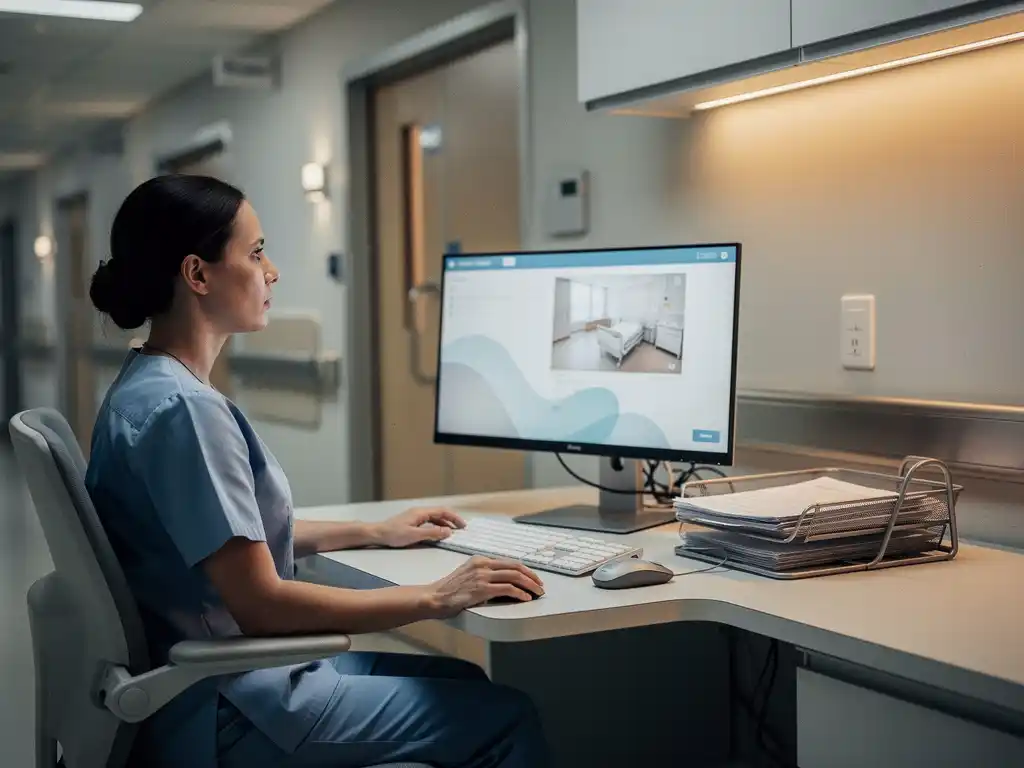
Reducing workload in healthcare without hiring additional staff is possible by working smarter with technology. By automating routine monitoring tasks, care staff can focus their attention on tasks that genuinely require a human presence. This helps existing staff work more effectively without increasing their workload. In this article, we answer the most frequently asked questions on this topic, from the causes of high workload to the practical steps for implementation. Discover more about smart care solutions at the Kepler Vision website.
What are the biggest causes of high workload in healthcare?
High workload in healthcare is primarily caused by a combination of staff shortages, growing demand for care, and the large number of administrative and monitoring tasks that staff carry out every day. These factors reinforce one another, making it increasingly difficult for care organizations to maintain the quality of care.
Demand for care grows by approximately 6% each year, while the supply of qualified staff fails to keep pace. As a result, existing employees face a heavier burden. In addition to rising demand, the following factors also play a significant role:
- Night shifts and continuous monitoring: Staff must keep an eye on residents throughout the night, which is both physically and mentally demanding.
- False alarms: Older monitoring technology generates a high number of false alerts, causing staff to be called unnecessarily and leading to exhaustion.
- Reactive working: Without proper tools, staff only respond once something has already gone wrong, which is more stressful than being able to act preventively.
- Administrative burden: Documentation and reporting take up time that could otherwise be spent on direct care.
Together, all these factors mean that staff are consistently overloaded. Addressing workload therefore starts not only with recruitment, but also with eliminating unnecessary tasks.
How can technology reduce workload in healthcare?
Technology can reduce workload in healthcare by automating repetitive and time-consuming monitoring tasks. This means staff no longer need to be continuously present with residents to check that everything is in order — they are only alerted when action is actually required.
The principle is straightforward: instead of a staff member doing rounds every hour to check that everyone is safely in bed, a smart system takes over that task. Staff are only called upon when the situation genuinely demands it. This offers several benefits:
- Fewer unnecessary check rounds and interruptions during night shifts
- More rest and focus for staff, contributing to their well-being
- Faster response in genuine emergencies, as alerts are received immediately
- Reduced risk of missing incidents, as monitoring takes place around the clock
Technology does not replace the care worker — it takes over the repetitive part of the job. That is precisely where the gain lies when you want to reduce workload without hiring additional staff.
What is the difference between reactive and preventive care monitoring?
Reactive care monitoring means responding after something has already gone wrong — such as a fall that has already occurred. Preventive monitoring focuses on identifying risk situations before they lead to an incident, allowing for earlier intervention and limiting the consequences.
This difference has significant implications for both resident safety and staff workload. With a reactive approach, a staff member is only alerted after someone is already on the floor. The resident may have been waiting for some time by then, and the staff member arrives in a stressful situation. With preventive monitoring, signals are recognized that indicate an impending fall or unsafe situation, enabling earlier action.
In practice, preventive monitoring means:
- Detection of risky movements or positions before a fall occurs
- Monitoring of lying positions to prevent pressure sores
- Immediate alerts for unusual behavior, enabling staff to respond quickly
For care organizations looking to reduce workload, shifting from reactive to preventive working is one of the most effective steps they can take.
How does AI fall detection work in a care facility?
AI fall detection works by analyzing camera footage in real time using artificial intelligence. The software automatically recognizes when someone falls or ends up in an unsafe position, and immediately sends an alert to the care worker. The footage is never viewed by humans, which protects the privacy of residents.
The technology uses computer vision: algorithms trained to recognize human movements and postures. The AI distinguishes normal movements from dangerous situations, such as a fall from bed or an unsafe lying position. As soon as such a situation is detected, the staff member receives a warning within seconds.
A key advantage of modern AI fall detection is its high accuracy. Older systems, such as motion sensors or pressure mats, generate many false alarms, which in itself is a source of added workload. A well-designed AI system distinguishes genuine emergencies from ordinary movements, meaning staff are only called upon when it is truly necessary.
Because the software is active around the clock, staff no longer need to continuously monitor residents themselves. They can focus on other care tasks and are only called into action when the situation requires it.
When is AI monitoring right for your care organization?
AI monitoring is well suited to a care organization when there are staff shortages, high workload during night shifts, or an elevated fall risk among residents. Organizations that frequently deal with false alarms from existing systems, or that want to better protect resident privacy, also stand to benefit significantly from AI monitoring.
Some concrete signs that AI monitoring may be a good fit:
- Staff regularly carry out unnecessary check rounds due to a lack of reliable monitoring
- There have been incidents where a fall was discovered too late
- Existing sensors or camera systems generate too many false alerts
- The organization wants to improve resident privacy by reducing direct human observation
- There is a need for objective data on movement and lying positions for care records
AI monitoring is not exclusively for large hospitals. Elderly care facilities, rehabilitation centers, and psychiatric clinics can benefit just as much. Today’s technology is plug-and-play ready, meaning implementation is relatively straightforward without the need for extensive IT infrastructure.
What steps are needed to implement AI care monitoring?
Implementing AI care monitoring involves a number of concrete steps: assessing needs, technical installation, integration with existing workflows, and training staff. Thorough preparation ensures that the technology can be put into use quickly and smoothly.
A practical step-by-step plan looks like this:
- Map out your needs: Which departments or rooms would benefit most from monitoring? Where are the risks greatest?
- Choose the right technology: Compare systems on accuracy, privacy safeguards, and ease of use. Look for certifications such as ISO27001 and NEN7510.
- Technical installation: Modern AI monitoring systems are plug-and-play, meaning they can be installed without major renovations.
- Integrate with workflows: Ensure alerts are delivered to the devices staff already use, keeping the barrier to adoption as low as possible.
- Train staff: Explain how the system works, what it does and does not do, and how to respond to alerts.
- Evaluate and optimize: After implementation, monitor whether the system is delivering the desired results and adjust settings where needed.
A successful implementation requires buy-in from the team. Staff who understand that the technology supports rather than replaces them are far more likely to embrace it.
How Kepler Vision helps reduce workload
At Kepler Vision Technologies, we develop AI software that helps care organizations reduce workload without hiring additional staff. Our solutions, Kepler Night Nurse and Kepler NurseAssist, watch over residents and patients around the clock and only send an alert when something genuinely requires attention.
What our approach delivers for your organization in concrete terms:
- Accurate fall detection: Our software generates just one false alarm every 92 days — 1,000 times better than older technologies.
- Full privacy: Footage is never viewed by humans. Staff only enter the room when the software indicates it is necessary.
- Fast response: Within seconds of a fall or unsafe situation, the staff member receives an alert.
- Simple implementation: Our software is plug-and-play and can be deployed quickly without major IT adjustments.
- Certified security: We comply with ISO27001 and NEN7510, ensuring the security of patient data is guaranteed.
Want to find out whether our AI monitoring is a good fit for your care organization? Visit keplervision.eu and discover how we can support your team.
Frequently Asked Questions
What does AI care monitoring cost, and is it financially feasible for smaller care organizations?
The cost of AI care monitoring varies by provider and the number of rooms or departments being monitored. Many providers work with a subscription model, which makes the investment more manageable than a single large purchase. Smaller care organizations can also weigh the costs against savings on overtime, staff turnover, and the consequences of fall incidents. A cost-benefit analysis based on your current situation will quickly reveal the payback period.
How do residents and their families feel about cameras in the room?
Resistance from residents and families is understandable, but it often fades once the system is properly explained. It is important to emphasize that footage is never viewed by humans and that the camera serves solely as a safety measure. Transparent communication, consent procedures, and the option to temporarily disable the system all help build trust. In practice, many residents and families find it reassuring to know that 24/7 oversight is in place without their privacy being compromised.
What happens if the AI system misses a situation or generates an incorrect alert?
No system is 100% error-free, but modern AI fall detection is significantly more accurate than traditional sensors or pressure mats. In the event of a missed alert, the care organization’s existing protocol remains in effect: regular checks and other safety measures continue to apply as a supplement. False alarms are greatly reduced with advanced systems, which is one of their major advantages over older technology. When selecting a system, it is advisable to ask for verifiable accuracy data and guarantees.
Can staff with little affinity for technology still use AI monitoring effectively?
Yes — modern AI monitoring systems are designed specifically for ease of use and require no technical background. Staff receive alerts on devices they already know, such as a smartphone or tablet, and do not need to configure or analyze anything themselves. A brief training session is typically sufficient to become comfortable with the system. Providers that offer solid onboarding and ongoing support ensure that even less tech-savvy staff can get up to speed quickly.
How does AI monitoring affect job satisfaction and retention among care staff?
Care workers who are less frequently disrupted by false alarms and unnecessary check rounds experience greater calm and can focus their attention on meaningful care tasks. This has a positive effect on job satisfaction, which in turn contributes to lower absenteeism and reduced staff turnover. Staff also feel better supported knowing that the technology provides a safety net. Organizations that invest in smart tools also demonstrate that they take the well-being of their staff seriously.
Are there privacy laws or regulations that care organizations need to consider when using AI monitoring?
Yes — when deploying camera-based monitoring in care facilities, the GDPR (General Data Protection Regulation) applies, as do sector-specific guidelines such as the NEN7510 standard for information security in healthcare. It is mandatory to obtain consent from residents or their legal representatives and to inform them of the purpose of the monitoring. Choose a provider that demonstrably complies with these standards and that offers support in drawing up the necessary data processing agreements and privacy documentation.
How do you measure whether AI care monitoring has actually reduced workload after implementation?
After implementation, you can measure the impact using concrete indicators such as the number of alerts per shift, response times to incidents, the number of fall incidents, and staff satisfaction scores. Compare these figures with the situation prior to implementation to make the difference visible. Many AI monitoring systems also offer reporting features that provide insight into movement patterns and incident history. Regular evaluations also help you fine-tune the system and further optimize the benefits.
Related Articles
- How do you keep healthcare workers in the workforce longer?
- How does a good employer deal with work pressure?
This content was generated with the help of AI and it may contain mistakes