


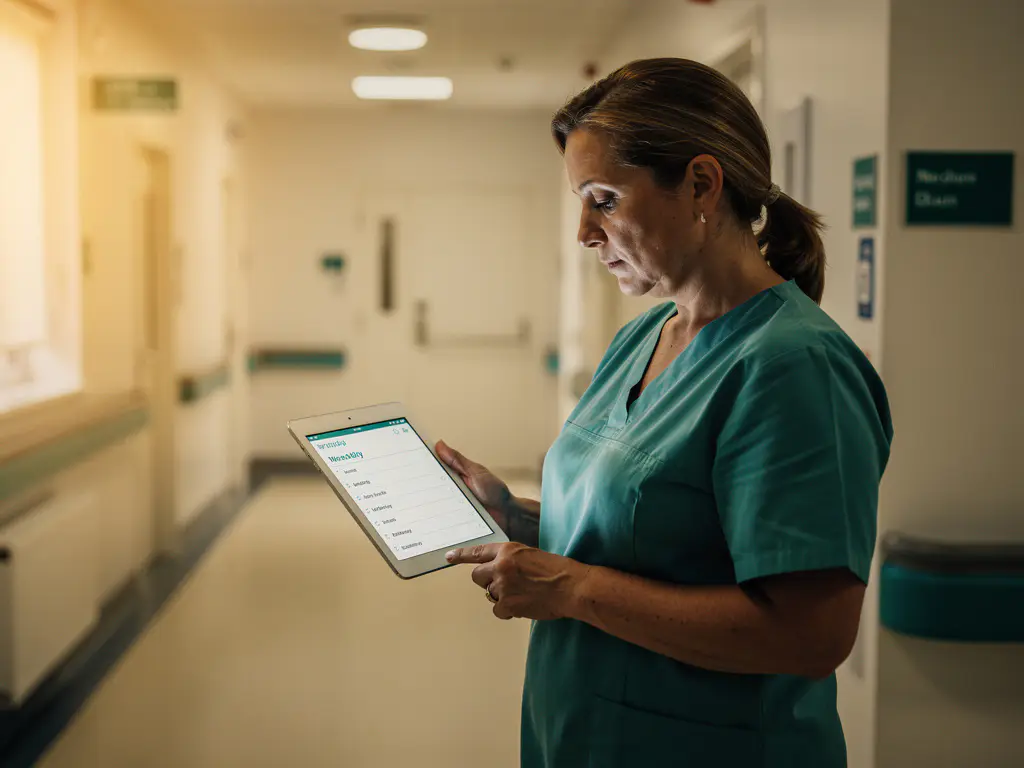
Smart scheduling reduces the pressure caused by staff shortages in healthcare by automating repetitive planning tasks, deploying available staff more efficiently, and eliminating unnecessary actions. Healthcare organizations struggling with staff shortages in healthcare can use this approach to responsibly support more clients with the same team. In this article, we answer the most frequently asked questions about smart scheduling and the role of AI monitoring within it.
What are the main causes of work pressure due to staff shortages in healthcare?
Workloads in healthcare are rising because the demand for care is growing faster than the available workforce. The need for care increases by approximately 6% each year, while attracting and retaining qualified staff is becoming increasingly difficult. This creates a structural gap between what is needed and what can be delivered.
Beyond the tight labor market, internal factors also play a significant role. Healthcare workers spend a considerable portion of their time on administrative tasks, manual reporting, and responding to alarms that ultimately turn out not to be genuine emergencies. These non-care activities consume valuable time that could be better spent on direct client care.
Other common causes include:
- Inefficient schedules that fail to account for peak demand or individual competencies
- High staff turnover due to burnout and job dissatisfaction
- Insufficient use of technology to ease supervisory tasks
- Night shifts where staff must monitor multiple clients simultaneously without technical support
How does smart scheduling work in the healthcare sector?
Smart scheduling in healthcare uses data and algorithms to optimize staffing based on care demand, availability, qualifications, and regulatory requirements. Rather than manually piecing together schedules, the system automatically generates rosters that align with the organization’s actual needs.
A smart scheduling system accounts for variables that a human planner would struggle to oversee all at once: contracted hours, specializations, leave balances, collective labor agreement rules, and historical staffing patterns. By combining these factors, the system produces a schedule that is not only compliant but also better suited to the day-to-day reality of the workplace.
Smart scheduling also works reactively. When a staff member calls in sick, the system immediately searches for the most suitable replacement based on availability and competencies. This saves planners hours of phone calls and ad hoc solutions.
Which tasks can smart scheduling automatically take over from care planners?
Smart scheduling can automatically handle a large share of repetitive and time-consuming planning tasks. These include drafting base schedules, processing leave requests, monitoring compliance with collective labor agreement standards, and finding replacements for sick employees.
Specifically, these tasks include:
- Automatically generating weekly and monthly schedules
- Checking compliance with working hours legislation and collective labor agreement rules with every change
- Processing and approving leave and shift-swap requests
- Flagging understaffing on specific shifts or departments
- Matching staff profiles to the appropriate client groups or departments
- Reporting on staffing levels and scheduling bottlenecks
By offloading these tasks, care planners can focus on strategic questions: how to keep staff satisfied, how to distribute workloads more fairly, and how to respond to long-term trends in care demand.
How does AI monitoring contribute to more efficient scheduling in elderly care?
AI monitoring in elderly care reduces the need for constant physical presence with clients, allowing staff to direct their attention more purposefully. This has a direct impact on how schedules are composed: fewer staff members need to be present simultaneously for supervisory tasks, as the AI partially takes this over.
In practice, this means night shifts can be structured differently. Where previously multiple staff members were needed to do rounds and observe clients, AI monitoring can provide continuous oversight and only alert a staff member when action is genuinely required. This makes it possible to deliver responsible care with a smaller team.
In addition, AI monitoring generates data that is valuable for scheduling. Insight into when clients need care most, at what times incidents occur, and how long tasks typically take helps planners align schedules more closely with actual care demand.
What are the benefits of smart scheduling for healthcare workers?
Smart scheduling leads to fairer workload distribution for healthcare workers, greater predictability in their working hours, and less administrative burden. This increases job satisfaction and reduces the risk of staff turnover, which helps ease staff shortages in healthcare over the long term.
The benefits are both practical and psychological:
- More control over their own schedule: staff can request leave, swap shifts, and view their planning through an app
- Fairer distribution of undesirable shifts: the system tracks who has worked which night or weekend shifts
- Fewer last-minute changes: better advance planning means less stress from unexpected adjustments
- More time for care: fewer administrative obligations means more room for direct client contact
For healthcare organizations, this is a double benefit: satisfied employees are more productive, take fewer sick days, and stay longer.
When is smart scheduling the right choice for a healthcare organization?
Smart scheduling is the right choice when a healthcare organization consistently struggles to fill shifts, planners spend too much time on manual tasks, or staff regularly complain about unfair or unpredictable schedules. The larger the organization, the greater the gains to be made.
Specific signs that it is time for smart scheduling:
- Planners spend more than a day per week drafting or adjusting schedules
- Shifts are regularly opened with insufficient staffing because no suitable replacements can be found
- Staff perceive the scheduling process as unfair or lacking transparency
- The organization is growing or operating across multiple locations, making manual planning unmanageable
Smart scheduling works best in combination with other technological solutions, such as AI monitoring. Together, they ensure that both the planning and delivery of care become more efficient, without compromising quality or safety.
How Kepler Vision helps with staff shortages in healthcare
At Kepler Vision Technologies, we understand the immense pressure on healthcare organizations that are struggling every day to keep their heads above water with too few staff. Our AI solutions are specifically designed to relieve that pressure, so that employees can direct their time and energy toward what truly matters: delivering great care.
Kepler Night Nurse and Kepler NurseAssist support smart scheduling in concrete ways:
- 24/7 automated monitoring: the AI continuously watches over clients, so that night shifts can be carried out responsibly with fewer staff
- Instant fall detection: staff receive an alert within seconds, making unnecessary rounds redundant
- Only one false alarm every 92 days: staff are not disturbed by unnecessary notifications, providing calm and focus
- Privacy-first approach: footage is never viewed by humans — staff only enter a room when the software requests it
- Plug-and-play installation: easy to implement in existing care environments, with no complex IT projects required
Want to find out how our solutions fit your organization and how they can contribute to a more efficient use of your team? Get in touch with us and discover what Kepler Vision can do for your healthcare organization.
Frequently Asked Questions
How long does it take to implement smart scheduling in a healthcare organization?
Implementation time varies by organization and system, but most healthcare organizations are up and running within four to twelve weeks. It is important to start with a thorough inventory of existing scheduling systems, collective labor agreement arrangements, and staff profiles, so that the new system can work with current data from day one. Where possible, choose a vendor that provides support during the transition period, so that planners can become familiar with the system without putting daily care continuity at risk.
What are the most common mistakes when introducing smart scheduling?
A common mistake is implementing a scheduling system without involving staff from the outset. Buy-in on the floor is essential: if staff do not trust or understand the system, they will work around it rather than with it. Other pitfalls include entering incomplete or outdated staff data, skipping a testing phase, and underestimating the time needed for training and adjustment.
Can smart scheduling also be used by small healthcare organizations or home care teams?
Yes, smart scheduling is not reserved for large institutions. Smaller home care organizations or teams of ten to twenty staff members also benefit from automated scheduling solutions, especially when staff work across multiple locations or with varying clients. Many providers offer scalable subscription plans, meaning the investment is proportionate to the size of the organization.
How does smart scheduling handle unexpected absences, such as same-day sick calls?
In the event of a last-minute absence, a smart scheduling system automatically searches for the most suitable available staff member based on competencies, contracted hours, and collective labor agreement rules, and immediately sends a request via the associated app. This replaces the time-consuming phone calls and messages that planners would otherwise have to make themselves. Some systems use a fairness-based priority list, so that the same staff members are not always asked to take on extra shifts.
How do AI monitoring and smart scheduling work together in practice?
AI monitoring provides real-time and historical data on when clients need care, how long tasks take, and at what times incidents occur. These insights are then used as input for the scheduling system, so that staffing levels align more closely with actual care demand rather than assumptions or fixed patterns. In this way, both technologies reinforce each other: monitoring optimizes the delivery of care, while smart scheduling ensures the right people are available at the right times.
What are the privacy considerations when using AI monitoring in combination with workforce planning?
In healthcare AI monitoring, privacy is a legitimate concern for both clients and staff. Choose solutions that comply with GDPR and in which footage is not viewed by humans but analyzed only by algorithms. For staff, scheduling data and availability information must be stored securely and accessible only to authorized planners; being transparent about this with the team builds trust in the system.
How do you measure whether smart scheduling is actually having an impact on workload and staff retention?
Measure a number of concrete indicators before and after implementation: the time planners spend on scheduling tasks each week, the number of unfilled shifts per period, the absenteeism rate, and staff satisfaction through periodic surveys. After three to six months of use, measurable improvements in scheduling efficiency and staff satisfaction are typically already visible. Link these figures to longer-term turnover data as well, to map the full impact on staff retention.
Related Articles
- How to Scale AI Patient Monitoring Across Multiple Hospital Departments
- How do you solve understaffing without hiring new people right away?
- What is work pressure and what are the causes?
- How does aging affect the labor shortage?
- What are the risk factors for fall prevention?
This content was generated with the help of AI and it may contain mistakes