


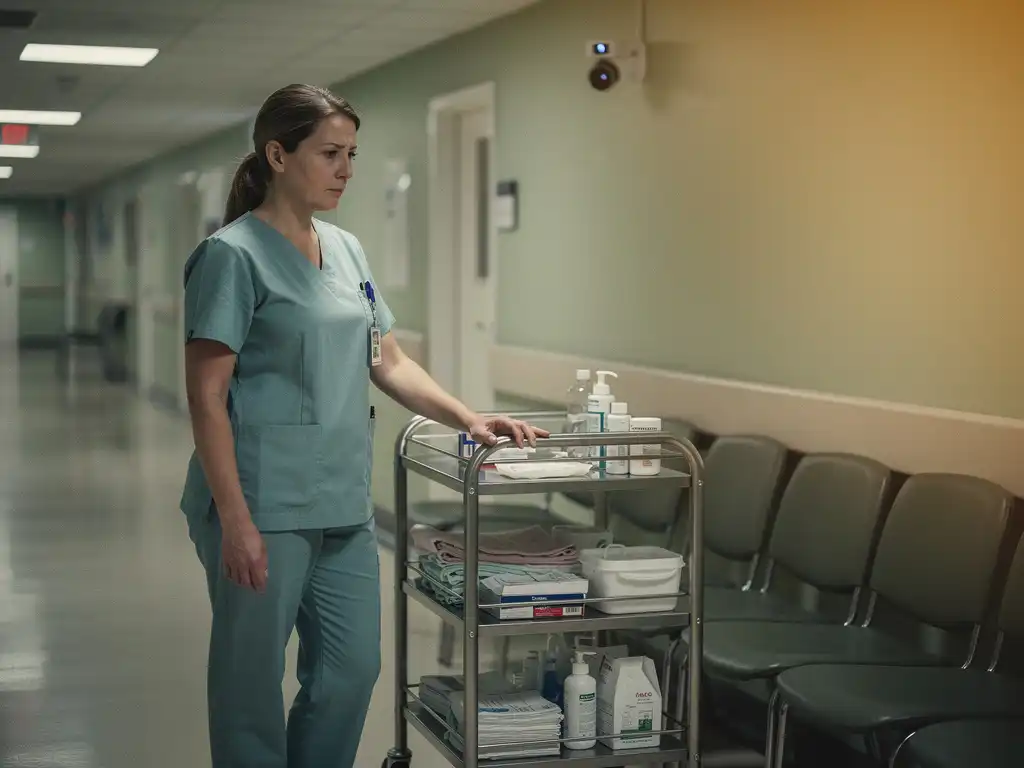
There are multiple solutions to staff shortages in healthcare, both technological and organizational. Technological innovations such as AI monitoring software take over repetitive monitoring tasks, allowing care staff to focus on tasks that truly require human attention. In addition, better employment conditions, smart scheduling, and preventive policies play an important role. In this article, we answer the most frequently asked questions about solutions to staff shortages in the healthcare sector.
What are the main causes of staff shortages in healthcare?
Staff shortages in healthcare are caused by a combination of an aging population, high workloads, and a shrinking workforce. Demand for care is growing by approximately 6% per year, while the supply of qualified healthcare workers is failing to keep pace. This makes recruiting and retaining staff a structural challenge for many healthcare organizations.
The most commonly cited causes are:
- An aging population: More elderly people means higher demand for care, while the working-age population is relatively shrinking.
- High workload: Healthcare workers regularly experience burnout, leading to absenteeism and early departure from the sector.
- Limited intake: Healthcare training programs are not attracting enough new students to compensate for those leaving the profession.
- Administrative burden: A large portion of working time is lost to documentation and reporting rather than direct patient care.
- Night shifts and irregular hours: These make the profession less attractive, particularly for younger generations.
Healthcare organizations that structurally struggle with understaffing also risk entering a negative spiral: high workloads lead to more absenteeism, which further increases the pressure on remaining staff.
What technological solutions help address staff shortages?
Technology cannot fully solve staff shortages in healthcare, but it can significantly reduce the pressure on employees by automating time-consuming tasks. The most effective technological solutions focus on monitoring, communication, and scheduling.
Relevant technological applications include:
- AI monitoring software: Automatic detection of fall incidents, unsafe lying positions, and other high-risk situations, so that staff are only called upon when truly necessary.
- Smart sensors and IoT applications: Devices that measure movement, temperature, and other environmental factors to enable early intervention.
- Digital scheduling systems: Software that optimizes rosters based on availability, competencies, and care demand.
- Electronic client records: Streamlined documentation reduces the administrative burden and gives staff more time for direct care.
- Telecare and video consultations: Remote client support reduces the need for physical presence at every care interaction.
The choice of a specific technology depends on the type of healthcare facility, the population being served, and the nature of the bottlenecks in day-to-day care delivery.
How does AI monitoring work as a solution to staff shortages in healthcare?
AI monitoring works by continuously analyzing camera footage using computer vision and machine learning, without any human needing to view the images. When the software detects an unsafe situation — such as a fall — it immediately sends an alert to the care worker. This allows fewer staff to effectively supervise more clients.
The system functions as a digital watchdog that is active 24 hours a day, 7 days a week. This is especially valuable during nighttime hours, when staffing is scarce and supervision is harder to organize. A care worker only needs to enter a client’s room when the software requests it, preventing unnecessary disturbances and promoting a restful environment for clients.
Specifically, AI monitoring can take over the following tasks:
- Detection of fall incidents and immediate alerting
- Recognition of unsafe lying positions
- Fall prevention through early identification of at-risk behavior
- Continuous monitoring without human intervention
By taking over repetitive monitoring tasks, the software allows care workers to direct their attention to tasks where human insight, empathy, and professional expertise are indispensable.
What is the difference between AI monitoring and traditional surveillance technology?
The key difference lies in accuracy and the number of false alarms. Traditional surveillance technology — such as motion sensors or conventional camera systems — generates a high number of false alerts. AI monitoring analyzes situations in context, distinguishing a genuine emergency from an innocuous movement, which drastically reduces the burden on staff.
Traditional surveillance technology
Motion sensors and basic camera systems respond to any movement, regardless of context. This results in a high number of false alarms, causing staff to be called in unnecessarily on a regular basis. Over time, this can lead to alarm fatigue, where staff become slower to respond to alerts because they have grown accustomed to false signals.
AI-based monitoring
AI monitoring analyzes footage in real time and understands the context of a situation. The software learns to recognize patterns and distinguishes between normal activity and a genuine emergency. This results in far fewer false alarms, reducing staff workload and increasing confidence in the system. Furthermore, camera footage is never viewed by humans, ensuring client privacy is fully protected.
What non-technological measures can reduce staff shortages?
Non-technological measures focus on making the healthcare profession more attractive, reducing absenteeism, and deploying available staff more efficiently. These measures are essential alongside technological solutions, because technology alone does not address the underlying causes of staff shortages.
Effective non-technological measures include:
- Better employment conditions: Higher salaries, flexible working hours, and good pension arrangements make the profession more attractive.
- Investment in training and career development: Employees who have opportunities to grow tend to stay longer.
- Preventive absence management: Early identification of work-related stress and burnout risk prevents long-term sick leave.
- Task differentiation: Not every care task requires a highly trained nurse. By distributing tasks intelligently, qualified staff can be deployed more efficiently.
- Collaboration with educational institutions: Structural internship placements and dual learning pathways increase the intake of new healthcare professionals.
- Involvement of informal caregivers and volunteers: For certain support tasks, informal caregivers and volunteers can help absorb part of the care demand.
The most successful approach combines several of these measures simultaneously, tailored to the specific situation of the healthcare organization.
When is AI monitoring software the right choice for a healthcare organization?
AI monitoring software is the right choice when a healthcare organization structurally faces understaffing — particularly during night shifts — and when client safety is at risk due to limited supervision capacity. It is also well suited to organizations that want to improve client privacy compared to traditional surveillance methods.
Concrete signs that AI monitoring is an appropriate solution:
- Staff cannot adequately monitor all clients, especially at night.
- Incidents such as falls are regularly discovered too late.
- Traditional alarm systems generate too many false alerts, leading to alarm fatigue.
- The organization wants to better protect client privacy than conventional camera surveillance allows.
- There is a need for a scalable solution that can be easily rolled out across multiple locations.
How Kepler Vision Technologies helps address staff shortages
At Kepler Vision Technologies, we develop AI software that supports healthcare organizations in managing staff shortages through smart, reliable monitoring. Our products Kepler Night Nurse and Kepler NurseAssist watch over clients in elderly care facilities and patients in hospitals around the clock — 24/7 — without footage ever being viewed by humans.
What our solution concretely offers:
- Immediate fall detection: Care staff receive an alert within seconds of an incident.
- Just one false alarm every 92 days: That is a thousand times more accurate than traditional technologies, preventing alarm fatigue.
- Privacy by design: Footage is processed by AI and never viewed by humans.
- Plug-and-play installation: Easy to configure and roll out across multiple locations.
- ISO 27001 and NEN 7510 certified: Security and compliance are guaranteed.
Want to find out whether our AI monitoring software is the right fit for your organization’s challenges? Visit our website for more information or contact us to discuss the possibilities.
Frequently Asked Questions
How long does it take to implement AI monitoring software in a healthcare facility?
Implementation time varies by organization, but thanks to plug-and-play installation, AI monitoring software such as Kepler Night Nurse can typically be up and running at a location within a few days. For rollout across multiple locations, a phased approach is recommended — starting with a pilot location to familiarize staff with the system. Make sure your team is well informed in advance about how the software works and what benefits it offers, so that buy-in is secured from the start.
How do care staff and clients typically react to the introduction of AI monitoring?
Resistance is a common initial reaction, both from staff and from clients and their families — often due to concerns about privacy or a sense of being “watched.” It is important to communicate transparently that footage is never viewed by humans and that the system is solely intended to enhance safety and reduce workload. In practice, staff quickly come to see the software as a welcome form of support, and clients feel safer knowing that continuous supervision is in place without any intrusion on their privacy.
What are the most common mistakes when addressing staff shortages in healthcare?
A common mistake is relying on a single measure — such as recruiting alone or implementing technology in isolation — without a structural, combined approach. Organizations also frequently underestimate the impact of alarm fatigue: deploying traditional sensors that generate too many false alerts increases workload rather than reducing it. A successful strategy combines technological tools with improved employment conditions, task differentiation, and preventive absence management.
Is AI monitoring suitable for smaller healthcare facilities with a limited budget?
Yes, AI monitoring is not exclusive to large healthcare organizations. Many solutions are scalable and can start with a limited number of rooms or wards, keeping the initial investment manageable. Moreover, the cost of the system is often offset by the savings generated through fewer incidents, lower absenteeism costs, and more efficient use of staff. It is advisable to carry out a cost-benefit analysis beforehand, based on your facility’s specific staffing challenges and incident history.
Does AI monitoring software comply with privacy legislation such as GDPR?
High-quality AI monitoring solutions are designed with privacy by design as a core principle, meaning that camera footage is processed exclusively by the AI and never viewed by humans. Certifications such as ISO 27001 and NEN 7510 provide additional guarantees for information security and compliance. It is advisable to conduct a Data Protection Impact Assessment (DPIA) during implementation and to involve the works council in a timely manner, as required by GDPR when deploying new monitoring technology.
Can AI monitoring also contribute to fall prevention, or does it only detect falls that have already occurred?
Modern AI monitoring software goes beyond simply detecting a fall after it has happened. By recognizing at-risk behavior — such as a client sitting unsteadily on the edge of the bed or getting up multiple times during the night — the system can issue an early alert so that a staff member can intervene preventively. This makes AI monitoring not only reactive but also proactive, structurally improving client safety and reducing the likelihood of serious fall incidents.
What is the best first step a healthcare organization can take to address staff shortages?
Start with a thorough analysis of where the biggest bottlenecks lie: is it primarily absenteeism due to workload, insufficient supervision capacity at night, or a heavy administrative burden? Based on that analysis, you can make a targeted choice about which combination of measures — technological and organizational — will have the greatest impact. A pilot project with AI monitoring on a single ward or location is a low-threshold way to quickly gain insight into the practical impact, without committing to a large investment upfront.
Related Articles
- What is workplace happiness and how does it relate to workload?
- How do you implement fall prevention for elderly people in healthcare facilities?
- What are the most common causes of falls in elderly people?
- How can healthcare institutions prepare for future technology?
- What are the benefits of intelligent care systems?
This content was generated with the help of AI and it may contain mistakes