


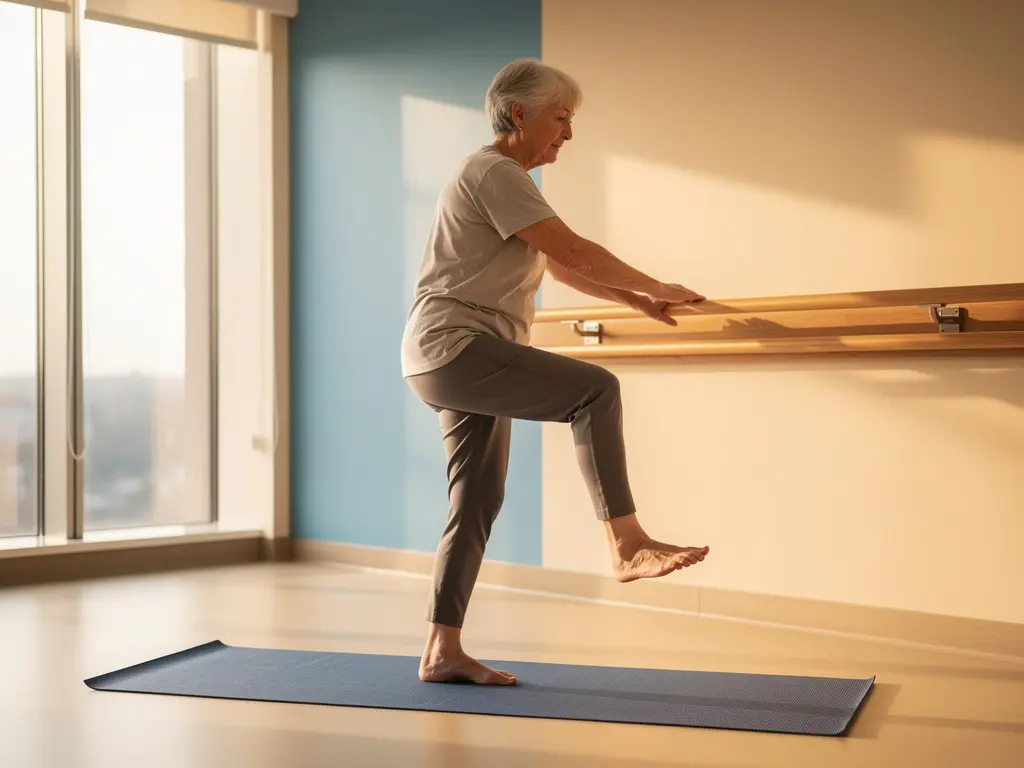
Falls are one of the biggest concerns for older adults and their family members. Annually, approximately 1 in 3 older adults aged 65 and older fall, sometimes with serious consequences for their health and independence. Fortunately, targeted exercises can significantly reduce fall risk by improving balance, muscle strength, and coordination. Fall prevention for older adults begins with the right exercise program.
The effectiveness of fall prevention exercises is scientifically proven. Through regular exercise, older adults can increase their stability and regain confidence in their own movements. In this article, we discuss the most effective exercises and provide practical tips for safe execution.
What are the most effective exercises for fall prevention?
The most effective fall prevention exercises combine balance training, strength training, and flexibility. Tai Chi, single-leg stands, leg and core strengthening exercises, and walking training on different surfaces form the foundation of a successful fall prevention program.
Tai Chi tops the list of proven effective exercises. These gentle, flowing movements improve not only balance but also muscle strength and body awareness. Research shows that regular Tai Chi practice can reduce fall risk by up to 25%.
Single-leg stand exercises are simple to perform but highly effective. Start with standing on one leg for 10 seconds next to a sturdy chair for support. Gradually build this up to 30 seconds per leg. For advanced practitioners, this can be expanded by exercising with eyes closed or standing on an unstable surface.
Strength training for the legs and core is essential. Squats, lunges, and hip bridges strengthen the large muscle groups needed for stability. Core exercises such as planks and abdominal exercises also contribute to better posture and balance.
How often should you do fall prevention exercises?
Fall prevention exercises should be performed at least 2 to 3 times per week, with sessions lasting 30 to 45 minutes. For optimal results, daily activity is ideal, where you can alternate between different types of exercises to prevent overuse.
The frequency depends on your current fitness level and goals. Beginners can start with two sessions per week and gradually expand this. The most important thing is consistency: regular, shorter sessions are more effective than sporadic, long training sessions.
Distribute your exercises throughout the week by emphasizing different aspects. For example: Monday and Thursday for strength training, Tuesday and Friday for balance exercises, and Wednesday for flexibility and mobility. Weekend days can be used for lighter activities such as walking or gardening.
Always listen to your body. When experiencing fatigue or pain, it’s better to take a day of rest than to continue and risk injuries. A good rule is that you should feel energetic after exercises, not exhausted.
Which balance exercises help best against falling?
The best balance exercises against falling are single-leg stand exercises, heel-to-toe walking, sideways steps, and static positions on different surfaces. These exercises train both static and dynamic balance, which is essential for fall prevention.
Heel-to-toe walking, also called tandem walking, simulates walking on a narrow line. Place your heel directly in front of the toes of your other foot and walk 10 to 15 steps forward this way. This exercise improves coordination and balance during walking.
Sideways steps train the stabilizing muscles on the side of your body. Take 10 to 15 steps to the left and then to the right, without crossing your feet. Keep a chair within reach for safety.
Static positions on different surfaces make the exercises more challenging. Try performing balance exercises on a cushion, mat, or other unstable surface. This trains your body to respond to unexpected disruptions to your balance.
Also practice functional movements, such as standing up from a chair without using your hands or picking up objects from the ground. These are daily movements where falls often occur.
How do you strengthen muscles to prevent falls?
Muscle strength for fall prevention is best built with functional exercises that strengthen the legs, core, and torso. Squats, lunges, hip bridges, and leg extensions are effective exercises to strengthen the muscles essential for stability and balance.
Squats are the king among leg-strengthening exercises. Start with support from a chair and slowly sit down and stand up again. Focus on a controlled movement where your knees don’t fall inward. Work up to 10 to 15 repetitions per set.
Lunges train not only strength but also balance and coordination. Take a step forward and lower your back knee toward the ground. Hold onto a chair for support if necessary. Alternate between both legs.
Hip bridges strengthen the glute muscles and hamstrings, which is crucial for good posture and stability. Lie on your back with bent knees and lift your pelvis until your body forms a straight line from knees to shoulders.
Don’t forget the core. Planks, modified wall planks, and seated torso rotation exercises help create a strong foundation for all movements. A strong core is the basis for good balance.
What is the difference between fall prevention exercises at home and in care facilities?
Fall prevention exercises at home are usually simpler and focus on independent execution, while exercises in care facilities are often more structured, offer professional guidance, and use specialized equipment. Both approaches are valuable but have different advantages.
Home exercises offer flexibility and convenience. You can exercise when it suits you and don’t need to travel. Simple exercises such as single-leg stands, walking, and basic strength training can be effectively performed with minimal equipment. A chair, a mat, and possibly light weights are often sufficient.
In care facilities, professional guidance is available from physical therapists or movement specialists. They can adapt exercises to individual needs and limitations. There is also access to specialized equipment such as balance trainers, treadmills with fall protection, and strength training equipment.
The social component in care facilities can be motivating. Group classes create a sense of community and make exercising more enjoyable. Home exercising requires more self-discipline but offers privacy and comfort.
For optimal results, a combination of both approaches may be best: professional guidance to learn the correct techniques and home exercises for daily application and maintenance.
How Kepler Vision Technologies helps with fall prevention
We at Kepler Vision Technologies support fall prevention with advanced AI technology that watches over clients 24/7 in care facilities. Our Kepler Night Nurse software detects falls within seconds and immediately alerts care staff, enabling rapid assistance.
Our technology offers various advantages for fall prevention:
- Direct fall detection with an average of only one false alarm per 92 days
- Continuous monitoring without privacy intrusion
- Support for care staff in early identification of risk situations
- Recognition of lying position for optimal care
By combining effective exercise programs with our intelligent monitoring, care facilities can implement a complete fall prevention strategy. Contact us to discover how our AI solutions can strengthen your fall prevention program and increase the safety of your clients.
Frequently Asked Questions
Can I do fall prevention exercises if I have already fallen once?
Yes, fall prevention exercises are especially important after a fall. Start carefully with simple exercises such as sit-to-stand movements and balance exercises with support. First consult with your doctor or physical therapist about which exercises are most suitable for your situation.
What equipment do I need to exercise safely at home?
For safe home exercises, you need at least a sturdy chair, a non-slip mat, and a spacious, well-lit room. Optional items include light weights (0.5-1 kg), a cushion for balance training, and a mirror to check your posture. Always ensure your phone is within reach during exercise.
How do I know if I'm performing the exercises correctly?
Correct execution is recognized by controlled, smooth movements without pain. Start with fewer repetitions and build up slowly. If you’re unsure, ask a physical therapist to guide you the first time or follow online videos from qualified instructors. Always stop if you experience pain or dizziness.
What should I do if I become dizzy during exercise?
Stop exercising immediately and sit or lie down until the dizziness passes. Drink some water and wait at least 15 minutes before standing up again. If dizziness occurs regularly during exercise, consult your doctor to rule out possible causes.
Are there specific exercises I should avoid as an older adult?
Avoid exercises with sudden movements, jumping, or complex coordination without support. Also, exercises where your head goes below your heart (such as bending forward) can cause dizziness. Always adapt exercises to your own abilities and never force through pain.
How long does it take before I see results from fall prevention exercises?
The first improvements in balance and confidence can be noticed after just 2-4 weeks of regular exercise. Significant improvement in muscle strength and coordination is usually visible after 6-8 weeks. For optimal fall prevention, it’s important to maintain the exercises permanently, as the benefits disappear when stopping.
Can I combine fall prevention exercises with other activities?
Absolutely! Walking, swimming, gardening, and household tasks can all contribute to fall prevention. Yoga, pilates, and dancing are also excellent additions. The most important thing is to stay active and combine different forms of movement for optimal results.
Related Articles
- How do you recognize work pressure in your employees?
- How do you reduce workload without hiring additional staff?
- How do you choose the best fall prevention solution for seniors?
- How do you prevent false alarms in fall prevention systems for the elderly?
- How does technology support healthcare professionals in their core tasks?
This content was generated with the help of AI and it may contain mistakes