


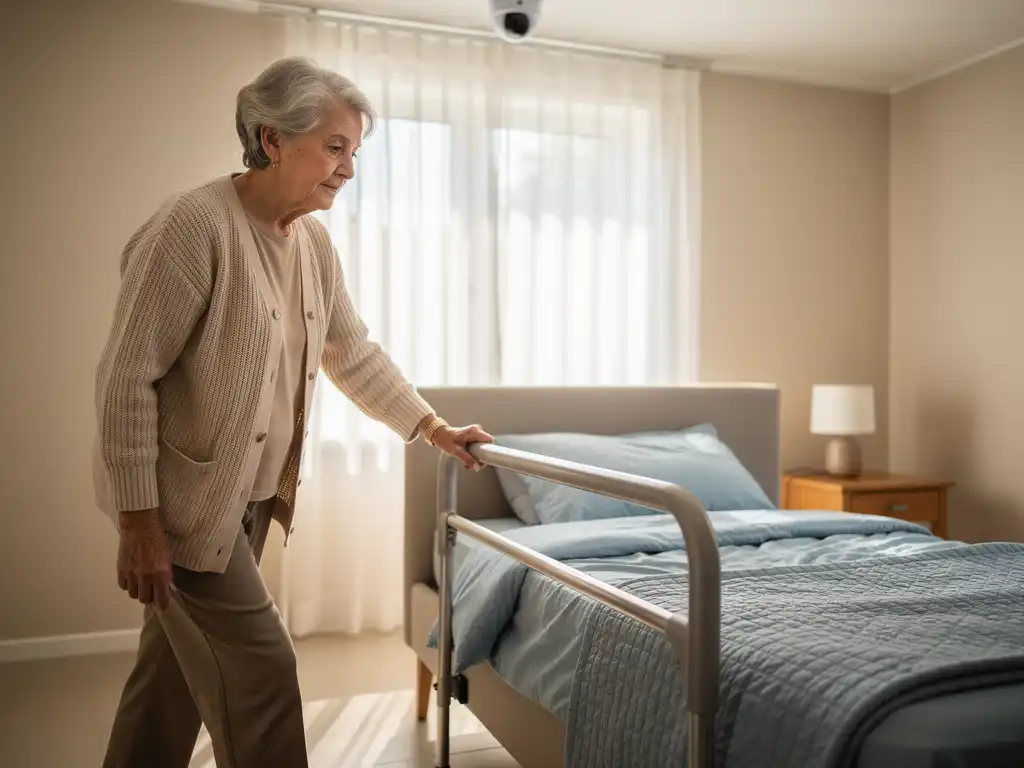
Falls are one of the greatest health risks for elderly people: annually, more than a third of all people over 65 fall at least once. For healthcare organizations, fall prevention for the elderly is therefore a crucial challenge that becomes increasingly complex due to staff shortages and growing care demands.
Effective fall prevention requires a thoughtful approach that takes into account the specific characteristics of different spaces within care facilities. From bedrooms to bathrooms and common areas: each environment brings unique risks and challenges that require a tailored prevention strategy.
What is fall prevention for the elderly and why is it so important?
Fall prevention for the elderly is a systematic approach to prevent fall incidents by identifying risk factors, removing environmental hazards, and implementing protective measures. This preventive care combines technological solutions, environmental adaptations, and care protocols to ensure the safety of elderly people.
The importance of fall prevention cannot be underestimated. Falls not only lead to physical injuries, such as hip fractures and head injuries, but also cause psychological consequences, such as fear of falling again. For healthcare organizations, fall incidents mean higher care costs, longer admission times, and increased workload for staff. Moreover, undetected falls can have fatal consequences, especially when help arrives too late.
Modern fall prevention goes beyond traditional methods, such as motion sensors or alarm buttons. By using advanced technologies, caregivers can act proactively instead of reactively responding to incidents that have already occurred.
Which different spaces require specific fall prevention approaches?
Each space within a care facility has unique fall risks that require specific prevention strategies. Bedrooms, bathrooms, hallways, common areas, and outdoor areas each bring their own challenges.
Bedrooms and private spaces
Bedrooms form a critical zone, as many falls occur at night when residents get up to go to the bathroom. Poor lighting, disorientation after waking, and medication effects significantly increase fall risk. Preventive measures include adequate night lighting, obstacle-free walkways, and continuous monitoring without compromising privacy.
Bathrooms and sanitary facilities
Bathrooms have the highest fall risk due to slippery surfaces, water, and the necessity of movements such as standing up from the toilet or getting in and out of the shower. Anti-slip measures, grab bars, and water-resistant monitoring systems are essential here.
Hallways and common areas
These spaces bring challenges due to crowds, different floor surfaces, and furniture that can act as tripping hazards. Wide walkways, good lighting, and strategic placement of seating help minimize fall risks.
How does AI technology for fall detection work in practice?
AI technology for fall detection uses advanced computer vision algorithms to analyze human movements in real-time and recognize unsafe situations before a fall occurs. These systems can distinguish between normal activities and potentially dangerous situations.
The technology works through continuous video analysis, without images being viewed by humans, which ensures privacy. Machine learning algorithms are trained to recognize patterns that indicate increased fall risk, such as unsteady movements, sudden direction changes, or unusual body postures. When the system detects a potentially dangerous situation, an alarm is immediately sent to care staff.
Modern AI systems achieve unprecedented accuracy, with only one false alarm per 92 days. This is a huge improvement compared to traditional motion sensors, which often generate dozens of false alarms per day, leading to “alarm fatigue” among care staff.
The technology can also recognize lying positions and detect when someone is on the ground for an extended period, which is crucial for preventing complications after a fall. Thanks to this automated monitoring, healthcare organizations can deploy their limited staff capacity more efficiently.
What are the advantages of automated fall prevention versus traditional methods?
Automated fall prevention offers significant advantages over traditional methods, thanks to higher accuracy, better privacy protection, and more efficient staff deployment. Traditional systems, such as pressure mats or wearable alarm buttons, have important limitations.
Traditional methods have various disadvantages. Pressure mats can only detect when someone has already fallen, not when a fall is imminent. Wearable alarm buttons require residents to be alert and able to call for help, which is not always the case with confusion or unconsciousness. Motion sensors often generate false alarms due to normal activities, leading to inefficient staff deployment.
Automated AI systems, on the other hand, offer proactive detection, recognizing potentially dangerous situations before a fall occurs. They work 24/7, without residents needing to wear or remember anything. Privacy is better protected, as images are analyzed exclusively by software and not by humans.
For healthcare organizations, this means a drastic reduction in false alarms, allowing staff to focus on real emergency situations. The cost-benefit ratio is favorable, as less staff is needed for continuous monitoring, while the quality of care improves.
How do you implement a fall prevention system in different care environments?
The implementation of a fall prevention system requires a phased approach that begins with a risk analysis, followed by technical installation and staff training. Each care environment has specific implementation considerations that must be tailored to the local situation.
The first step is conducting a thorough risk analysis per room type. Identify the highest-risk areas and times, such as nighttime in bedrooms or peak hours in common areas. This analysis determines the priority order for implementation.
Technical installation involves strategically placing cameras and sensors to achieve optimal coverage without blind spots. In bedrooms, privacy is crucial, while more extensive monitoring is possible in common areas. Bathrooms require water-resistant equipment and careful positioning to respect privacy.
Staff training is essential for successful implementation. Care workers must learn how to interpret alarms, set priorities, and respond adequately. They must also understand how the system works to promote trust and acceptance.
Monitoring and optimization form the final phase. Analyze alarm patterns, adjust settings, and gather feedback from staff and residents to continuously improve the system.
How Kepler Vision Technologies helps with fall prevention for the elderly
We at Kepler Vision Technologies offer a revolutionary solution for fall prevention with our advanced AI software Kepler Night Nurse. Our system combines the latest developments in artificial intelligence with practical applicability in care environments.
Our solution offers concrete advantages:
- Unprecedented accuracy: Only one false alarm per 92 days, 1,000 times better than traditional technologies
- 24/7 monitoring: Continuous monitoring without care staff needing to be constantly present
- Privacy-friendly: Images are never viewed by humans, but analyzed exclusively by AI
- Direct alerting: Within seconds, care workers receive warnings about dangerous situations
- Easy implementation: Plug-and-play concept that is easy to install and configure
With our robust international patent portfolio of 21 patents and strict compliance with ISO 27001 and NEN 7510 standards, we guarantee the security and privacy of patient data. Our 25 experts in machine learning, computer vision, and healthcare are ready to support your healthcare organization in implementing effective fall prevention.
Would you like to know more about how our AI solutions can help your healthcare organization with fall prevention? Contact us for a personal conversation about the possibilities for your specific situation.
Frequently Asked Questions
How long does it take to fully implement an AI fall prevention system in our care facility?
The implementation of an AI fall prevention system takes an average of 2-4 weeks, depending on the size of your facility. This includes risk analysis, technical installation, system configuration, and staff training. Smaller departments can be operational within a week, while large care facilities need more time for complete rollout.
What happens to residents' privacy when using cameras for fall detection?
Privacy is strictly protected through the use of edge computing: all image analysis happens locally on the device itself, without images being sent to external servers. The AI only analyzes movement patterns and does not store image material. Furthermore, images are never viewed by humans, ensuring complete privacy according to GDPR guidelines.
Can the system distinguish between a real fall and normal activities like bending or sitting?
Yes, advanced AI algorithms are trained to distinguish between normal daily activities and actual fall risks. The system recognizes natural movements like bending, sitting, or lying down, and only alerts for unexpected or dangerous movement patterns. This results in only one false alarm per 92 days.
How do we as care workers respond to different types of alarms from the system?
The system generates different alarm types: preventive warnings for increased fall risk, direct alarms for detected falls, and prolonged lying alarms. Each alarm type has a specific urgency level and response time. During implementation, your staff receives comprehensive training in alarm interpretation and proper response protocols.
What costs are associated with implementing and maintaining an AI fall prevention system?
Costs vary per facility and number of rooms to be monitored. Besides the initial investment in hardware and software, there are maintenance costs and possible training costs. However, many healthcare organizations see a positive ROI through reduced fall incidents, lower care costs, and more efficient staff deployment. Contact us for a personalized cost calculation.
What if the system experiences technical problems or is temporarily offline?
The system has built-in redundancy and backup functionalities to minimize downtime. In case of technical problems, you receive immediate notification, and our technical team provides 24/7 support. During maintenance or failures, traditional backup methods can be activated, so monitoring never completely fails.
Can we integrate the system with our existing care registration systems and alarm systems?
Yes, modern AI fall prevention systems are designed for seamless integration with existing care infrastructure. Through standard APIs, the system can be connected to your EHR, nurse call systems, and dashboards. This ensures streamlined workflows and prevents staff from having to monitor multiple systems.
Related Articles
- How does smart scheduling reduce the pressure of staff shortages in healthcare?
- What are the forecasts for the staffing shortage in healthcare by 2030?
- What is the difference between fall detection and fall prevention for elderly people?
- How does AI contribute to more efficient nighttime care?
- How does AI help improve continuity of care?
This content was generated with the help of AI and it may contain mistakes