
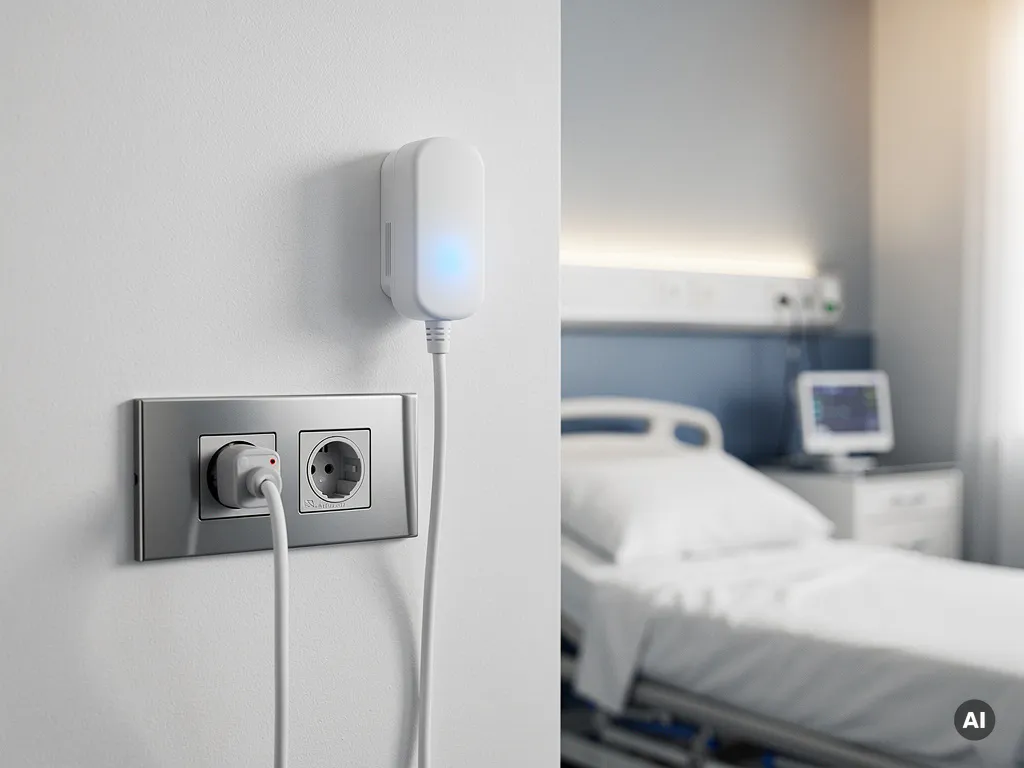
Yes, AI patient monitoring can be integrated with existing hospital IT. Modern AI monitoring solutions are designed as plug-and-play systems that connect to common hospital infrastructure without requiring a complete replacement of existing systems. Integration does require careful preparation in terms of data security, compatibility, and privacy legislation. In this article, we answer the most frequently asked questions about how such an integration works in practice.
Which hospital systems need to be compatible with AI monitoring?
AI patient monitoring must at minimum be compatible with the electronic health record (EHR), the alarm management system, and the hospital’s internal network. In addition, integration with nurse call systems and mobile communication tools for healthcare staff is strongly recommended, so that notifications reach the right person directly.
In practice, the following systems require connection:
- Electronic health record (EHR): for linking monitoring data to patient profiles
- Alarm management system: so that AI-generated alerts are distributed via existing alarm routes
- Nurse call system: for direct notifications to healthcare staff on the floor
- Internal hospital network (LAN/wifi): as the infrastructural basis for data transmission
- Mobile devices and apps: for receiving real-time alerts
Not every system needs to be connected immediately during the first implementation. A phased approach, starting with the most critical connections, makes the transition manageable.
How does the technical integration of AI monitoring software proceed?
The technical integration of AI monitoring software typically proceeds in three phases: preparation and network check, hardware and software installation, and configuration of notification routes. With modern solutions, this process has been greatly simplified thanks to plug-and-play architecture, minimizing the impact on daily care delivery.
Concretely, the integration process looks as follows:
- Network analysis: The IT department assesses bandwidth, network segmentation, and security protocols.
- Hardware installation: Camera sensors or other sensors are placed in the relevant rooms.
- Software configuration: The AI software is configured for the specific environment, including alert thresholds.
- System integration: Existing hospital systems are connected via API connections or direct integration.
- Testing phase: The system is tested for accuracy and alarm response before it is fully put into use.
A good supplier guides the hospital through every step and provides support during configuration, so the IT department does not have to figure everything out on its own.
What are the biggest challenges when connecting AI to existing IT?
The biggest challenges when connecting AI patient monitoring to existing hospital IT are outdated infrastructure, a lack of standardized interfaces, and resistance from staff. In addition, data quality and network security play a crucial role in a successful implementation.
Technical and organizational obstacles
Many hospitals work with legacy systems that were not designed to integrate external software. This means that custom development or middleware may be required. Furthermore, not all EHR systems are equally open to API connections, which slows down integration.
Human and cultural resistance
In addition to technical challenges, acceptance by healthcare staff is a common stumbling block. Staff are sometimes skeptical about AI in healthcare, particularly if they fear it will change their role or that the system is unreliable. Good training, transparent communication, and a proven low error rate help to build this trust.
How does AI patient monitoring protect privacy during IT integration?
AI patient monitoring protects privacy because footage is processed exclusively by the software and is never viewed by humans. Healthcare staff only receive a notification when the AI detects an unsafe situation, preventing unnecessary intrusion into patients’ personal space.
From an IT perspective, there are additional privacy safeguards that a reliable supplier must provide:
- Encrypted data transmission: all data sent between sensors and servers is encrypted
- Local processing: image analysis preferably takes place locally, so that raw images do not leave the network
- Access control: strict user permissions determine who has access to which system data
- Regulatory compliance: adherence to GDPR, ISO 27001, and NEN 7510 is a minimum requirement
Privacy in IT integration is not an afterthought but an architectural choice that must be embedded in the design of the software from the outset.
What questions should a hospital ask an AI monitoring supplier?
When selecting an AI monitoring supplier, a hospital should ask questions about compatibility, accuracy, privacy safeguards, support, and certifications. The answers to these questions determine whether a solution is genuinely suitable for the hospital’s specific IT environment and care context.
Use the following questions as a guide during a supplier conversation:
- Which EHR systems and alarm management systems is the software compatible with?
- What certifications do you hold in the area of information security, such as ISO 27001 or NEN 7510?
- How are images processed and who has access to them?
- What is the accuracy of the system and how often does it generate false alarms?
- How does the implementation proceed and what support do you offer afterwards?
- Do you hold patents or other intellectual property rights that demonstrate the uniqueness of your technology?
- Are there references from other hospitals or healthcare organizations that are already using the software?
A supplier who answers these questions clearly and transparently gives you the confidence that the integration will proceed smoothly and that the technology will remain reliable in the long term.
How Kepler Vision Technologies helps with AI patient monitoring in your hospital
We at Kepler Vision Technologies offer a proven AI monitoring solution specifically developed for the complex IT environment of hospitals and healthcare institutions. Our software is designed as a plug-and-play system, meaning that integration with existing infrastructure proceeds quickly and without major disruptions.
What our solution concretely offers:
- Exceptionally low error rate: only one false alarm per 92 days, which is 1,000 times better than older technologies
- Privacy by design: images are never viewed by humans; healthcare staff only enter the room when the software indicates this
- Certified security: we comply with ISO 27001 and NEN 7510 for maximum data protection
- Robust patent portfolio: 21 patents support the uniqueness and reliability of our technology
- International experience: our software is already deployed by healthcare institutions across Europe
Would you like to know how we can support your hospital in integrating AI patient monitoring? Discover our solutions and contact us for a no-obligation conversation.
Frequently Asked Questions
How long does an average AI patient monitoring implementation in a hospital take?
The implementation duration varies depending on the complexity of the existing IT infrastructure and the number of systems to be integrated, but a phased implementation takes an average of four to twelve weeks. An initial working connection with the most critical systems, such as the EHR and the alarm management system, can often be operational within a few weeks. A good supplier draws up a realistic timeline in advance and guides the hospital step by step through the process.
What if our hospital uses an outdated EHR that does not support API connections?
Outdated EHR systems without standard API support are a common challenge, but not an insurmountable obstacle. In such cases, a supplier can work with middleware that acts as a bridge between the AI system and the legacy EHR. It is important to discuss this scenario explicitly during the selection phase, so that the supplier can propose an appropriate technical solution and you are not faced with surprises during implementation.
How are healthcare staff trained to work with the AI monitoring system?
A good AI monitoring solution is designed to be intuitive, so that the learning curve for healthcare staff is as small as possible. Training typically focuses on interpreting notifications, handling alarms, and understanding the limits of the system. Suppliers often offer both initial training sessions and additional sessions for new staff, and some also provide digital instructional materials that can be consulted at any time.
Can AI patient monitoring also be deployed outside the nursing ward, for example in the emergency department or in operating rooms?
AI patient monitoring is primarily designed for nursing wards and rooms where patients stay for extended periods, but the technology can in principle also be deployed in other care environments. However, settings such as the emergency department or operating rooms have different requirements in terms of speed, accuracy, and integration with specialized equipment. It is advisable to discuss this specifically with the supplier, who can assess whether and how the solution can be made suitable for that environment.
What happens to the monitoring data if the hospital network temporarily goes down?
A reliable AI monitoring system is designed with redundancy in mind, so that a temporary network outage does not directly lead to a complete loss of monitoring functionality. Many solutions make use of local processing and temporary local storage, allowing the system to remain active during a network interruption and ensuring that data is not lost. Ask your supplier explicitly about the failover procedures and how the system behaves during network or power outages.
How does a hospital know whether the AI monitoring solution complies with Dutch and European privacy legislation?
A supplier that complies with GDPR, ISO 27001, and NEN 7510 provides a solid basis for privacy compliance, but a hospital as the data controller also bears its own legal responsibility. Make sure that a data processing agreement is concluded with the supplier and involve your organization’s data protection officer (DPO) in the implementation. A Data Protection Impact Assessment (DPIA) is in many cases legally required when deploying AI systems that process personal data.
What are the most common mistakes hospitals make when selecting an AI monitoring supplier?
A common mistake is focusing on price or technological impression without verifying actual compatibility with the existing IT environment. Other pitfalls include failing to request concrete references from comparable healthcare institutions, and underestimating the role of change management and staff acceptance. Choose a supplier who not only delivers a technically strong product, but also has demonstrable experience with implementations in complex care environments and offers a clear plan for training and aftercare.
Related Articles
- How to Choose the Right AI Patient Monitoring for a Healthcare Organization
- What Results Can You Expect From a Pilot With AI Fall Detection?
- What Risks Should You Assess Before Purchasing AI Fall Detection?
- What is a staff shortage and how does it occur?
- How do you recognize excessive workload due to understaffing?
This content was generated with the help of AI and it may contain mistakes