


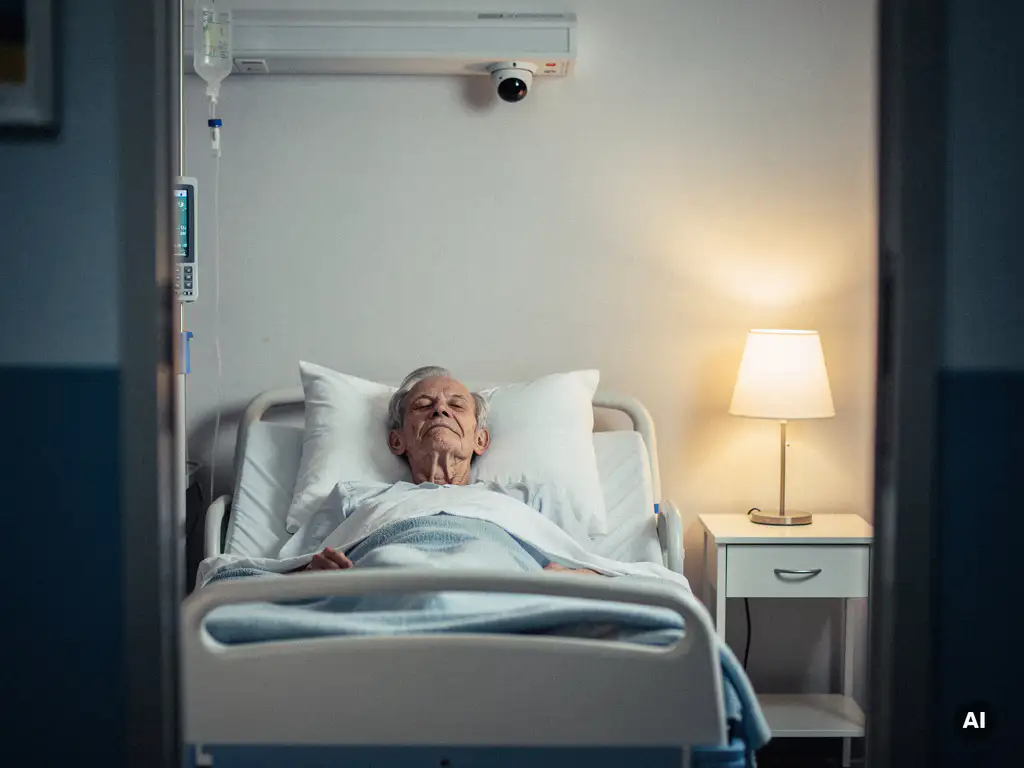
Before purchasing AI fall detection, you must assess at least six risks: detection accuracy, real-world reliability, privacy risks associated with camera surveillance, compliance with healthcare regulations, integration complexity, and organizational suitability. For healthcare organizations struggling with staff shortages and growing care demand, a thorough risk assessment is not a formality but a prerequisite for responsible procurement. The questions below address each of these risks concretely.
What types of fall incidents does AI software detect and not detect?
AI fall detection software reliably detects situations where a person suddenly changes position and ends up on the floor, such as a fall from a standing position, a fall from a bed, or a fall from a chair. What the software typically does not detect are fall incidents outside the camera’s field of view or situations where someone slowly slides to the floor without a clear change in movement.
The accuracy of fall detection for elderly individuals depends heavily on the quality of the algorithm used and the placement of the camera. Modern AI systems use computer vision to analyze body movements without images being viewed by humans. This makes it possible to respond quickly and privacy-consciously to unsafe situations.
When making a purchase, keep in mind the following limitations that most systems share:
- Fall incidents in areas without camera coverage (bathroom, toilet) are not detected unless separate equipment is installed there
- Situations where multiple people are in frame simultaneously can complicate detection
- Poor lighting or extreme camera angles reduce reliability
- Slow, gradual changes in position are not always recognized as a fall
How reliable is AI fall detection in practice?
The reliability of AI fall detection varies significantly by provider and is directly dependent on the number of false alarms the system generates. A high number of false alarms leads to alarm fatigue among care staff, causing real emergencies to be missed. High-quality systems demonstrably generate fewer than one false alarm per month.
Traditional motion sensors and older camera systems produce dozens or even hundreds of false alarms per day. That may sound exaggerated, but in practice this is one of the biggest complaints from care institutions switching to AI-based fall detection for the elderly. The benefit lies not only in detecting fall incidents, but precisely in drastically reducing unnecessary disruptions.
Ask each provider explicitly about:
- The average number of false alarms per day or per month in active installations
- The sensitivity and specificity of the algorithm (how many real falls are missed?)
- Independent validation studies or clinical evaluations
- References from care institutions that are already using the system
What privacy risks does camera surveillance in care institutions entail?
Camera surveillance in care institutions carries significant privacy risks when images are stored, shared, or viewed by people without the knowledge of the resident or patient. The greatest risks are unauthorized access to footage, the absence of consent from the resident or their representative, and the use of images for purposes other than those for which they were collected.
Under the GDPR (General Data Protection Regulation), care institutions are required to carefully protect special categories of personal data, including footage of vulnerable individuals. This means that every implementation of camera surveillance for fall detection in the elderly requires a Data Protection Impact Assessment (DPIA).
Systems that process images locally and never store them or send them to humans significantly reduce privacy risk. The rule of thumb is: the fewer people who see footage, the lower the risk. Always ask when purchasing:
- Are images stored, and if so, for how long and where?
- Who has access to the footage?
- Does the system process images locally or are they sent to the cloud?
- Is a data processing agreement available that complies with the GDPR?
Does AI fall detection software comply with healthcare-specific compliance requirements?
Not all AI fall detection software automatically complies with the healthcare-specific compliance requirements applicable in the Netherlands and Europe. Relevant standards include ISO 27001 for information security, NEN 7510 for information protection in healthcare, and the GDPR for data protection. A provider that cannot present any of these certifications poses a legal and operational risk.
Care institutions are themselves ultimately responsible for compliance with these standards, even when using software from an external vendor. This makes it essential to verify in advance which certifications a provider holds and whether an up-to-date data processing agreement is available.
Check the following points with each provider:
- Is the provider ISO 27001 certified?
- Does the software comply with NEN 7510?
- Is a documented DPIA available?
- Is data processed and stored within the European Economic Area?
- Is there a clear data processing agreement that aligns with the GDPR?
How easy is it to integrate AI fall detection into existing care systems?
The integration complexity of AI fall detection depends on the architecture of the system and the existing infrastructure of the care institution. Plug-and-play systems that operate via a standard Wi-Fi connection and require no modifications to existing networks are considerably easier to implement than systems that require custom integrations with electronic patient records or nurse call systems.
A common mistake is underestimating how much time and resources an implementation requires. Even with relatively simple systems, configuration, staff training, and adapting work processes take time. Keep the following in mind when conducting a risk assessment:
- Network and hardware requirements (Wi-Fi, power supply, camera mounting)
- Integration with existing alarm or nurse call systems
- Required training for care staff
- Vendor support and response times for technical issues
- Scalability when expanding to multiple departments or locations
When is AI fall detection the right choice for a care organization?
AI fall detection is the right choice when a care organization is dealing with structural staff shortages, has a high fall risk among its target group, and current monitoring methods are insufficiently accurate or too burdensome for staff. It is not a suitable solution to replace all human care, but rather as a supplement that relieves care staff and shortens response times to incidents.
Organizations that benefit most from fall detection for the elderly are nursing homes and residential care centers with high occupancy rates, hospital wards with vulnerable patients, and psychiatric clinics where nighttime supervision is difficult to organize. The technology is most valuable in situations where 24/7 human supervision is not feasible.
Ask yourself the following questions before making a decision:
- Do we demonstrably struggle with attracting or retaining sufficient night care staff?
- Have there been fall incidents in recent times that were discovered late or not at all?
- Is the current monitoring technology outdated or does it generate too many false alarms?
- Do we have sufficient budget and organizational support for a careful implementation?
How Kepler Vision Technologies helps with responsible fall detection
We at Kepler Vision Technologies developed Kepler Night Nurse specifically to address the risks described in this article. Our software offers the following:
- Unparalleled accuracy: just one false alarm every 92 days, which is 1,000 times better than older technologies
- Complete privacy protection: images are never viewed by humans; care staff only enter the room when the software requests it
- Healthcare-specific compliance: we are ISO 27001 certified and comply with NEN 7510
- Easy installation: plug-and-play concept, so implementation is fast and without major infrastructure changes
- 24/7 monitoring: fall detection, fall prevention, and lying position recognition combined in one solution
Want to know whether our solution fits the specific situation of your care organization? View our options at Kepler Vision Technologies and get in touch for a no-obligation conversation.
Frequently Asked Questions
How long does it typically take for AI fall detection to be fully operational after purchase?
Implementation time varies by system and organization, but for plug-and-play solutions, allow one to three weeks for installation, configuration, and staff training. For systems that require custom integrations with existing EHR or nurse call systems, this can extend to several months. Always plan a testing period before the system goes fully into production, so staff can get used to the workflow and any settings can be adjusted.
What are the most common mistakes when purchasing AI fall detection software?
The most common mistake is comparing providers solely on price, without asking for demonstrable performance metrics such as the number of false alarms in active installations. A second common mistake is underestimating the organizational preparation required: technology only works if workflows and responsibilities are clearly defined in advance. Finally, many care institutions forget to inform residents and their representatives in a timely manner and obtain consent, which is both a legal and ethical obligation.
How do I inform and involve residents and their families when introducing camera surveillance?
Transparent communication is essential: inform residents and their legal representatives in writing about the purpose of the system, what data is processed, and who has access to it. Ensure that consent is explicit and documented, and always offer an alternative for residents who do not wish to participate. An information session or a clear information leaflet can help address questions and build support among both residents and families.
Can AI fall detection also be used for fall prevention, or is it purely reactive?
Modern AI fall detection systems go beyond purely reactive detection: advanced solutions also analyze movement patterns and lying positions to flag risky situations before a fall occurs. Think of recognizing a resident who is restless in bed or trying to get up without assistance. This makes it possible to intervene preventively and structurally reduce fall risk, rather than only responding after an incident has taken place.
What should I do if the system generates a false alarm or misses a real fall?
Establish a clear protocol in advance for both scenarios: who is notified, what steps are taken, and how the incident is documented. In the event of a missed fall, it is important to analyze together with the vendor why the detection failed, so that settings or camera placement can be corrected. A reliable vendor offers proactive support and is transparent about the system’s limitations, ensuring your organization is never entirely dependent on technology alone.
Is AI fall detection also suitable for small-scale residential settings or home care settings?
AI fall detection can in principle be deployed in small-scale residential settings, provided the camera infrastructure is present or can easily be installed. For home care settings, however, additional considerations apply, such as more limited network options, the need for consent from the resident in a private home, and the question of who handles alarms outside office hours. Always discuss this specific context with the provider to assess whether the system is technically and organizationally feasible.
How do I objectively compare providers of AI fall detection?
Ask each provider for concrete, verifiable performance data: the average number of false alarms per month, the sensitivity and specificity of the algorithm, and preferably independent clinical validation studies. Also always request references from care institutions that are already using the system and, if possible, visit an active installation. Finally, draw up a standardized questionnaire for compliance requirements such as ISO 27001, NEN 7510, and GDPR conformity, so that you evaluate providers on the same criteria.
Related Articles
- How Can AI Patient Monitoring Help Reduce Unnecessary Check Rounds?
- What is a staff shortage and how does it occur?
- How is the government addressing the staff shortage?
- What are your rights as an employee when workload is too high due to staff shortages?
- How do you reduce false positives in fall prevention for the elderly?
This content was generated with the help of AI and it may contain mistakes