


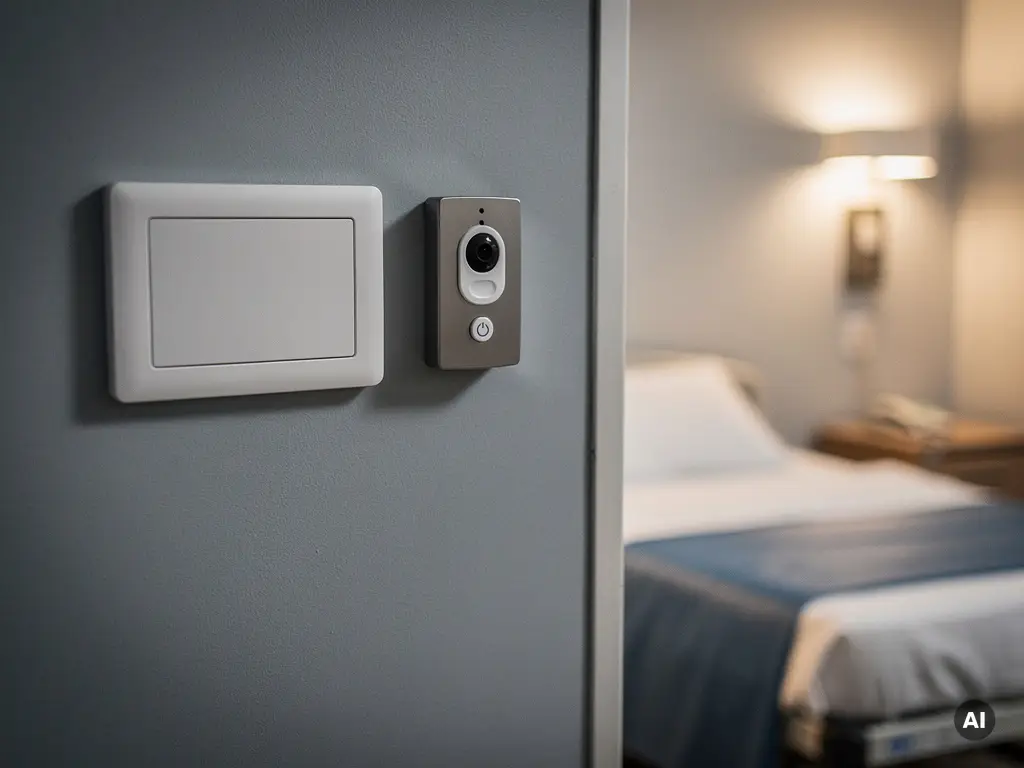
You can integrate AI patient monitoring with existing nurse call systems via a software connection that uses open standards such as HL7, REST APIs, or MQTT protocols. The AI software detects a situation, generates a signal, and automatically forwards that signal to the care facility’s call system. This works for most modern nurse call systems without requiring major infrastructure changes. In this article, we answer the most frequently asked questions about this integration, from compatibility to implementation time.
Which nurse call systems are compatible with AI monitoring?
Most modern nurse call systems are compatible with AI monitoring software, provided they use open communication protocols or have an available API. Systems from vendors such as Aurus, Ascom, Bewatec, and Tyco are commonly used examples that are regularly connected to AI monitoring solutions in elderly care and hospitals.
Compatibility primarily depends on two factors: whether the nurse call system operates via a network-based architecture and whether the vendor is willing to make an integration point available. Older, fully analogue systems sometimes require an intermediate layer, such as a hardware interface or a middleware solution, to receive the digital output from AI software. In practice, however, this is rarely an insurmountable obstacle.
Care facilities are well advised to explicitly ask, when purchasing an AI monitoring solution, which nurse call systems have already been successfully connected. A vendor with a proven integration track record significantly reduces implementation time.
How does the technical connection between AI software and a call system work?
The technical connection works via an API connection or a standardised protocol through which the AI software sends a message to the nurse call system as soon as a situation is detected. This message contains information about the location, the type of alert, and the urgency level. The call system then processes this message as a regular call.
In most implementations, the technical architecture looks as follows:
- The AI camera or sensor registers a movement or situation in the patient’s room.
- The AI software analyses the footage locally, without storing it or sending it to external servers.
- When a situation is detected, the software generates a structured alarm message.
- This message is forwarded via a secure network connection to the nurse call system.
- The call system displays the alert on the dashboard and sends a notification to the on-duty staff member.
The connection typically requires configuration by a technical implementation team, but does not require any changes to the care facility’s existing network hardware. Most AI monitoring solutions work plug-and-play on the existing hospital network.
What happens to an alert after the AI detects a fall?
After the AI detects a fall, an alert is created and forwarded to the nurse call system within a few seconds. The on-duty staff member receives a notification on their device, sees the patient’s location, and can take immediate action. No manual intervention is required to trigger the alert.
The speed of this alert chain is one of the greatest advantages over traditional methods such as pull cords or button alarms. In the event of a fall, the patient is often unable to raise the alarm themselves. The AI automatically detects the fall and initiates the alarm chain without depending on the patient’s own ability to act.
Once the staff member has received the alert and goes to the room, the alert can be acknowledged or closed in the call system. This closing process is recorded in most systems for reporting and quality purposes.
What data is exchanged between the systems?
Only structured alarm messages are exchanged between the AI monitoring software and the nurse call system — no images. The data exchange is limited to alert type, timestamp, location, and urgency level. Personal patient data or video footage is never shared between the systems.
This is an important distinction for care facilities subject to strict privacy legislation such as the GDPR. The AI software processes images locally, on the device itself, and only forwards the conclusion of that analysis — not the raw image information. Care staff therefore never see camera footage of patients, but receive only a functional alarm message.
For reporting and quality monitoring, both systems can generate log data separately. Some care facilities link this log data to a central care record or a dashboard solution, but this is an optional step that is separate from the basic integration.
How long does the implementation of an AI monitoring integration take?
The implementation of an AI monitoring integration takes an average of a few days to a few weeks, depending on the complexity of the existing nurse call system and the number of rooms to be monitored. A standard plug-and-play implementation on a ward of ten rooms is operational within a week in most cases.
The lead time is determined by a number of factors:
- Compatibility of the call system: Is an API already available, or does a middleware layer need to be set up?
- Network infrastructure: Is the Wi-Fi network stable enough for real-time data transfer?
- Number of locations: A rollout across multiple wards or buildings requires more coordination.
- Involvement of the IT department: Quick access to network configurations significantly speeds up the process.
After the technical installation, there is typically a short testing phase in which the connection is validated and staff are trained in receiving and processing alerts. In practice, this training rarely takes longer than half a day.
What are common bottlenecks in the integration and how are they resolved?
The most common bottlenecks in integrating AI patient monitoring with nurse call systems are an unstable network connection, a closed API at the call system manufacturer, and insufficient involvement of the internal IT department. Each of these bottlenecks has a practical solution.
Network issues and connectivity
AI monitoring cameras require a stable and sufficiently fast Wi-Fi or wired network connection. In older care buildings, the network infrastructure is sometimes not equipped for real-time data transfer from multiple rooms simultaneously. The solution is a targeted network audit prior to implementation, followed by targeted signal reinforcements on the relevant wards.
Closed systems from call system manufacturers
Some nurse call system vendors use closed, proprietary architectures that do not offer direct API access. In that case, a middleware solution is deployed that acts as a translation layer between the AI software and the call system. This adds a step to the implementation, but is a proven approach that is regularly applied in the sector.
A third bottleneck is organisational in nature: if the care facility’s IT department is not involved in the preparation in time, access rights and network configurations can delay the implementation. Early alignment with IT, preferably already during the selection phase, prevents this.
How Kepler Vision Technologies helps with the integration of AI patient monitoring
We at Kepler Vision Technologies have made the integration of AI patient monitoring with existing nurse call systems as straightforward as possible. Our software, Kepler Night Nurse, is designed as a plug-and-play solution that connects to the systems care facilities already use. What sets us apart:
- Exceptionally low error rate: Only one false alarm every 92 days, which greatly reduces the workload on staff.
- Privacy by design: Images are never viewed by humans. Staff only enter the room when the software requests it.
- Proven integrations: Our software has already been successfully connected to multiple international nurse call systems.
- Compliance: We comply with ISO 27001 and NEN 7510, the gold standard for data protection in healthcare.
- Fast implementation: Thanks to our plug-and-play concept, the software is up and running quickly, without major infrastructure changes.
Would you like to know how we can support your care organisation in implementing AI patient monitoring? Contact us for a no-obligation conversation.
Frequently Asked Questions
Can AI patient monitoring also be connected to mobile call systems such as smartphones or pagers?
Yes, in many care facilities alerts from AI monitoring software are forwarded not only to a central dashboard but also directly to mobile devices such as smartphones or pagers carried by staff. This does require the nurse call system to support a mobile notification module. When selecting an AI monitoring solution, explicitly ask whether the software is compatible with the mobile infrastructure your organisation already uses.
What happens if the network connection drops while monitoring a patient?
Most AI monitoring solutions are designed with a local processing architecture, meaning the software continues to analyse footage on the device itself, even without an active network connection. Once the connection is restored, any generated alerts are still forwarded. However, it is strongly recommended to carry out a network audit during implementation and to set up redundant connection options, so that connectivity outages are kept to a minimum.
How do I ensure that staff follow up on AI alerts correctly without creating additional workload?
Good preparation starts with clear work instructions and a short, practical training session for all staff involved — something that is already included in most implementations. In addition, ensure that alerts are logically categorised by urgency level so that staff can prioritise immediately. A low error rate in the AI software, such as one false alarm every 92 days with Kepler Night Nurse, is crucial here: the more reliable the alerts, the greater the team’s confidence in the system.
Is patient consent required for the use of AI monitoring cameras in the room?
Yes, under the GDPR and applicable healthcare legislation, informing patients — and in most cases obtaining their consent (or that of their legal representatives) — is a requirement before cameras are installed. Although the AI software processes images locally and never stores them, the presence of a camera remains a privacy-sensitive matter. Care facilities are well advised to formulate a clear consent policy and align it with the organisation’s data protection officer (DPO).
What is the difference between a direct API connection and a middleware solution, and which is preferred?
A direct API connection is the most efficient and maintenance-friendly solution: the AI software communicates directly with the nurse call system without any intermediate components. A middleware solution is an alternative used when the call system does not offer an open API; it acts as a translation layer between the two systems. A direct connection is always preferred due to lower latency and simpler troubleshooting, but a middleware solution is a fully valid and widely used approach when a direct connection is not possible.
Can the AI monitoring integration be extended to care situations other than fall detection?
Yes, modern AI monitoring solutions are often built in a modular way and can recognise not only falls but also other situations, such as restlessness in bed, leaving the room, or an abnormal breathing pattern. Each detection function generates its own type of alert that is forwarded to the nurse call system via the same integration. When selecting a solution, it is advisable to ask which detection modules are available and how easily they can be added afterwards without disrupting the existing integration.
What questions should I ask an AI monitoring vendor before signing a contract?
At a minimum, ask the following questions: Which nurse call systems have you already successfully integrated with? How are network outages or system failures handled? Does the solution comply with ISO 27001 and NEN 7510? Who is responsible for maintenance and updates of the integration after go-live? And: what is the average response time for technical issues? The answers to these questions give a reliable picture of the maturity of the solution and the reliability of the vendor as a long-term partner.
Related Articles
- Which KPIs Do You Use to Measure the Impact of AI Patient Monitoring?
- How does delegating help reduce workload?
- How can I claim fall prevention physiotherapy?
- How effective is fall prevention for older adults?
- Why is innovation a strategic theme within healthcare?
This content was generated with the help of AI and it may contain mistakes